



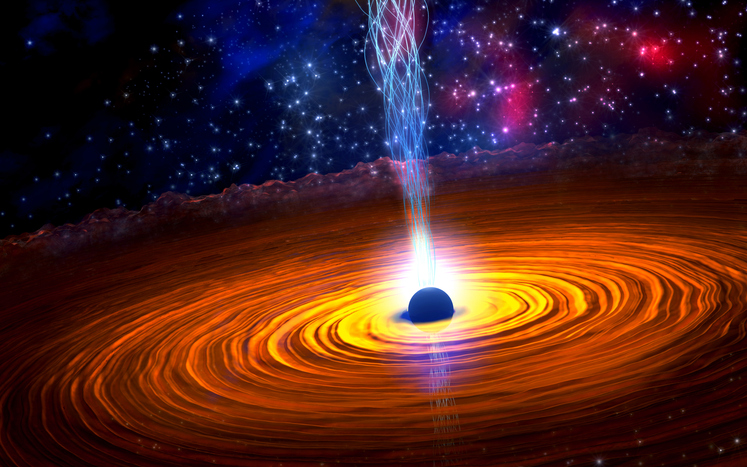
Scientists have detected the brightest flare ever recorded from a supermassive black hole, a cosmic explosion that burned with the light of 10 trillion suns and has left astronomers stunned.
According to The Associated Press, the dazzling display, spotted by a camera at California’s Palomar Observatory in 2018, reached its peak over three months before slowly fading. Researchers now believe the phenomenon occurred when a massive star strayed too close to the black hole and was ripped apart by its immense gravitational pull.
“At first, we didn’t really believe the numbers about the energy,” said study author Matthew Graham of the California Institute of Technology, which operates the observatory.
The findings were published Tuesday in Nature Astronomy and mark a milestone in the study of black holes — the mysterious giants lurking at the heart of most galaxies.
Located 10 billion light years away, the flare is also the most distant ever observed, giving scientists a glimpse of the universe when it was still relatively young. (For scale, a single light year equals nearly 6 trillion miles.)
Researchers say bursts like this — triggered by tangled magnetic fields or disruptions in the swirling disks of hot gas surrounding black holes — offer key clues about how these cosmic monsters evolve and interact with their surroundings.
The discovery, said Joseph Michail of the Harvard-Smithsonian Center for Astrophysics, who was not involved in the research, allows scientists “to probe the interaction of supermassive black holes with their environments early in the universe.”
Those early interactions, astronomers say, helped shape the galaxies — and the universe — we know today.