



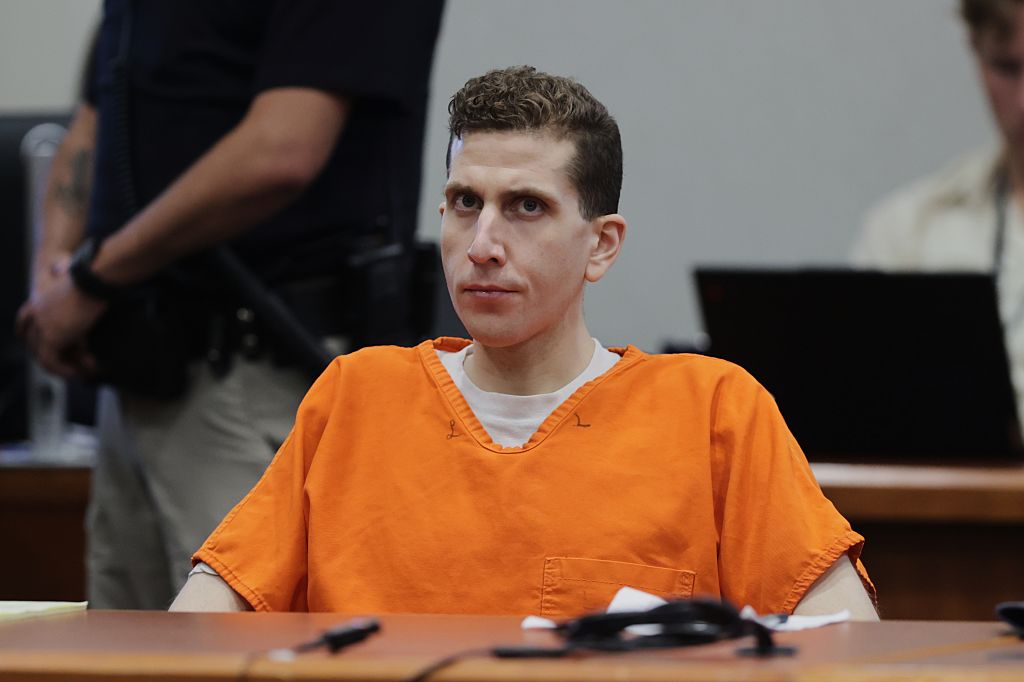
An Idaho judge revealed Thursday that convicted killer Bryan Kohberger received more than $28,000 in donations while behind bars.
According to Fox News, the disclosure emerged exactly three years after he murdered four University of Idaho students during a 4 a.m. home-invasion stabbing rampage.
“State’s Exhibit 3, filed with its reply brief, demonstrates that Defendant received several hundred donations totaling $28,360.96 while incarcerated at the Latah County and Ada County jails,” Judge Steven Hippler wrote. “According to defense counsel, many of these donations came from Defendant’s family members.”
The court did not release a breakdown identifying individual donors. Records show Kohberger’s parents previously filed for bankruptcy twice, in the mid-1990s and again in 2010.
Both jails where Kohberger has been held permit inmates to use commissary funds on food, toiletries, writing materials, clothing, snacks, drinks, and tablet or phone access. Ada County’s commissary allows bundles that include junk food, protein products, haircare supplies, and socks.
Proceeds from commissary purchases are used to buy items for the jail itself, including chairs, books, and televisions.
Defense attorney Jim Leonard, who has represented high-profile clients including reality TV star Teresa Giudice, called the donation total “offensive on every level.” He said families of the victims could sue Kohberger civilly to prevent him from benefiting in any way from the murders.
“Obviously, you can spend money in the commissary, and you can buy toiletries, you can buy food, you can buy, you know, the prison-approved clothing,” Leonard told Fox News Digital. “But in all candor, that money is also there. That money could be seized, pursuant to, you know, wrongful death litigation by the families or court fees, etc.”
Leonard said families could pursue additional civil judgments beyond court-ordered restitution and that commissary funds would not be shielded from such claims.
Kohberger, who turns 31 next week, is serving four consecutive life sentences without parole — plus an additional 10 years — for killing Madison Mogen, 21, Kaylee Goncalves, 21, Xana Kernodle, 20, and Ethan Chapin, 20, on Nov. 13, 2022. All but Kernodle were asleep in bed when he attacked.
After losing his efforts to remove the death penalty as a possibility, he accepted a plea deal in July, admitting guilt without offering a motive.
The court released Kohberger’s financial information after prosecutors sought additional restitution for the victims’ families. Judge Hippler ruled that some proposed payments exceeded the plea agreement but ordered Kohberger to pay nearly $3,000 in restitution — $1,420 to the Goncalves family and $1,587.79 to Mogen’s mother, Karen Laramie — with a 9.125% annual interest rate.
Hippler also rejected the defense’s argument that Idaho’s “Son of Sam” law would permanently prevent Kohberger from profiting off any future media deals.
“Pursuant to subsection three (3) of that statute, any leftover funds in the escrow account must be paid over to a defendant upon a showing that five years have elapsed from the establishment of the escrow account and that no actions are pending against him,” Hippler wrote. “Thus, the statute leaves open the potential for Defendant to receive money from media contracts in the future.”
However, Leonard warned that even potential media revenue could spark more legal action. He cautioned that people often find ways to get around restrictions.
“I’ll give you an example: You’re his cousin, and you do some sort of book deal, or you sell some interview or picture, and you get the money, and then what happens is, instead of giving the money to him on his books, you give the money to another inmate in the facility, right? And say, ‘Hey, here’s $1,000. You can use $300 of it. Give $700 to my cousin.'”












