



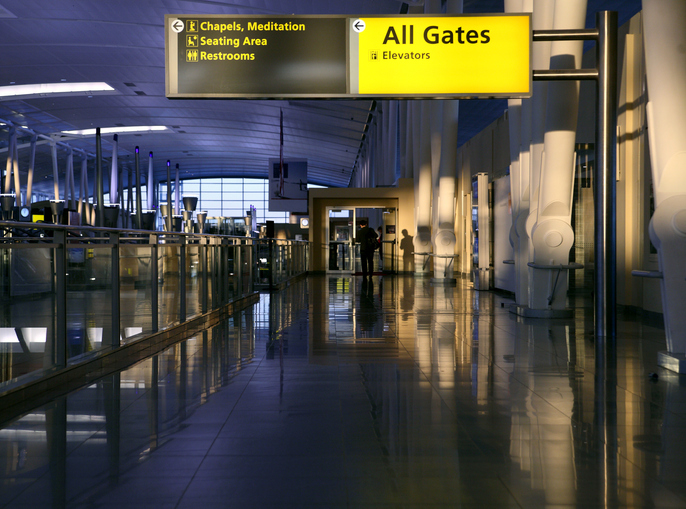
Airports are crowded, tensions are high, and holiday travel is in full swing. Amid the chaos, small chapels tucked away behind terminals across the country quietly provide what travelers rarely encounter at a gate: a moment of peace.
According to The Associated Press, with government shutdown flight restrictions hitting just as holiday travel peaks, passengers are seeking calm wherever they can find it.
These chapels have long offered that sanctuary—not just for travelers, but for airport workers too, who were the original focus when the first spaces were established.
“I love seeing travel bags and workers’ outfits. It gives hope that you’re ministering to a need,” said the Rev. Brian Daley, one of the priests at Our Lady of the Airways, the chapel at Boston’s Logan International Airport.
Built in the 1950s so airport employees could attend Mass without leaving their workplace, the Logan chapel is widely viewed as the first airport chapel in the United States.
Unlike most airport spaces today, it still functions as a Catholic church — though Muslim prayer rugs placed quietly on back pews show that worshippers of all backgrounds are welcome.
On a recent Friday, a man with a carry-on paused to pray on one of those rugs. Airline workers wearing reflective vests slipped in and out, crossing themselves with blessed water before returning to their shifts.
“I come here almost every day to pray for a few minutes,” said Brian Babcock, a Southwest Airlines baggage handler. “It’s awesome that I have a chapel within walking distance of where I work.”
The mid-20th-century push to build such chapels — including later Catholic chapels at New York’s JFK and Chicago’s O’Hare — grew from the church’s effort to reach workers where they spent most of their time.
Inspired by Pope Leo XIII’s Rerum Novarum, Boston’s Cardinal Richard Cushing spearheaded chapels in train stations, on fishing docks, in commercial hubs, and at airports expanding into modern aviation.
“He really had a program for establishing chapels for working people,” said James O’Toole, professor emeritus of history at Boston College. “Boston’s Catholicism was overwhelmingly a working-class phenomenon.”
Logan’s chapel quickly outgrew its first home. Even with six weekend Masses, it couldn’t keep up with demand, and a larger space opened in 1965. The original metal Virgin Mary statue remains, depicted standing on a globe with three airplanes circling her feet.
“You couldn’t get in there,” recalled longtime attendee John Cappucci, who grew up going to those packed Masses. Now, he’s one of a smaller group of regulars. “It’s quiet and peaceful,” he said.
Today, declining religiosity and a shortage of priests mean only one Mass is offered each Sunday, celebrated by pastors who also oversee several nearby churches but insist on continuing the airport ministry.
“They need to be reached in the secular world where they are,” Daley said of the workers and travelers he serves.
By the 1970s and 1980s, Protestant and Jewish leaders had also opened airport chapels. But over the last three decades, most spaces have shifted to interfaith rooms — or even generic “meditation spaces.”
“I’m not aware of any that have been built recently that are anything other than warm waiting rooms,” said Wendy Cadge, a sociology professor at Bryn Mawr College.
Chicago’s O’Hare now houses an interfaith chapel with glass walls overlooking taxiing planes, a compass rose marking the direction of Mecca, and a tabernacle for daily Catholic Mass.
“Everybody is grateful to have a quiet place to pray,” said the Rev. Michael Zaniolo, longtime leader of O’Hare’s chapel. “Our first customer is the airport worker. The traveler is the frosting on the cake.”
Back in Boston, JetBlue gate agents Manuel Tejeda Pimentel and a colleague say the chapel remains vital.
“We come every day to pray before our shift starts, to get some guidance,” Pimentel said. “It’s a little escape.”












