



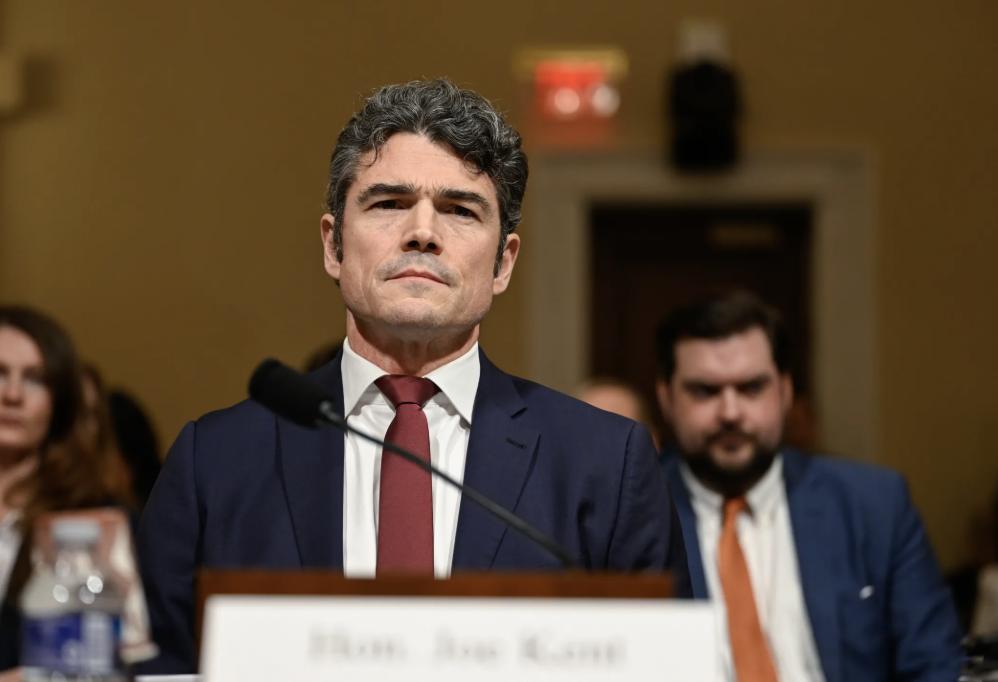
A sudden resignation inside President Donald Trump’s national security apparatus is raising eyebrows — and resurfacing a trail of past statements that appear to clash sharply with the reason given for stepping down.
Joe Kent officially resigned on March 17, 2026, from his role as Director of the National Counterterrorism Center, citing opposition to ongoing U.S. military action against Iran. In his resignation letter, Kent made his position clear, stating he “cannot in good conscience support the ongoing war in Iran” and arguing that Tehran “posed no imminent threat” to the United States.
He went further, claiming the conflict was driven by “pressure from Israel and its powerful American lobby,” while warning that continued involvement in the Middle East would cost American lives and drain national resources. Drawing on his own military background and experience as a Gold Star husband, Kent framed his decision as a refusal to support sending more Americans into what he described as an unnecessary war.
Trump’s restraint shows that he wants a deal with Iran & his red line is American loss of life & IR nuke development.
Our fundamental venerability remains- Troops in striking range of IR weapons & proxies w/ no vital US mission.
— Joe Kent (@joekent16jan19) January 8, 2020
But Kent’s earlier public remarks are now drawing renewed scrutiny — and they tell a notably different story.
In multiple posts spanning several years, Kent repeatedly described Iran as a serious and persistent threat, at times even advocating for direct military action against its capabilities.
In a January 2020 post, Kent acknowledged vulnerabilities posed by Iran’s weapons and regional proxies, while also suggesting that stronger action could be warranted. He explicitly stated that he believed the United States should have “crushed their ballistic & nuke capes,” referring to Iran’s missile and nuclear programs, though he also expressed confidence in Trump’s strategic restraint at the time.
By 2024, Kent’s rhetoric had sharpened further. In late September, he linked Iran directly to broader instability in the Middle East, including the events surrounding October 7, arguing that Tehran sought to undermine regional alliances like the Abraham Accords. He credited Trump-era policies — including targeted strikes and the killing of Iranian General Qassem Soleimani — with containing Iran and strengthening U.S. and allied security.
Important
Iran’s goal in orchestrating 7 Oct was to break up the Abraham accords because the historic alliance isolated Iran’s terror regime.
Trump used a balance of diplomacy, economic pressure & targeted strikes to contain Iran. The embodiment of peace through strength.… https://t.co/88yh9CtaXG
— Joe Kent (@joekent16jan19) September 29, 2024

Just days later, Kent again pointed to Iran’s access to significant financial resources and its role in regional violence, contrasting what he described as the effectiveness of Trump’s earlier approach with policies he criticized under the Biden administration.
Taken together, those statements emphasized Iran’s influence, its military capabilities, and the strategic rationale for confronting it — a position that appears difficult to reconcile with his current claim that the country poses no imminent threat.
The contrast is fueling questions about what prompted the shift.
Kent’s resignation comes at a time when polling shows strong Republican and MAGA base support for the ongoing operation against Iran, adding another layer of political tension to an already high-stakes situation.
As the situation unfolds, the gap between Kent’s past warnings about Iran and his current opposition to military action is likely to remain a focal point — both inside Washington and among voters watching closely.












