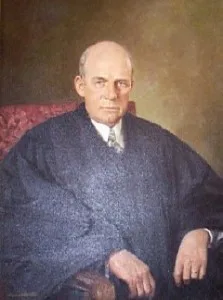
The case involved the E. C. Denton Stores Company, which had entered an equity receivership in federal court after financial difficulties and preferential payments by its officers. Following the receivers' resignation amid irregularities, shareholders authorized and the company filed a voluntary bankruptcy petition, leading a receiver and creditor to move to vacate the adjudication on grounds including fraud on the court. The court found that former directors' manipulations rendered the corporate action constructively fraudulent and that the company did not come into court with clean hands, so it vacated the bankruptcy adjudication, dismissed the voluntary petition, and also dismissed a pending involuntary petition. The decision rested on the principle that a district judge must ensure bankruptcy authority is not invoked for fraudulent purposes, as established in precedents like Zeitinger v. Hargadine-McKittrick Dry Goods Co.
This case is a bankruptcy proceeding involving the McAllister-Mohler Co. in which a party sought review of a referee's findings and conclusions. The District Court dismissed the petition for review and approved and confirmed the referee's decision. The ruling was issued on the authority of two cited precedents: Wells v. Realty Co. and Kothe, Trustee, v. R. C. Taylor Trust.
The case involved coal mining companies seeking a mandatory injunction against former employees who were members of the United Mine Workers of America, requiring them to vacate company-owned houses after their employment contracts expired on March 31, 1927, amid a labor dispute over wages. The court had previously issued a preliminary injunction against interference with mine operations based on a finding of conspiracy by the union. The companies argued that the houses were provided solely as an incident of employment under written contracts that terminated upon cessation of work, and that they needed the properties to house new non-union workers. The court decided that it had equity jurisdiction to grant the requested relief because there was no adequate remedy at law available in federal court for restoring possession of real property, and it ordered the evictions effective April 1, 1928, excluding one mine where no current need was shown.
The case involved the Columbus Gas & Fuel Company challenging a 1924 city ordinance that set a 40-cent per 1,000 cubic feet rate for natural gas service as unconstitutional and confiscatory, after the prior rate ordinance had expired. The company sought injunctive relief, leading to a preliminary injunction and temporary higher rates (55-75 cents) that were later reviewed following a special master's report on property valuation using reproduction cost new less depreciation. The court decided to modify the temporary rate to a flat 48 cents per 1,000 cubic feet with a 75-cent monthly minimum, required refunds of excess amounts collected, and reserved jurisdiction over remaining issues including the city's cross-bill. The core reasoning centered on ensuring the rate allowed a fair return on the fair value of the utility's property to avoid confiscation under constitutional standards, while treating the rate-setting process as primarily legislative but subject to judicial review for constitutionality.
This case involves a public utility challenging tax assessments on its property in five Ohio counties, alleging both overvaluation by the state tax commission and intentional discriminatory undervaluation of other property violating the Equal Protection Clause of the Fourteenth Amendment; the company sought to enjoin collection of the taxes under Ohio law. The primary issue before the court was whether section 266 of the Judicial Code required a three-judge panel to hear the application for a preliminary injunction. The court held that section 266 did not apply, allowing a single district judge to hear and decide the case alone. The core reasoning was that the suit targeted county treasurers for enforcement of taxes under local procedures rather than seeking to enjoin a statewide legislative act or commission order affecting the state at large, and that Congress did not intend the three-judge requirement for such ordinary taxpayer disputes.
The case involved Red Ball Transit Co., an Indiana corporation operating a motor truck business for transporting household goods and personal property, seeking to enjoin the Ohio Public Utilities Commission from enforcing the state's Motor Transportation Act against it through criminal prosecutions or requiring certificates of public convenience and necessity. The company argued it was not a common carrier subject to the Act, particularly for its interstate operations, after the Commission denied its intrastate certificate application and revoked an interstate one when the company refused to accept it. The court denied injunctive relief and dismissed the case, reasoning that the company had not shown it was exempt from the Act for intrastate business (which the Ohio Supreme Court had upheld as constitutional), that certain insurance requirements were invalid for interstate traffic but the Commission was willing to issue a compliant certificate, and that the company had not clearly demonstrated a violation of its constitutional rights warranting federal interference.