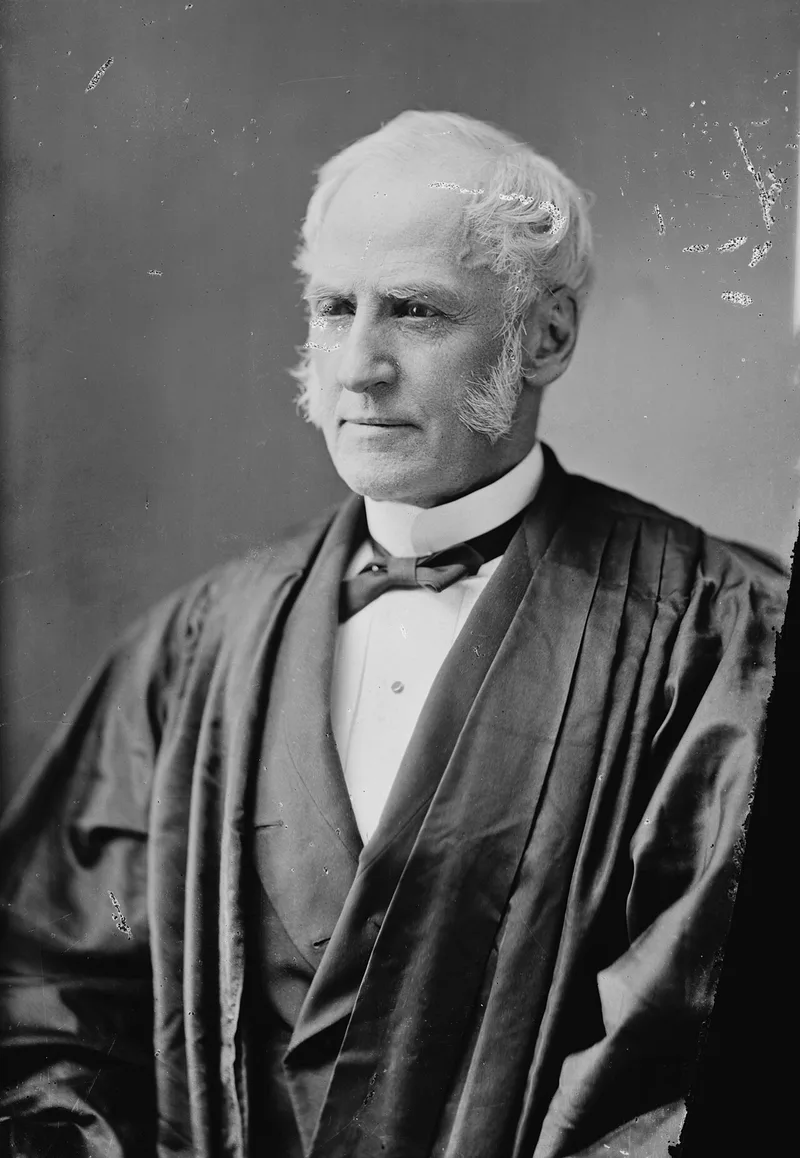
The case concerned whether a tax exemption for manufacturing property in the District of Columbia, enacted by the local legislative assembly in 1873, remained in effect after a 1874 act of Congress that levied taxes on all real estate except specific categories. The Supreme Court held that the exemption had been repealed by the later congressional act, making the manufacturing property subject to taxation. The Court reasoned that the exemption was merely a revocable bounty rather than an irrevocable contract, and that Congress intended the 1874 act to establish a new, independent taxation system with its own limited exemptions for properties used by the United States, the District, and for educational and charitable purposes.
The case involved a suit by a bondholder to collect interest coupons on bonds issued by Daviess County, Missouri, to the Chillicothe and Omaha Railroad Company in exchange for stock, following voter approval. The county court had overruled a demurrer and entered judgment for the plaintiff, leading to certified questions on whether the bonds were void because the railroad company was not fully organized until after the voter assent, and whether a prior judgment on other coupons estopped the county from defending on the merits. The Supreme Court affirmed the judgment, holding that the bonds were valid in the hands of a bona fide purchaser because the railroad's articles were filed and the corporation perfected before the county made its subscription and issued the bonds, satisfying the statutory requirement for voter-approved aid to an existing company; any timing irregularity did not invalidate the securities. The Court further noted that the county had accepted the stock, built the railroad, and paid interest for years, and that agents' procedural errors bind the municipality rather than innocent holders.
This case involved a dispute over an additional tax on tobacco imposed by an act of Congress passed on March 3, 1875. Tobacco manufacturers Salmon & Hancock had their tobacco stamped, sold, and removed before the act was approved by the President later that day, having already paid the prior tax rate. The collector sought to collect an extra four cents per pound, but the court ruled in favor of the manufacturers, allowing them to recover the payment. The core reasoning was that a statute takes effect only upon presidential approval, so the new tax did not apply to goods removed beforehand, and imposing it would constitute an ex post facto law prohibited by the Constitution.
The case concerned whether the city of Little Rock remained liable on new bonds and ledger credits it issued after accepting the surrender of its earlier notes, which had been printed on bank-note paper and used locally as currency. The trial court ruled for the bank on both the new bonds and the credited amounts, and the Supreme Court affirmed. The Court held that the original notes, even if their issuance violated state statutes restricting private currency, represented claims for valid underlying debts the city had incurred; by voluntarily cancelling those notes and substituting formal bonds or book credits, the city exercised its power to acknowledge and bind itself to pay those debts in proper form. The statutes regulating circulation did not prevent a municipality from creating new, lawful obligations based on the surrender of disputed prior instruments. References to Arkansas currency laws and cases on municipal contract capacity supported the conclusion that the substituted obligations were enforceable.
The case involved a dispute over bonds issued in 1871 by Schuyler County, Missouri, to subscribe to stock in the Missouri, Iowa, and Nebraska Railway Company, with the county denying the bonds' legality on grounds that the railroad's original 1857 charter did not authorize a route through the county and that subsequent consolidations and route changes exceeded the company's powers. Thomas, a good-faith purchaser of the bonds and coupons, sued to recover their value, and the lower court entered judgment in his favor. The Supreme Court affirmed, holding that the charter's language permitting subscriptions by any county along a possible route allowed broad latitude for location and extension, that the company's consolidation with an Iowa railroad and related route adjustments were consistent with the original purpose, and that these issues were controlled by prior decisions such as County of Scotland v. Thomas and County of Callaway v. Foster, which upheld similar bonds without requiring a popular vote. The Court construed the statutes as they would have been understood at enactment, without applying later interpretations to avoid payment.
The case involved a judgment against the named commissioners of Pickens County, South Carolina, for a county debt of $7,132 arising from a contract the county was authorized to make. The defendants argued on appeal that the suit was defective because it named the commissioners individually rather than the county itself as a corporate body. The court held that the commissioners were the proper parties given their statutory role in managing county affairs, including settling accounts and drawing orders on the treasurer, and that counties were expressly made bodies politic and corporate under state law. Even if the naming was a misdescription, South Carolina statutes required courts to disregard such errors in pleadings when they did not affect substantial rights and allowed amendment of party names, and the objection had not been timely raised. The judgment for the plaintiff was therefore affirmed.