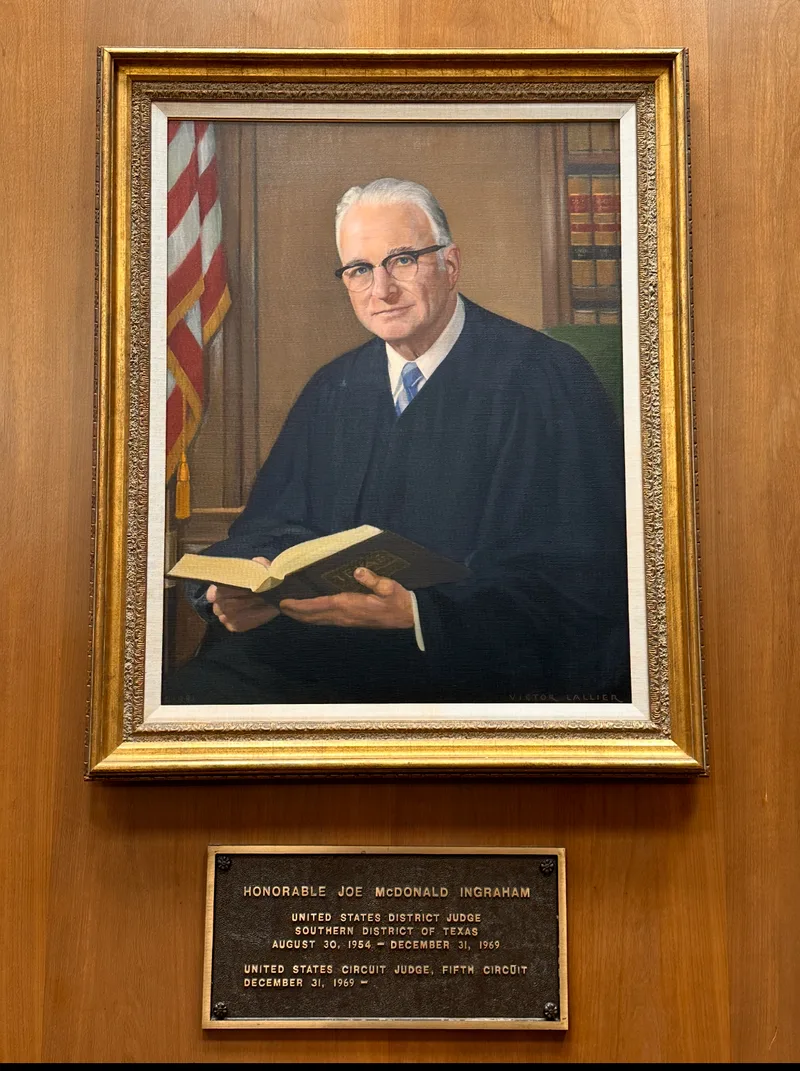
This case involved three students at Bellaire High School who sued the Houston Independent School District under 42 U.S.C. § 1983 after school officials directed them to leave campus until their attitudes changed, in response to their on-campus distribution of an unauthorized off-campus publication called “The Plain Brown Watermelon.” The students sought injunctive relief claiming violations of their First, Fifth, and Fourteenth Amendment rights. After an evidentiary hearing consolidated with the trial on the merits, the court denied all relief and dismissed the complaint. The court reasoned that the students were disciplined primarily for willful disobedience of announced school rules requiring prior approval for on-campus distribution, rather than for the content of their speech, and that school authorities retain authority to enforce reasonable regulations on time, place, and manner of expression so long as they do not target particular viewpoints. The court further held that the students received adequate process through offered hearings and were not denied due process.
The case involved Cassius Marsellus Clay, Jr.'s 1967 conviction for unlawfully failing to submit to induction into the armed forces, which was remanded by the Supreme Court to determine whether the conviction was tainted by illegal FBI electronic surveillance of five telephone conversations in which Clay participated. After conducting hearings and reviewing the logs of the conversations, the district court found that the surveillance was illegal but that none of the evidence supporting Clay's conviction derived from or was tainted by the overheard conversations. The court concluded that the evidence was obtained independently and was not the product of exploitation of the primary illegality under the standard from Wong Sun v. United States. A fifth conversation was deemed lawfully obtained pursuant to Attorney General authorization for foreign intelligence purposes. The court therefore denied Clay's motions to dismiss the verdict, set aside the sentence and indictment, or grant a new trial.
The case involved Joe Givas Acosta's federal habeas corpus petition challenging his 1965 Texas state conviction for possession of heroin with a prior conviction enhancement, which resulted in a 30-year sentence. The petitioner raised three issues: that the search warrant affidavit failed to establish probable cause, that the trial court did not properly conduct the hearing on the voluntariness of his confession, and that the court should have required identification of the confidential informant. After an evidentiary hearing, the court analyzed the affidavit under precedents such as Aguilar v. Texas, emphasizing that only information presented to the magistrate could be considered and that additional details about the surveillance and informant reliability were not conveyed, while addressing exhaustion of state remedies and the standards for probable cause.
This case involves an unfair competition dispute between two companies engaged in oil and gas exploration and development, with the plaintiff incorporated in New York and the defendant a Nevada corporation based in the Western District of Texas. The defendant moved to dismiss for improper venue, arguing it had never conducted business in the Southern District of Texas despite holding a statewide license to do business in Texas. The court held that venue does not lie in the Southern District under 28 U.S.C. § 1391(c), ruling that a corporation licensed in a multi-district state is considered a resident only of the specific districts where it actually does business. The decision emphasized that venue statutes aim to connect litigation to locations with logical ties to the parties and to protect defendants from undue hardship, leading the court to grant the motion to dismiss unless the plaintiff seeks transfer to the Western District within ten days.
This case concerned a Greek seaman's claim against a vessel's owner and U.S. agent for unpaid wages and statutory penalties under 46 U.S.C. § 596 after the seaman was discharged in Trinidad and repatriated without receiving earned wages. The court accepted jurisdiction over the foreign parties because U.S. citizens held beneficial ownership of the Panamanian-flagged ship, which regularly sailed to and from U.S. ports, and the plaintiff had since become a U.S. resident. It held the agent not liable but found the owner liable for the wages plus a double-wage penalty for 300 days, reasoning that the deduction of repatriation expenses was unauthorized by statute and made without sufficient cause, while limiting the penalty period due to the plaintiff's delay in filing suit.
This case is a declaratory judgment action filed by Struthers Scientific seeking a ruling that General Foods' planned Houston, Texas plant would infringe Struthers' U.S. Patent No. 3,381,302 on a dewaxing process for coffee extract used in making Maxim coffee. General Foods moved to dismiss for lack of a justiciable controversy under the Declaratory Judgment Act, arguing the patent had just issued and there had been no prior dispute over the Houston plant; alternatively, it sought transfer to New Jersey under 28 U.S.C. § 1404(a) or a stay pending a related infringement suit there, plus other procedural relief. The court rejected the argument that no actual controversy existed, citing the parties' year-long history of conflict over the invention and patent applications, and it addressed whether a declaratory judgment action could circumvent the special venue rules for patent infringement suits under 28 U.S.C. § 1400(b) by relying on the general venue statute. The court denied the motion to stay discovery, found that an interlocutory appeal would not advance the litigation, and indicated the case would proceed.