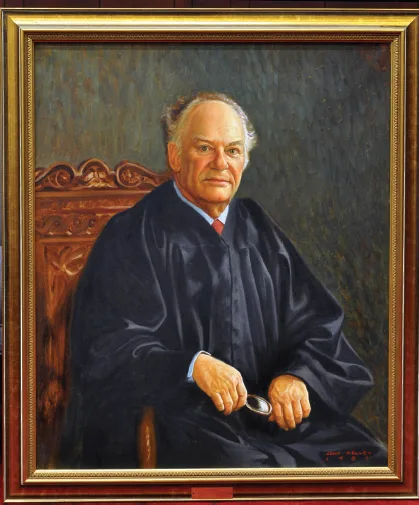
District Court, E.D. Tennessee — appointed by John F. Kennedy
Decision levers
AI-measured from their own opinions — each lever cites its cases
PurposivismTextualism
The opinions apply statutory text plainly and literally, as in enforcing the ten-year products-liability limitation period from the date of first purchase and denying pendent jurisdiction where federal remedies suffice. Mathis v. Eli Lilly and Co. ↗ Jenkins v. Carruth ↗
Willing to revisit precedentStrong stare decisis
The opinions adhere closely to existing precedent and affirm prior rulings without revisiting them, including upholding the constitutionality of a limitations statute on the basis of an earlier decision affirmed by the circuit court. Mathis v. Eli Lilly and Co. ↗ Ball v. United States ↗
Deference to government powerSkepticism of government power
The opinions show measured skepticism toward expanding government obligations, refusing to impose a novel duty of uninterrupted electrical service on TVA while enforcing constitutional limits on state officials acting under color of law. AFG Industries, Inc. v. Holston … ↗ Green v. Williams ↗
Judicial activismJudicial restraint
The opinions consistently exercise restraint by deferring to legislative text on limitations periods, procedural rules, and the absence of a constitutional right to plea bargains or court-created exceptions. Mathis v. Eli Lilly and Co. ↗ Ball v. United States ↗
In Ball v. United States, a federal prisoner moved under 28 U.S.C. § 2255 to vacate his 1981 criminal sentence, claiming that his retained trial counsel provided ineffective assistance in violation of the Sixth Amendment by giving false advice about a rejected plea bargain and making poor strategic decisions at trial regarding impeachment by prior convictions. The district court dismissed the motion summarily after preliminary review, holding that the claims failed to meet the two-part test from Strickland v. Washington requiring both deficient performance and resulting prejudice. The court reasoned that defendants have no constitutional right to plea bargain or to avoid trial, that counsel's actions were within the range of competent assistance and trial strategy, and that the prior appellate ruling had already confirmed the trial was fundamentally fair, making any claimed errors insufficient to show a reasonable probability of a different outcome.
This civil rights action under 42 U.S.C. § 1983 involved claims by the plaintiffs against a defendant, later adding the county and sheriff as parties, arising from an incident on February 10, 1981. The court declined to exercise pendent jurisdiction over the plaintiffs' state-law claims, such as assault and battery, because the federal claim, if proven, would provide adequate remedies making additional state claims duplicative. The court also held that the county and sheriff had not waived their statute of limitations defense under T.C.A. § 28-3-104(a), which was properly raised in the pretrial order and motions, and that the claims against them were time-barred since the amended complaint adding them was filed after the one-year limit and did not relate back under Federal Rule of Civil Procedure 15(c) as it added new parties rather than correcting a misnomer.
This case involves multiple defendants, including Howard Franklin Watts, Sandy White Jr., Eddie Earl Arms, and others like Mr. Stinson, facing federal criminal conspiracy charges in the Eastern District of Tennessee. The court addressed numerous pretrial motions, including requests for discovery and inspection, transfers to the Eastern District of North Carolina, continuances, bills of particulars, and suppression of evidence. The court denied the discovery motions as premature, moot, and overbroad under precedents like United States v. Short; denied transfers under Rule 21(b) because defendants failed to show a substantial balance of inconvenience outweighing the burdens of split trials; and rejected other motions like continuances as premature or lacking justification under the Federal Rules of Criminal Procedure. Core reasoning emphasized adherence to procedural rules, avoidance of duplicative proceedings, and the defendants' failure to meet required showings for relief.
This case involves a diversity action by Jabco, Inc. against the Town of Greeneville, Tennessee and Boyd, Arthur & Gass, Architects, arising from a construction project and claims including negligence, vicarious liability, and failure to obtain required all-risk insurance under the contract. The court accepted a magistrate's recommendation and denied the Town's motion to dismiss for failure to state a claim. It granted summary judgment to the architects because the plaintiff did not produce evidence creating a genuine issue of material fact or cite supporting state law authority. The court denied the plaintiff's motion for summary judgment, granted the Town's cross-motion only on the vicarious liability claim under respondeat superior for an independent contractor, but denied it on the insurance claim due to a factual dispute over contractual intent, and denied the defendants' request for a late jury trial after waiver.
The case is a civil rights action under 42 U.S.C. § 1983 brought by the plaintiff against defendant Harry Parmley, a police officer, concerning events surrounding her arrest, incarceration, and alleged rape. The court denied the plaintiff's motion to compel non-party law enforcement agencies to produce witness statements, noting that Rule 34 of the Federal Rules of Civil Procedure applies only to parties and that a subpoena under Rule 45 would be the appropriate mechanism instead. It granted some of the plaintiff's exceptions to the pretrial order, disallowed her objection to certain exhibits on grounds that she had opened the door to evidence about the circumstances of her arrest and that the exhibits were relevant and not unfairly prejudicial under Rules 401 and 403, and denied the defendant's motion to dismiss for failure to state a claim because a pretrial stipulation established that he had acted under color of state law. The court also amended the pretrial order to add a contested issue regarding potential body searches.
The case involved an indigent defendant charged with mail theft who requested court-funded expert services, including a questioned-documents analyst, fingerprint expert, and psychiatric evaluation, due to financial inability to obtain them for his defense. The court found the services necessary under the Criminal Justice Act and authorized their provision, while also ordering a mental competency examination under 18 U.S.C. § 4244 after defense counsel raised concerns about the defendant's hospitalizations and ability to assist in his defense. Following the examination, the court determined the defendant was competent to stand trial, with the finding not to prejudice any insanity defense or be disclosed to the jury, and granted a continuance to allow counsel time to prepare. The court further allowed the defense to access or obtain additional psychiatric expert services at government expense for trial preparation without reporting to the court or prosecution.