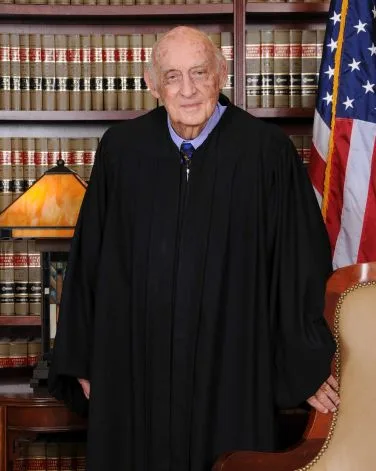
District Court, D. Kansas — appointed by Gerald Ford
Decision levers
AI-measured from their own opinions — each lever cites its cases
Willing to revisit precedentStrong stare decisis
The opinion in Hernandez-Carrera follows Supreme Court holdings in Zadvydas and Clark v. Martinez to limit indefinite detention authority under the statute. Hernandez-Carrera v. Carlson ↗
Deference to government powerSkepticism of government power
The opinion in Hernandez-Carrera rejects an agency regulation that would expand detention power beyond the statute's reach. Hernandez-Carrera v. Carlson ↗
PurposivismTextualism
The opinion in Ellis defers to the Bureau of Prisons' reasonable interpretation of its statutory discretion to deny sentence reductions. Ellis v. Terrell ↗
The case arose from Kansas Penn Gaming's termination of a real estate purchase contract with HV Properties for land intended for casino development in Kansas; KPG filed for declaratory relief, HV counterclaimed for breach of contract, and HV separately sued Penn National on a related guaranty, with the actions consolidated. After granting summary judgment to KPG and Penn National, the court considered their motion for attorneys' fees and expenses based on a contractual provision entitling the substantially prevailing party to recover reasonable fees and expenses in a breach lawsuit. The court held that KPG was the prevailing party entitled to recovery under the contract, reviewed the requests for reasonableness under Kansas law, disallowed certain items such as expert witness costs already covered elsewhere and some travel expenses, and awarded $765,058.50 in attorneys' fees plus $207,652.27 in expenses.
The case involved a defendant charged with possession with intent to distribute over 500 grams of methamphetamine after a Kansas Highway Patrol trooper stopped his vehicle on Interstate 70, observed signs of a possible hidden compartment, obtained consent to search, and found the drugs. The defendant moved to suppress the evidence, contending that the traffic stop lacked reasonable suspicion, the detention was improperly extended, and the search exceeded the scope of consent by disassembling part of the console. The court denied the motion after hearings and briefing, concluding that the trooper's observations of lane violations justified the stop, the brief pursuit and questioning were reasonable, and the consent was voluntary with the search limited to actions that did not destroy the vehicle and supported by probable cause from indicators like modified bolts and a missing heat shield.
The case involved a former employee suing his employer for retaliation under Kansas workers' compensation law and for interference with and retaliation under the Family and Medical Leave Act after the employee took time off for back issues and was later terminated. The court addressed the employer's motion for summary judgment and a subsequent motion for reconsideration by the plaintiff. Applying summary judgment standards, the court reviewed uncontroverted facts regarding the employee's medical history, work restrictions, FMLA leave periods, short-term disability benefits, and termination. It concluded there were no genuine disputes of material fact supporting the claims of unlawful retaliation or interference, as the employee had been properly placed on and exhausted FMLA leave and could not show improper denial of reinstatement or pretext. The court therefore denied the motion for reconsideration.
This case is an appeal from a bankruptcy court order dismissing an adversary proceeding complaint filed by a pro se plaintiff against a deceased debtor, her attorneys, and others. The complaint alleged various claims including malicious prosecution, legal malpractice, negligence, RICO violations, fraud, and due process violations arising from a state court judgment, its nondisclosure in the debtor's 2002 Chapter 7 bankruptcy, and a subsequent garnishment of over $19,000 from the plaintiff's bank account after the debtor's death. The bankruptcy court dismissed some claims for lack of subject matter jurisdiction, finding no authority to review the state court judgment or garnishment and that the claims did not relate to or affect the bankruptcy estate, and others for failure to state a claim. The district court affirmed, holding that the bankruptcy court properly exercised its limited jurisdiction under 28 U.S.C. §§ 157 and 1334, correctly allowed a motion to dismiss, and that remaining procedural objections were moot. The court also found no error in declining to transfer the case.
The case involved a dispute over a real estate purchase contract between Kansas Penn Gaming (KPG) and HV Properties for land in Cherokee County, Kansas, intended for casino development under the Kansas Expanded Lottery Act. KPG sought a declaratory judgment that it had no further obligations after terminating the agreement upon withdrawing its casino application, while HV sought $37.5 million in contingent payments, alleging breach. The court granted summary judgment to KPG and denied HV's motion, finding no genuine issues of material fact. It reasoned that KPG had fulfilled its contractual duties by using good faith commercially reasonable efforts to obtain a management contract and properly terminated before receiving a reasonably acceptable final contract, triggering HV's repurchase remedy under the agreement.
This case involves an indictment charging defendants Timothy Wayne Stein II, Eddie Raul Collazo, Jr., and Anthony Maurice Hodges with possession with intent to distribute one kilogram or more of phencyclidine (PCP) in violation of 21 U.S.C. § 841(a)(1). The defendants filed various pretrial motions, including motions to suppress evidence obtained during a July 2009 traffic stop on Interstate 70 and motions related to discovery, severance, and evidentiary issues. The court denied the motions to suppress filed by Stein and Collazo, finding that the initial stop was justified by the lack of a visible license plate and that the officer developed reasonable suspicion of criminal activity based on the smell of marijuana, nervous behavior, and unusual vehicle ownership details, leading to a valid detention and consent to search. The court also denied most of defendant Hodges' other motions, such as those for severance and limits on certain testimony, while granting limited relief on requests for disclosure of Rule 404(b) evidence, rough notes, and probation records.