Judicial data via CourtListener (Free Law Project). Social links via Wikidata.
Affiliations
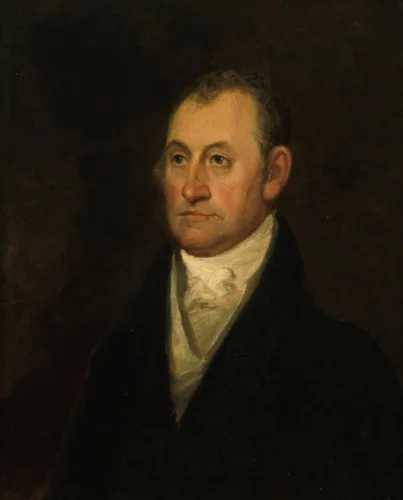
Supreme Court of the United States — appointed by Thomas Jefferson
Party: j
Decision levers
AI-measured from their own opinions — each lever cites its cases
PurposivismTextualism
Opinions construing land-entry statutes examine legislative history, treaty context, and purpose alongside text to determine intent, as in the 1777 North Carolina act and 1783 reservation statute. Danforth's Lessee v. Thomas ↗ Preston v. Browder ↗
Willing to revisit precedentStrong stare decisis
Opinions repeatedly emphasize that settled constructions of insurance phrases and statutory provisions must not be disturbed and follow directly on-point state supreme court rulings without reexamination. Dickey v. Baltimore Insurance ↗ Danforth's Lessee v. Thomas ↗
This case involved a lawsuit over a written contract for the sale of stock in the Central Bank of Georgetown, where the plaintiff sought to introduce testimony from a subscribing witness about the contract's terms after both parties claimed to have lost their copies. The Circuit Court excluded the secondary evidence based on the plaintiff's affidavit, which expressed only an impression that he had torn up the document after the stock transfer and had searched unsuccessfully for it if not destroyed, leading to a verdict for the defendant. The Supreme Court reversed, holding that the affidavit sufficiently established the document's loss or destruction to permit secondary evidence under established rules, as the destruction (if it occurred) resulted from a mistaken belief rather than fraud or intent to injure the other party. The Court further noted that the declaration included counts for money had and received that could independently support the claim, rendering other objections immaterial.
This case concerns a dispute over land titles in the Virginia military reservation between the Scioto and Little Miami Rivers in Ohio, where plaintiff Watts sought to compel respondents to surrender legal title to land under an elder grant. Watts claimed title based on a 1787 entry by Captain Ferdinand O’Neal that depended on Stephen T. Mason’s entry, which called for beginning at the mouth of the 'third creek' running into the Ohio above the Little Miami River. The respondents denied the validity of O’Neal’s entry, arguing it was vague and that the survey did not match the described land, with disagreement over which creek qualified as the 'third.' The Circuit Court dismissed Watts’s bill in chancery, and on appeal the Supreme Court affirmed, holding that a party must prevail on the strength of their own title and that the entry could not be sustained because the objects called for were not sufficiently described or notorious to allow others to locate them with reasonable diligence.
The case involved a dispute over title to 789 acres of land in the Virginia Military District, where Justus Miller's heirs held a junior patent based on an 1783 military warrant assigned to Seymour Powell for Thomas Powell's alleged Continental line service, while John Neville's heirs held a senior patent from a 1806 entry. Miller's heirs sued in equity to enjoin an ejectment action and compel conveyance of the legal title, arguing their prior entry and survey gave superior equity despite the later patent. The court found that Powell's certificate and warrant were issued by mistake for Continental line service, when records showed the service was actually in the State line, and that after Virginia's 1784 cession of the territory to the United States, only Continental warrants could validly appropriate land in that district. The court held that a warrant issued due to a ministerial error by the land office register does not create an equity superior to a later legal title obtained without such defect, and affirmed the decree in favor of Neville's heirs.
The case concerned whether entries for land claims under North Carolina's 1777 statute could validly include territory west of the boundary line established by the 1777 treaty with the Overhill Cherokee Indians. The court held that such entries were prohibited and void, affirming the circuit court's decision. Its reasoning relied on the historical context of the state's recent treaty and independence, the statute's purpose of settling vacant lands without provoking conflict, and explicit language in the 1778 amending act that forbade entries within Indian hunting grounds. The court interpreted the 1777 act in light of these circumstances to reflect a legislative intent to respect the treaty boundary rather than violate it shortly after signing.
This case was an ejectment action over land south of the Holston and French Broad rivers, where the plaintiff claimed title under a 1791 North Carolina grant and the defendant under a 1809 Tennessee grant. The circuit court excluded the plaintiff's grant from evidence on the ground that it covered land reserved for the Cherokee Indians under North Carolina's 1783 statute, which barred entries, surveys, and grants within those limits, resulting in a verdict for the defendant. The Supreme Court affirmed, holding that the 1783 act expressly rendered such grants void and that later statutes from 1784, 1786, and 1789 did not authorize entries on the reserved lands. The Court further reasoned that extinguishment of Indian title by treaty did not alone open the land to appropriation without new legislative authorization, and it followed a directly on-point decision by the North Carolina Supreme Court in Avery v. Strother construing the same laws.
This case involved a dispute over whether an insurance policy covering a ship 'at and from' the island of Trinidad protected the vessel while it sailed between two ports in Trinidad to complete its cargo, or whether the loss at sea during that leg fell outside the policy. The Supreme Court held that the loss was covered and reversed the circuit court's judgment to the contrary. The core reasoning was that established English precedents, including Camden v. Cowley, Bond v. Nutt, and Thelusson v. Furguson, interpreted the phrase 'at and from an island' in West Indies policies as granting liberty to coast between ports for voyage purposes, and that settled construction of insurance contracts should not be disturbed.