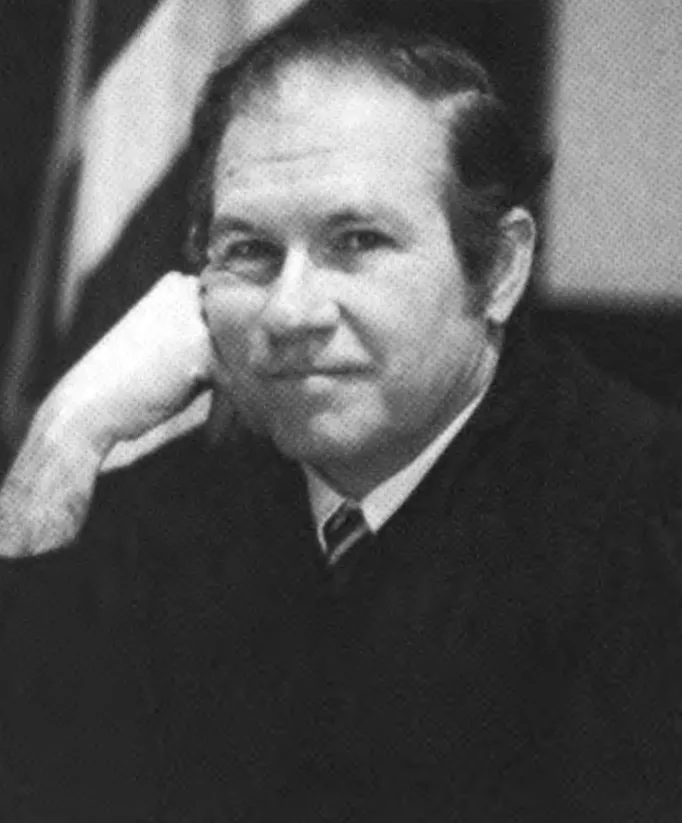
This case involved healthcare providers challenging a regulation issued by the Department of Health and Human Services regarding Medicare. The court considered cross-motions for summary judgment after reviewing arguments and other district court rulings on the same issues. It granted the plaintiffs' motion and denied the defendant's motion, holding that the regulation was arbitrary and capricious and did not comply with the Medicare statute. The court adopted the detailed reasoning from a similar decision in St. James Hospital v. Heckler without adding further analysis.
This case involved a guardian seeking a refund of gift taxes paid to the IRS after one spouse's death under a joint and mutual will that disposed of both spouses' property. The court ruled for the plaintiff, ordering the United States to refund $315,298 plus interest. It held that the transfer was not a completed gift because the surviving spouse retained a life estate with an unlimited power to invade the corpus for her health, support, comfort, and maintenance. Under Illinois law interpreting similar language, this power allowed the life tenant to determine and consume assets as needed for comfort, potentially exhausting the entire corpus and leaving any remainder interest incomplete. The decision relied on the principle that a retained, non-ascertainable power prevents a taxable gift under federal regulations.
In United States v. Strawser, the court addressed whether attorney Richard Anderson charged an excessive fee of $47,500 for representing Ronald Strawser in two federal drug prosecutions that ended in guilty pleas. After Michael Strawser, who paid the fee, later required court-appointed counsel at government expense, the court examined the facts and applied the Illinois Code of Professional Responsibility Rule 2-106 to determine reasonableness based on factors such as time required, case complexity, customary fees, and results obtained. The court found the fee grossly excessive given the routine nature of the cases, minimal motions filed, and short duration, and it also noted the fee's impact on the federal treasury through public funding of counsel and potential forfeiture of drug proceeds. The court ordered Anderson to reimburse $1,582.50 for appointed counsel costs and $25,117.50 to the treasury pending forfeiture proceedings, leaving him with a $20,000 fee.
The case concerns a deputy sheriff who was reprimanded by the Champaign County Sheriff’s Department for writing a letter to a local newspaper endorsing a private ambulance service and identifying himself as a ten-year department veteran, in violation of department rules requiring prior approval for public statements or use of official title. The plaintiff also sought a ruling that a newly adopted rule barring officers from engaging in political activity was unconstitutional. The court granted summary judgment to the defendants on all claims. Applying the Pickering balancing test, the court found that the department’s legitimate interest in preserving an appearance of impartiality in its dealings with emergency services outweighed the plaintiff’s interest in the speech, and the rules were not facially invalid. The defendants were also entitled to qualified immunity because no clearly established constitutional rights had been violated.
This case arose after plaintiffs obtained large default judgments in Illinois state court against several defendants and initiated garnishment proceedings against banks holding assets of the judgment debtors. The banks removed the new garnishment actions to federal court on diversity grounds under 28 U.S.C. § 1332, prompting plaintiffs to move for remand on grounds that the removals were untimely and that garnishment proceedings are not separate civil actions under 28 U.S.C. § 1441. The court denied the motions to remand, ruling that the voluntary dismissal of prior garnishment actions made the January 1983 filings new proceedings that were removed within the 30-day federal deadline, and that federal law treats such garnishment actions as removable independent civil actions when diversity and amount-in-controversy requirements are met, regardless of state-law characterizations. The court applied the same analysis to the remaining garnishee BCI, finding its exposure to a new personal liability claim also supported removal.
This case consolidated three tax refund suits brought by R.V. Evans Company and its shareholder brothers against the United States after the IRS disallowed corporate rental expense deductions and treated the amounts as constructive dividends. The disputes arose from the company's 1976 sale of vehicles and computer equipment to an irrevocable trust established for the shareholders' children, followed by the company's leaseback of the assets from the trust, which the IRS deemed a sham transaction under federal tax law and alternatively sought to reallocate under IRC Section 482. Following a bench trial, the court found that the trust was validly created with an independent bank trustee exercising control, that the sale and lease terms were reasonable and motivated by legitimate business purposes such as centralized leasing and improved liquidity, and that the shareholders retained no reversionary interests or incidents of ownership. The court therefore held that the transactions were not shams, Section 482 did not apply, and the plaintiffs were entitled to the claimed refunds.