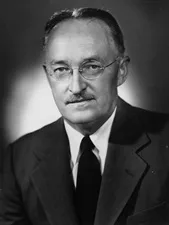
The case involved a barber shop proprietor who had displayed a union shop card under a 1936 agreement with the defendant union but refused to join as a proprietor member after the union amended its rules in 1948 to require such membership. The proprietor sued to prevent the union from removing the card, claiming a contractual right to continued use. The court held that the 1936 agreement gave the plaintiff no right to retain the card, as it explicitly allowed the union to reclaim it for any reason when the conditions were not met and stated that the card remained union property. The core reasoning was that the contract terms were clear and controlling, there was no common-law or statutory public policy requiring the union to continue recommending or approving the plaintiff's services, and continued display without approval would constitute a false representation to the public and employees.
The case concerned whether a 1946 mortgage given by the borrower to the Second National Bank of Warren secured a subsequent 1948 promissory note for additional advances that the bank had no obligation to make. The Supreme Court of Ohio held that the 1946 mortgage did not secure the 1948 indebtedness, affirming the lower court's judgment that the mortgage lien did not have priority over later liens held by a judgment creditor, the state, and the United States. The court's reasoning was that although a mortgage may secure future advances even without an obligation to make them, such advances are secured only if made in reliance on the mortgage; here the bank's pleadings and evidence showed no expression of intent to accept the mortgagor's offer or reliance on the 1946 mortgage when extending the 1948 loan.
The case concerned whether the auditor of the University of Toledo was protected by civil service laws when facing removal from employment. The court held that the city's civil service charter and ordinances did not apply to the university due to state statutes vesting control in the university's board of directors. Assuming state civil service statutes applied, the court determined that the auditor qualified as an administrative officer under the unclassified service exemption in Section 486-8(a)(7) of the General Code, based on the position's duties and prominence in the university's bylaws. As a result, the relator was not entitled to notice, a hearing, or other civil service protections, and the denial of the writ of mandamus was affirmed.
The case concerned a plaintiff injured while helping free the defendant's truck from mud using a tool supplied by the defendant's employee; the plaintiff sued for negligence after the tool allegedly caused harm. Lower courts had ruled for the defendant, holding that the plaintiff was either an employee barred from suit by the Workmen’s Compensation Act or a volunteer to whom no duty of care was owed. The court determined there was no express or implied contract of hire obligating payment, so the plaintiff was not an employee under the Act and the statutory bar did not apply. Because the assistance was requested for the defendant's benefit and a tool was furnished for that purpose, the defendant owed the plaintiff a duty of ordinary care to provide a reasonably safe tool or warn of defects. The judgment for the defendant was therefore reversed and the case remanded.
The case concerned a railroad employee's claim under the Federal Employers' Liability Act and whether a signed release of that claim could be set aside on grounds of fraud in the inducement or mistake. The Ohio Supreme Court held that a state trial court, rather than a jury, ordinarily decides whether such a release should be avoided for fraud or mistake, and that Ohio law governs this question when the release was executed in Ohio. The court distinguished fraud in the factum, which renders a release void, from fraud in the inducement, which requires equitable relief before the underlying claim can proceed, and found substantial evidence supporting the trial court's determination that the release was valid. It further rejected the argument that federal law mandates a jury resolution of the release's validity in state-court FELA actions, concluding instead that state procedural rules apply in state forums.
federal powerproceduretorts & liabilitylabor & employment
This case involved Ohio lawsuits by a plaintiff against Benguet Consolidated Mining Co., a Philippine-organized sociedad anónima engaged in mining, seeking to enforce claims arising outside Ohio and unrelated to the company's limited Ohio activities. The company had not appointed a statutory agent for service or otherwise consented to Ohio jurisdiction. The Ohio Supreme Court affirmed the Court of Appeals judgments, holding that service of process on the defendant was invalid under the Due Process Clause because a foreign corporation's in-state business does not subject it to personal jurisdiction over unrelated out-of-state claims absent consent or an agent. The court further concluded that the defendant qualified as a corporation under Ohio law based on its essential attributes under Philippine law, despite differences in terminology or structure from domestic corporations.