



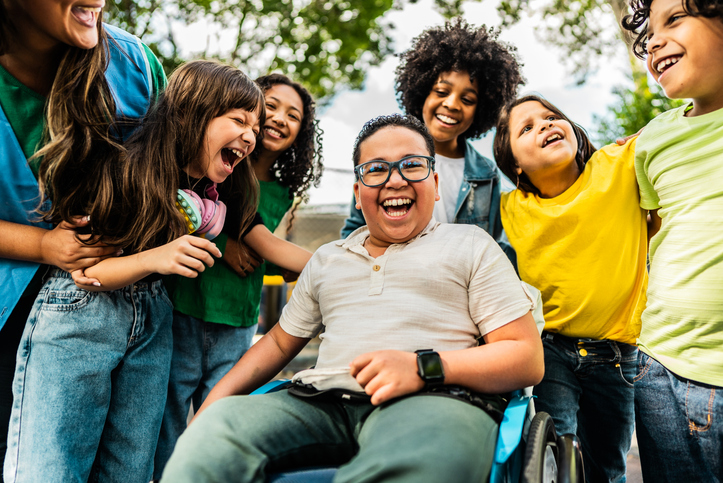
A group of children living with serious autoimmune diseases traded hospital visits for hiking trails this summer, as an upstate New York camp partnered with pediatric specialists to give young patients a chance at a traditional sleepaway experience.
For 12-year-old Dylan Aristy Mota, diagnosed with lupus earlier this year, the opportunity meant soaring through the trees on a high-ropes course — something his family once thought would be impossible, according to The Associated Press.
“It’s really fun,” Dylan said, adding that he felt reassured knowing doctors were stationed at the camp. If “anything else pops up, they can catch it faster than if we had to wait til we got home.”
Children’s Hospital at Montefiore joined with the Frost Valley YMCA last summer to create a medically supported camp session for kids with conditions such as lupus, myositis, and forms of juvenile arthritis. While rare in childhood, these autoimmune diseases can be more severe when they begin early, particularly before puberty.
“People always ask, ‘Can kids have arthritis? Can kids have lupus?’” said Dr. Natalia Vasquez-Canizares, a pediatric rheumatologist at Montefiore. “Imagine for an adult, it’s difficult. If you have that disease since you’re young, it’s very difficult to, you know, cope with.”
Symptoms can also be difficult to detect in young children. Instead of explaining joint pain, some may limp or revert to crawling. Dylan’s symptoms first appeared as a sudden change in the color of his face.
“Before, I looked like everybody else, like normal,” he said. Then, “my face turned like the bright pink, and it started to like get more and more red.”
His family initially assumed allergies were to blame. After several medical appointments, he was diagnosed with lupus in January.
Treatments for childhood autoimmune disorders remain challenging. Medications that suppress inflammation also weaken the immune system at a critical stage of development, leaving children more vulnerable to infections and potentially affecting bone strength. But researchers say new therapies are showing promise.
Seattle Children’s Hospital recently launched the first clinical trial of CAR-T therapy for pediatric lupus. The approach, already used in adults, reprograms a patient’s own T cells to eliminate problematic B cells. Early adult trials have led to long-term remissions without ongoing medication, raising hopes for younger patients.
Researchers are also working to prevent autoimmune complications in infants. Certain antibodies found in lupus, Sjögren’s, and similar conditions can cross the placenta and damage a developing fetal heart.
Dr. Jill Buyon at NYU Langone Health is investigating whether a drug used for another autoimmune disorder can block that process. Her team recently reported a healthy birth from a mother with mild lupus treated under the experimental protocol.
“This is a rare example where we know the exact point in time at which this is going to happen,” said Dr. Philip Carlucci, an NYU rheumatology fellow involved in the study.
The research is personal for Kelsey Kim, who lost a baby to congenital heart block and later saw another child require a pacemaker. She pursued the experimental treatment during her most recent pregnancy, and her third daughter was born healthy in June after weekly visits to NYU. A larger NIH-funded trial is expected to begin soon.
For the children at Frost Valley, the focus wasn’t on the science — it was on reclaiming parts of childhood too often overshadowed by illness.
“I do kind of get to forget about it,” said 11-year-old Ethan Blanchfield-Killeen, who has juvenile idiopathic arthritis.
One day, he had his hands checked by a doctor. On another, he was dashing across a field covered in paint splatter from a spirited game.
“Just seeing them in a different perspective,” outside the clinical setting, “almost brings tears to my eyes,” Vasquez-Canizares said.