



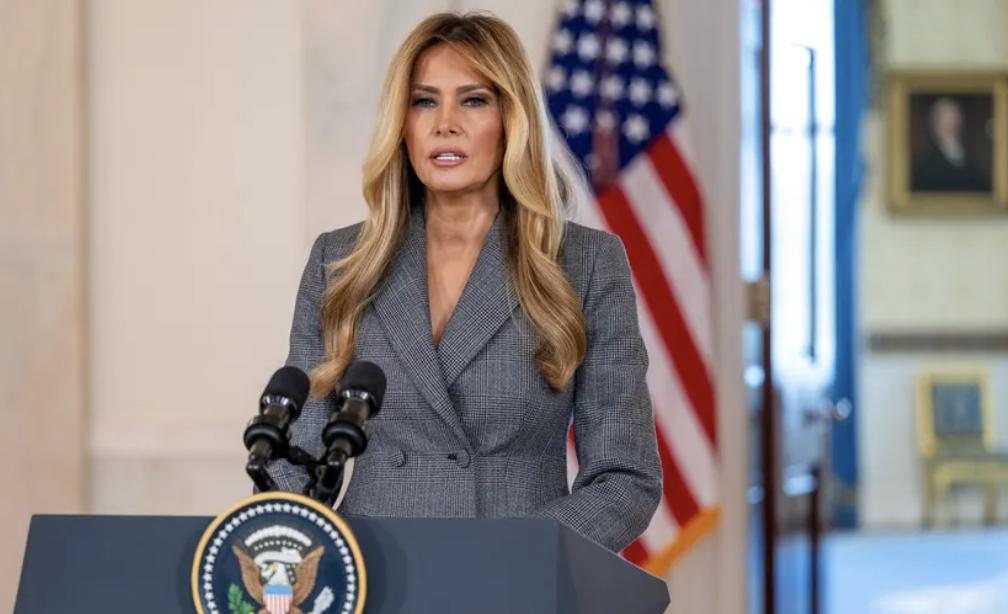
The TV was on in the background, nothing unusual, and then suddenly there was a live shot from the White House. Melania Trump stepped up and began reading a prepared statement. That alone isn’t especially rare. What caught people off guard was the subject: Jeffrey Epstein.
She wasn’t taking questions. There had been no advance detail about what she planned to address, only that her remarks would be “newsy.” Still, few seemed to expect the first lady to wade directly into an issue as charged and scrutinized as Epstein.
In a brief statement, she firmly denied any connection to him or to Ghislaine Maxwell. She described a past email exchange with Maxwell as casual and insignificant, pushing back on the idea that it meant anything more. She also said clearly that she was not a victim, had never been introduced to Donald Trump by Epstein, and had no knowledge of Epstein’s criminal behavior at the time.
There was a noticeable strain in her delivery. The speech was short, just a few minutes, but it didn’t come across as easy or routine. She spoke carefully, at times haltingly, as if aware of how closely every word would be examined.
The timing raised questions. While there had been some renewed circulation of Epstein-related documents, it wasn’t immediately clear what prompted her to address the issue so directly and publicly. Some observers said they weren’t even aware of specific rumors involving her, which made the decision to speak out feel like a preemptive move.
First Lady Melania Trump’s full remarks in the White House Grand Foyer today 4/9/26 pic.twitter.com/eYFwCOZFt1
— FLOTUS Report (@MELANIAJTRUMP) April 9, 2026
Should Melania Trump's speech about Epstein have addressed the allegations directly?
She did mention that false claims and manipulated images tying her to Epstein had been circulating online for years. According to her, those claims are entirely fabricated, and she said her legal team has successfully pushed back against them. The message was straightforward: the accusations are baseless, and she wants them to stop.
Even so, the reaction was mixed, and in some cases, confused. Coverage in major outlets reflected that uncertainty, noting that the reason for the speech wasn’t entirely clear. Others pointed out that by addressing the topic so directly, she had effectively put it back into the spotlight.
That may be the most significant outcome. The Epstein case, while never far from public attention, had recently been overshadowed by other major developments. This speech shifted the focus back, at least temporarily.
There are also political ripples. Some lawmakers are already calling for renewed scrutiny, including the possibility of additional hearings. At the same time, divisions remain over how much more investigation is necessary and what form it should take.
What remains unanswered is why this statement happened in this way. It wasn’t a press conference. There were no follow-ups, no clarifications. Just a short, direct address that left as many questions as it answered.