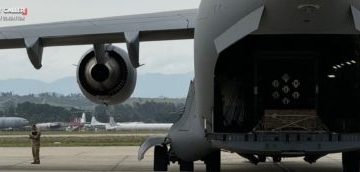




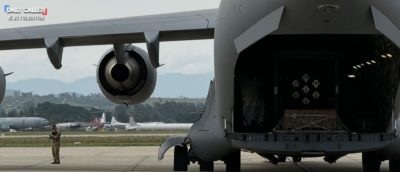

HILL AIR FORCE BASE, Utah — The military airlifted a nuclear reactor using a C-17 on Sunday in a historic first.
The effort, dubbed “Operation Windlord,” is a partnership between the Department of War (DOW), the Department of Energy (DOE) and Valar Atomics to fulfill executive orders setting aggressive goals for expanding nuclear power and provide proof-of-concept for rapid deployment of energy sources to support military needs.
“I think what we were able to demonstrate today is speed of technology development, speed of the ability to transport,” Under Secretary of War for Acquisition and Sustainment Michael Duffey told the Daily Caller News Foundation. “Transporting a nuclear reactor across state lines, and demonstrating that we can move the power source like that, is tremendous.”
Three Boeing C-17 Globemaster III aircrafts transported the Valar Ward250 reactor modules from March Air Force Base in California to Hill Air Force Base in Utah. The reactor will later go to Utah’s San Rafael Energy Lab for testing.
“We want to make sure that we’re giving innovators the opportunity to bring their technologies to bear without the burdens of bureaucracy,” Under Secretary of War for Acquisition and Sustainment Michael Duffey told the DCNF. “I think today is another example of that.”
Secretary of War Pete Hegseth announced the DOW’s Acquisition Transformation Strategy in November, which aims to modernize systems, increase production capacity and ensure the industrial base is on a “wartime footing” by transforming “a culture of compliance to one of speed and execution.”
Strict nuclear power regulations have made industry progress over the years difficult. While the Biden administration attempted to boost nuclear energy, its policy was focused on wind and solar projects.
The ability to deliver reliable, independent power to warfighters is a “strategic necessity,” Valar Atomics CEO Isaiah Taylor said during a press conference Sunday, noting energy sources need to be shielded from disruption by adversaries. The 5 megawatt nuclear reactor is designed to power about 5,000 homes, Taylor told reporters.
“Abundant scalable energy is the foundation of national strength,” Taylor said. “Coal built the industrial age. Oil won the wars of the 20th century. And nuclear energy, deployed at scale, at speed and with American ingenuity, will power the century ahead.”
.@SecretaryWright tells @DailyCaller News
Foundation what their @DeptofWar partnership could mean for civilian energy infrastructure.“Those same technologies that’ll power reactors in remote military operations — they’ll power small towns in Alaska, remote mines in locations,… https://t.co/NY0yNTYbak pic.twitter.com/ev4JkEOhYr
— Katelynn Richardson (@katesrichardson) February 16, 2026
Should the military expand the use of nuclear energy for operational needs?
In May, President Donald Trump signed four executive orders intended to clear regulatory hurdles for nuclear energy, including one directing the DOW to commence operation of a nuclear reactor “at a domestic military base or installation no later than September 30, 2028.”
“We went 40 or 50 years without building much in the nuclear space, and from executive orders only about 12 months ago, before July 4 of this year, we will have multiple nuclear reactors critical,” Department of Energy Secretary Chris Wright said during the Sunday press conference. “That’s speed. That’s innovation. That’s the start of a nuclear renaissance.”
The innovation driven by the partnership will eventually help develop civilian energy infrastructure, Wright told the DCNF.
“Those same technologies that’ll power reactors in remote military operations — they’ll power small towns in Alaska, remote mines in locations, and ultimately, they’ll be coupled together to power data centers and factories,” Wright said.
The DOE’s goal is to have three nuclear reactors reach criticality, the point where they are running, by the country’s 250th anniversary on July 4. While the date is an “aggressive benchmark,” American Energy Institute CEO Jason Isaac told the DCNF “it is important to be clear about what ‘criticality’ means.”
“It does not mean full commercial operation or sustained electricity production,” he said. “These are controlled learning platforms designed to validate materials, fuel forms, and operational concepts. The safety and authorization standards remain rigorous. If the objective is to build, test, and refine in a controlled environment, that timeline is feasible.”
Transporting the reactor using a C-17 is “about logistics and control, not theatrics,” Isaac said.
“When you’re dealing with advanced nuclear hardware on an accelerated timeline, airlift reduces transport risk, compresses schedule uncertainty, and maintains security,” he said. “If these systems are designed to be deployable and strategically relevant, demonstrating that capability is part of the mission.”
Nuclear energy will be a key part of the military’s increasing use of artificial intelligence, Duffey told the DCNF.
“I think we’ll be increasingly dependent on [AI] as a decisive advantage, in both our ability to execute operations, and to manage the huge, you know, mission that the Pentagon has in terms of, you know, financial management, acquisition, personnel management — all the things that make the military great,” Duffey told the DCNF. “So, our increasing dependence on AI will therefore have an increasing dependence on not only energy, but resilient energy. And I think nuclear is a really a critical part of it.”
All content created by the Daily Caller News Foundation, an independent and nonpartisan newswire service, is available without charge to any legitimate news publisher that can provide a large audience. All republished articles must include our logo, our reporter’s byline and their DCNF affiliation. For any questions about our guidelines or partnering with us, please contact [email protected].