



When the Supreme Court struck down President Donald Trump’s sweeping global tariffs imposed under the International Emergency Economic Powers Act (IEEPA), some predicted chaos. Had the Court just detonated U.S. trade policy?
Not quite. The justices may have done markets a favor. By removing IEEPA as a presidential Swiss Army knife for tariffs, the Court replaced improvisation with guardrails. Investors prefer lanes to open fields. So do America’s trading partners.
Under Trump, IEEPA functioned as an all-purpose “because I said so” clause: declare an emergency, reach for tariffs. The ruling doesn’t end the tariff era; it narrows the runway. And that narrowing brings clarity. The White House’s response made the point. Within hours it announced a temporary 10%—now 15%—global tariff under Section 122 of the Trade Act of 1974 and launched new investigations under Section 301 into unfair foreign trade practices.
That sequencing matters. Section 122 is a bridge, not a permanent platform. It allows tariffs of up to 15% for 150 days to address serious balance-of-payments problems. It is fast, broad, and—crucially—time-limited. Think of it as a tactical pause button.
This shift pushes U.S. tariff policy toward a narrower “landing zone”: tariffs justified as countermeasures to foreign barriers and anti-competitive market distortions—not as a free-floating instrument for revenue, reshoring, or general foreign-policy signaling. If tariffs are to endure, they must be tied to something concrete another government has done, not simply to something Washington would like to see happen.
The more durable strand of what some call the Trump Tariff Doctrine is precisely this focus on anti-competitive market distortions. In modern trade, the real action isn’t usually at the border. It is behind it.
Over recent decades, headline tariff rates have fallen worldwide. But protectionism has not retired; it has relocated. It now lives in domestic regulation, licensing systems, standards bodies, state-backed financing, and selective law enforcement. Governments can profess devotion to free trade while quietly tilting the playing field at home.
These distortions aren’t theoretical. They appear as regulatory “clarifications” that sideline foreign competitors, intellectual property rules that are strong on paper and porous in practice, and industrial policies that favor national champions with cheap credit, privileged procurement access, or regulatory forbearance.
With IEEPA off the table, presidential tariff authority is tethered—explicitly or implicitly—to such conduct. The debate shifts from “Can the president impose tariffs?” to “What exactly did the other country do?” That is a healthier argument. It forces specificity, disciplines policy, and provides a clearer signal to markets.
Section 301 is the workhorse. It authorizes action against foreign acts, policies, and practices that are unreasonable or discriminatory and that burden U.S. commerce. It requires investigations, public comment, and a factual record. In short, it requires homework. Tariffs imposed under Section 301 are not about topping up the Treasury. They are about countering identifiable behavior.
Section 338 offers a sharper instrument, allowing tariffs of up to 50% against countries that discriminate against U.S. commerce. Though used sparingly, its logic is similar: discrimination invites response.
For trading partners, the message becomes refreshingly concrete. Under IEEPA, tariffs could be justified by elastic invocations of “emergency,” leaving governments and boardrooms guessing what might trigger relief. Under a Section 122-to-301 or 338 pathway, the rule is simpler: reduce the distortion, reduce the tariff.
That changes the texture of trade negotiations. Talks become less about grand communiqués and more about nuts and bolts—licensing rules, conformity assessments, property-rights enforcement, and the conduct of state-linked firms. Lower barriers to entry, strengthen competition, and tariffs can ratchet down accordingly.
As traditional tariffs declined, protection often hid in plain sight—technical standards that exclude, opaque regulatory processes that delay, and competition enforcement that penalizes outsiders but spare insiders. These measures may comply with the letter of trade agreements while undermining their spirit.
A disciplined approach would translate such distortions into tariff equivalents calibrated to their economic impact. The greater the distortion in a given market, the stronger the permissible response. As reforms take hold, the response diminishes. That aligns enforcement with incentives rather than headlines.
The Supreme Court did not slam the door on tariffs. It installed hinges. The path forward is narrower, sturdier, and anchored in the principle that trade policy should respond to real, demonstrable distortions—not to moods or improvisation.
For governments seeking tariff relief, the advice is straightforward: fix the distortions. For American businesses, the task is equally clear: document where and how the playing field is tilted. The next chapter of U.S. trade policy will be written less in slogans and more in evidence. That may be less theatrical—but it will be far more durable.
Shanker A. Singham, a former cleared advisor to USTR and UK Trade Secretary, is CEO of Competere and President of the Competere Foundation.
The views and opinions expressed in this commentary are those of the author and do not reflect the official position of the Daily Caller News Foundation.
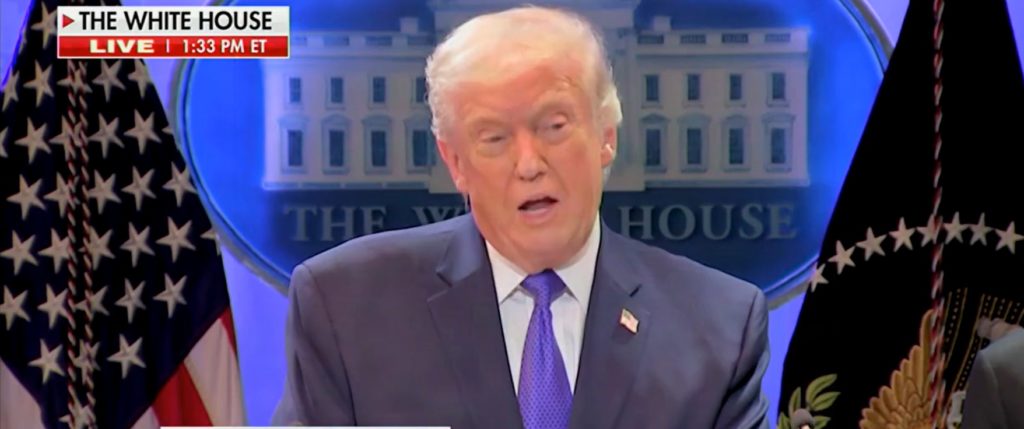
(Featured Image Media Credit: Screenshot/Rumble/Fox News)
All content created by the Daily Caller News Foundation, an independent and nonpartisan newswire service, is available without charge to any legitimate news publisher that can provide a large audience. All republished articles must include our logo, our reporter’s byline and their DCNF affiliation. For any questions about our guidelines or partnering with us, please contact [email protected].