



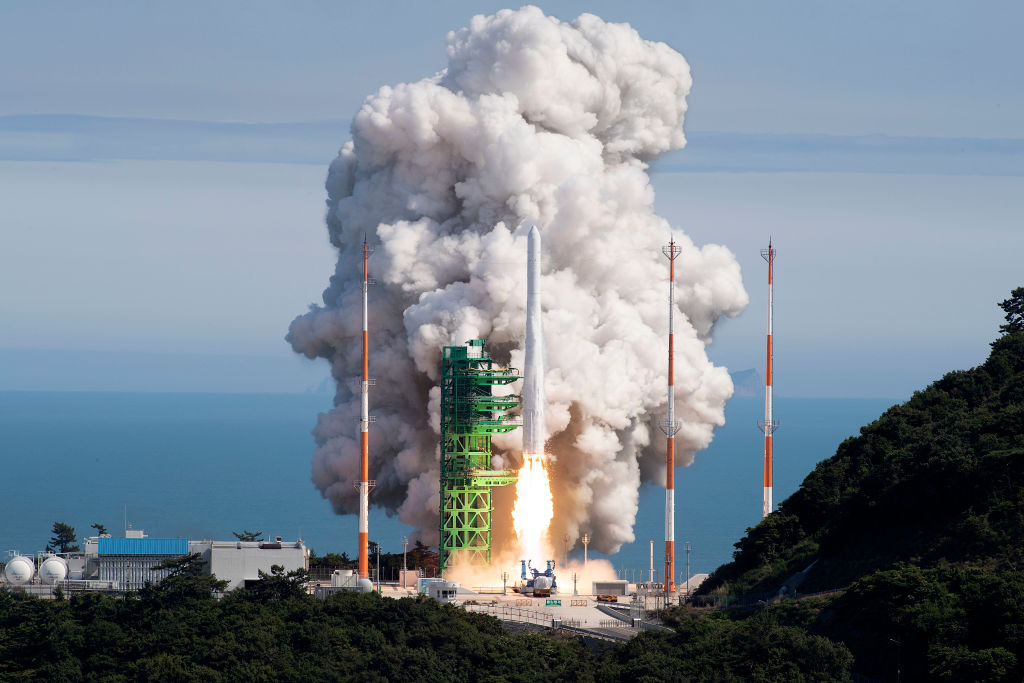
South Korea marked a significant milestone early Thursday with the launch of its largest satellite to date aboard its domestically built Nuri rocket.
According to The Associated Press, the three-stage rocket lifted off from the nation’s island-based spaceport in the southwestern coastal county of Goheung.
It is the fourth launch in South Korea’s six-mission plan set to run through 2027.
Aerospace officials monitored the rocket closely as it aimed to place a 516-kilogram (1,137-pound) science satellite into orbit, along with 12 microsatellites developed by universities and research teams.
The primary satellite is engineered to travel roughly 600 kilometers (372 miles) above Earth. It carries a wide-range airglow camera intended to capture auroral activity. It also includes dedicated systems to measure plasma, magnetic fields and to assess how life-science experiments perform in space.
The dozen smaller cube satellites each serve different missions. University teams and research institutions equipped them with tools such as GPS-based systems designed to analyze Earth’s atmosphere and infrared cameras built to track plastic pollution in the oceans.
Others carry technology for testing solar cells or communications equipment under space conditions.
Thursday’s flight marked the first time a Nuri rocket has launched since May 2023. During that previous mission, the rocket successfully deployed a 180-kilogram (397-pound) observation satellite into orbit.
The latest launch is the fourth overall since the rocket’s debut attempt in October 2021, when the vehicle reached its target altitude but failed to deliver a dummy payload.
The continued development and deployment of the Nuri rocket represent a major component of South Korea’s effort to expand its capabilities in space technology, scientific research, and satellite operations.












