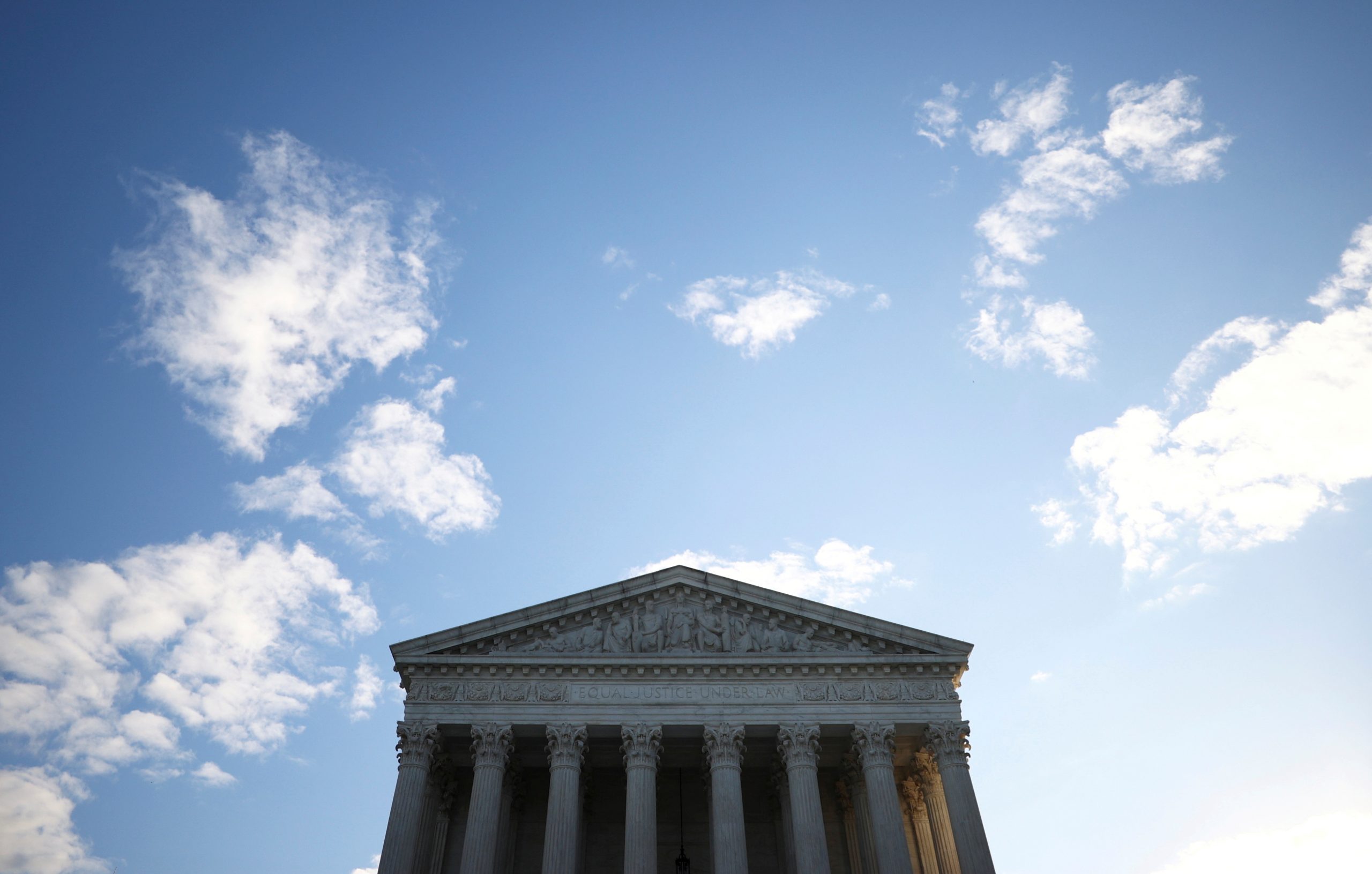




Liberals were left howling in rage Monday after one of the most controversial legal doctrines surrounding America’s police received a ringing endorsement from the U.S. Supreme Court.
Qualified immunity shields police officers from lawsuits that arise in the course of protecting the public unless they can be shown to have violated well-established rules or the Constitution.
Efforts to pass a police reform package in Congress this year foundered on Republicans’ refusal to pass a law wiping away that protection as progressives insisted upon it.
“Given that police violence, as a weapon of structural racism, continues to have devastating and deadly consequences for Black and brown lives across our country, we strongly urge you to not only maintain but strengthen the provision eliminating qualified immunity as negotiations in the Senate continue,” Democratic lawmakers, who included “squad” members Reps. Cori Bush of Missouri and Ayanna Pressley of Massachusetts, wrote in May, according to CNBC.
On Monday, in unsigned orders with no dissents, the Supreme Court ruled for the police in two cases that involved allegations of police misconduct, NBC News reported.
In a case from Union City, California, an officer was accused of excessive force when he put his knee on a man’s back while arresting him. The officer at the time was also trying to remove a knife from the man’s pocket.
In an Oklahoma case, two officers had been sued by the estate of a man they killed when he threatened them with a hammer in the city of Tahlequah.
“The doctrine of qualified immunity shields officers from civil liability so long as their conduct ‘does not violate clearly established statutory or constitutional rights of which a reasonable person would have known,'” the justices wrote in the Oklahoma ruling, according to Axios.
Qualified immunity protects “all but the plainly incompetent or those who knowingly violate the law,” said the opinion, which cited court precedent. It must be clear to “a reasonable officer that his conduct was unlawful in the situation he confronted,” the court said in that ruling.
The rulings sent liberals into spasms of anger.
Wrong just damn wrong. It gives them license to do whatever they want.
— Chris???? Moderate democrat. (@Cali3416) October 19, 2021
By shielding police officers from accountability, qualified immunity encourages more police violence against Black and Brown people. The Supreme Court remains unwilling to correct this injustice. Congress needs to pass my legislation to finally abolish qualified immunity. https://t.co/a0ePZrewjo
— Ed Markey (@SenMarkey) October 18, 2021
SCOTUS also doubled down on an extremely controversial aspect of its qualified immunity jurisprudence—the notion that a Fourth Amendment right is not “clearly established” unless there’s some very explicit precedent with nearly identical facts. This is bad news for QI opponents. pic.twitter.com/pGzt3Ppeps
— Mark Joseph Stern (@mjs_DC) October 18, 2021
The issue for critics of the doctrine, as noted by CNN, is that an officer could violate the Constitution but get away with it unless there have been clearly established rules in highly similar cases to say that the officer’s conduct was unconstitutional.
However, police officers say the protection is essential to fend off lawsuits that have no merit and allow them to respond to situations as they occur.
Police critics said new laws are needed to weaken the doctrine of qualified immunity.
“It is absolutely important for state houses to open up their courthouse doors to individuals with claims against officers,” said Anya Bidwell of the Institute for Justice, which opposes qualified immunity, according to The Washington Post.
Bidwell said the rulings were not a surprise.
“The Supreme Court has consistently over the years emphasized it would defer to law enforcement when it comes to split second decision-making,” Bidwell said.
Joanna Schwartz, a researcher at the University of California at Los Angeles, said the “two decisions taken together send a message that the Supreme Court is not interested in participating in the regulation of police.”
Jay Schweikert, a research fellow the Cato Institute who studies the issue, said, “Monday’s cases are further evidence that the Supreme Court is not going to reconsider the fundamentals of the doctrine and the justices are reaffirming the general idea that in most cases plaintiffs still need to find a nearly identical precedent to make their case.”
“This means that until and unless Congress addresses qualified immunity, public officials can continue to violate people’s rights with impunity,” Schweikert said, according to CNN.
“This represents a doubling-down by the Supreme Court on qualified immunity,” said Barry Friedman, founding director of New York University School of Law’s Policing Project.
“If the state rules were clearer there would be less of an application of qualified immunity,” Friedman said. “I don’t believe the Supreme Court will conclude that officers should be immune from liability even if they violate clearly established state statutes.
“Making those rules clear is a next step.”
Patrick Yoes, president of the National Fraternal Order of Police, said the decisions were “consistent with our deeply held beliefs and prior Supreme Court decisions.”
This article appeared originally on The Western Journal.