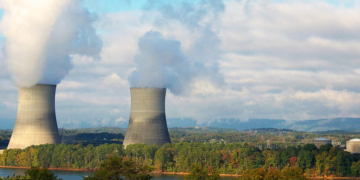


The Department of Energy’s (DOE) recently announced plan to work with state governments on nuclear research can open the door to a promising new energy landscape if policymakers take a “reality”-centered approach, analysts told the Daily Caller News Foundation.
The DOE sent out a request for information (RFI) Wednesday asking for state input on the possible creation of Nuclear Lifecycle Innovation Campuses, which would focus on fuel fabrication, enrichment, used nuclear material reprocessing or recycling, advanced separations, and the management of waste streams. Analysts told the DCNF that the RFI is a step in the right direction for strengthening America’s nuclear sector — though some highlighted the need for policymakers to avoid what they referred to as faulty science.
Steve Milloy, a biostatistician and founder and editor of JunkScience.com, told the DCNF that while these RFI goals are a step in the right direction, in order for the Trump administration to implement its nuclear power agenda, it will first have to address what he called “bad science” at the Environmental Protection Agency (EPA) and the Nuclear Regulatory Commission (NRC).
“There’s a lot of bad science in the EPA, at the NRC and that needs to be fixed and that needs to be fixed immediately and can be fixed immediately,” Milloy told the DCNF. “It’s just got to be done and they haven’t started doing it yet. They [Trump administration] need to appoint like a radiation science czar. There has got to be an inter-agency effort to get rid of this radiation risk model called the linear no threshold model, LNT, and come up with reasonable radiation standards … They just need to lay out and explain how people have been misled for decades [about radiation and nuclear power].”
Heritage Foundation Senior Research Fellow for Energy and Climate Policy Jack Spencer told the DCNF that the RFI’s flexibility provides a great framework for the states to step up and pursue policy they want according to their needs. Spencer also highlighted the RFI’s goal to make this initiative private sector led help make the RFI as another huge positive for developing nuclear policy.
“It sort of opens the door for almost anything,” Spencer told the DCNF. “It’s clear from the administration, since it’s been in place, that it’s very interested in moving nuclear forward and this is just their next step in doing that or [at least] trying to do that. I like [that] it’s very focused on the private sector. The [RFI] points out time and again, that this needs to be private sector.”
“What it’s [the RFI is] trying to do is lay out a vision. It’s not that it doesn’t define what that vision is. It doesn’t define what these campuses are. In fact, it says nothing in this that should be thought of as being comprehensive or exclusive,” Spencer added. “Tell us what you want to do and we want to help facilitate that. And consistent with the executive orders, it talks about what sort of regulatory reforms do you want to do? What can we do to help to make all of this stuff happen? So, I think it’s an interesting approach.”
The research fellow stated he has concerns about the public subsidies the RFI said it would use to help assist states that participate — but the focus on private sector initiatives makes him optimistic about the effort’s direction.
“The federal government is currently sitting on tens of billions of dollars that ratepayers have paid, for the federal government to dispose of nuclear waste, which it has not done and has utterly failed in that responsibility,” Spencer continued. “There’s certainly completely legitimate money to be used towards this end. When you talk about nuclear waste, the federal government is legally responsible for managing the 90,000 tons of waste that currently exists and I think that that’s an important bucket of money that, by law, needs to be used to managing that waste, and if a community wants to take on the responsibility of managing that waste, by all means, it should have access to that money.”
American Energy Institute CEO Jason Isaac told the DCNF that while states are doing better in welcoming nuclear power, policy makers must start aligning their standards to the reality of the situation regarding nuclear energy.
“Texas, and more recent proposals from other states, have taken important steps to welcome nuclear power,” said Isaac. “But policymakers must recognize that fuel cycle policy matters just as much as generation. The Department of Energy is now asking states to think holistically about nuclear energy, including fuel handling and long-term waste solutions. In Texas, current law blocks that kind of partnership. If states want to attract advanced reactors, private investment, and federal collaboration, their laws must align with reality, not outdated political fears.”
The DOE is seeking information from interested states about approaches that will prioritize private and state capital, rely on focused and limited federal support, and include robust financial assurances to protect federal taxpayers from open‑ended liabilities according to its RFI.
Republican Utah Gov. Spencer Cox announced he would be evaluating the DOE’s RFI to determine if it would align with Utah’s energy priorities before working with the DOE, according to Politico’s E&E News.
Cox’s office did not respond immediately to the DCNF’s request for comment about the governor’s evaluation.
President Donald Trump fired seven of the eight people on the Nuclear Waste Technical Review Board (NWTRB) in 2025, leaving only Chair Peter Swift. The NWTRB was created as a part of the Nuclear Waste Policy Act and was tasked to provide scientific reviews of DOE’s waste management, according to E&E News.
All content created by the Daily Caller News Foundation, an independent and nonpartisan newswire service, is available without charge to any legitimate news publisher that can provide a large audience. All republished articles must include our logo, our reporter’s byline and their DCNF affiliation. For any questions about our guidelines or partnering with us, please contact [email protected].