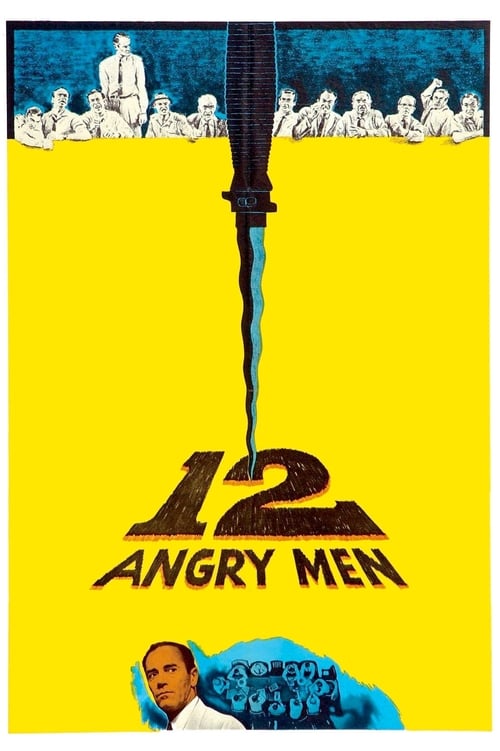
12 Angry Men is a 1957 American legal drama film directed by Sidney Lumet in his feature directorial debut, adapted by Reginald Rose from his 1954 teleplay. A critique of the American jury system during the McCarthy era, the film tells the story of a jury of twelve men as they deliberate the conviction or acquittal of a teenager charged with murder on the basis of reasonable doubt; disagreement and conflict among the jurors forces them to question their morals and values. It stars an ensemble cast, featuring Henry Fonda (who also produced the film with Rose), Lee J. Cobb, Ed Begley, E. G. Marshall, and Jack Warden.
An independent production distributed by United Artists, 12 Angry Men received acclaim from critics, despite a lukewarm box-office performance. At the 30th Academy Awards, it was nominated for Best Picture, Best Director and Best Screenplay. It is regarded by many as one of the greatest films ever made.
In 2007, it was selected for preservation in the United States National Film Registry by the Library of Congress as being "culturally, historically or aesthetically significant". Additionally, it was selected as the second-best courtroom drama ever (after 1962's To Kill a Mockingbird) by the American Film Institute for their AFI's 10 Top 10 list.
Contents
Plot
On a hot summer day in the New York County Courthouse, the trial has just concluded of an 18-year-old boy, characterized as a "slum kid", who is accused of killing his abusive father. The judge instructs the jury that if there is reasonable doubt, they must return a verdict of "not guilty". If found guilty by unanimous verdict, the defendant will receive a mandatory death sentence via the electric chair.
At first, the case seems clear. A neighbor who lives opposite testifies to having seen the defendant stab his father, as she lay in bed looking out of her window and through the windows of a passing elevated train into the apartment where the killing took place. A disabled neighbor living below testifies that he heard the defendant threaten to kill his father, then heard the body hitting the floor. He says that on going to his door and opening it, he saw the defendant running down the stairs. The defendant had recently purchased, but claims he had lost, a switchblade of the same type that was found at the murder scene, wiped of fingerprints.
In a preliminary vote, all jurors vote "guilty" except Juror 8, who wants discussion before any verdict. When his first few arguments – including proving that the switchblade, believed to be unique, is in fact not – fail to convince the other jurors, he suggests a secret ballot. This reveals one other "not guilty" vote; Juror 9 reveals that he, too, now agrees there should be more discussion.
Juror 8 argues that the noise of the passing train would have obscured everything the second witness claimed to have overheard. Several jurors question whether the death threat, even if correctly overheard, was simply a figure of speech. Juror 11 doubts that a defendant who was clear headed enough to wipe the blade of fingerprints would risk returning to the crime scene. Jurors 5 and 11 change their votes. After looking at a diagram of the second witness's apartment and conducting an experiment, the jurors determine that it was impossible for the disabled witness to have made it to the door in the time he stated. Infuriated at a comment made by Juror 8, Juror 3 lunges at him and threatens to kill him; all go silent as they realize his words cannot reasonably be taken literally. Jurors 2 and 6 change their votes; the jury is now evenly split.
The victim's stab wound was angled downwards. Juror 5, who has had personal experience with switchblades, points out that such blades are designed to be thrust upwardly, and that a downward thrust from a shorter, experienced assailant is inconceivable, as it would have required the blade to have been repositioned in the killer's hand. Jurors 7, 12 and 1 change their votes, leaving the jurors split 9:3. Juror 10 delivers a prejudiced rant against people from slum backgrounds, and the other jurors distance themselves from him.
Cast
Other, uncredited actors in the film include Rudy Bond as the judge, Tom Gorman as the court stenographer, James Kelly as the bailiff, Billy Nelson as the clerk, and John Savoca as the defendant.
Themes
Professor of Law Emeritus at UCLA School of Law Michael Asimow referred to the film as a "tribute to a common man holding out against lynch mob mentality". Gavin Smith of Film Comment called the film "a definitive rebuttal to the lynch mob hysteria of the McCarthy era".
Business academic Phil Rosenzweig called the jury in 12 Angry Men being made up entirely of white men "especially important", writing: "Many of the twelve would have looked around the room, and, seeing other white men, assumed that they had much in common and should be able to reach a verdict without difficulty. As they deliberate, however, fault lines begin to appear—by age, by education, by national origin, by socioeconomic level, by values, and by temperament."
Production
Development
Reginald Rose's screenplay for 12 Angry Men, titled Twelve Angry Men, was initially produced for television and was inspired by a jury summons. Although it is unclear what trial he was summoned to, according to Rose, in early 1954, he served as a juror on a manslaughter case in the New York Court of General Sessions. Though he and the other eleven jurors initially attended begrudgingly, Rose was deeply affected by the impassioned and deliberate atmosphere of the trial and the finality of his and the jury's verdict. Rose began writing Twelve Angry Men upon realizing that very few people knew what occurred during jury deliberations and that they could serve as an exciting setting for a drama. While writing the screenplay, Rose cut planned passages of dialogue to account for a fifty-minute time slot on television, leading to the characters to be less nuanced. A live production of "Twelve Angry Men", directed by Franklin Schaffner and starring Robert Cummings as Juror 8 and Franchot Tone as Juror 3, was broadcast on the CBS program Westinghouse Studio One on September 20, 1954, to positive reviews. It received four nominations for the 7th Primetime Emmy Awards, winning three on March 7, 1955: "Best Actor in a Single Performance", "Best Direction", and "Best Written Dramatic Material".
In February 1955, actor Henry Fonda formed Orion Productions under a three-year deal with distributor United Artists. He reportedly first saw Westinghouse Studio One's "Twelve Angry Men" as a kinescope in a Hollywood projection room following its success in the 7th Primetime Emmy Awards. He was impressed with the story and wanted to star as Juror 8. In mid-1956, Fonda partnered with Rose to produce a film adaptation of 12 Angry Men. As part of the partnership, Rose formed Nova Productions and combined it with Fonda's Orion Productions to form Orion-Nova Productions, and production of the film was budgeted at $340,000. To develop the screenplay and characters, Rose restored material he had cut for the broadcast and added dialogue that revealed character's backgrounds and motivations.
Fonda and Rose recruited Sidney Lumet to direct 12 Angry Men, his film directorial debut. Lumet had previously directed numerous episodes, including adaptations of Rose's plays, for TV series such as Danger and You Are There. Fonda said he hired Lumet because of his proficient directing skills and because he was "wonderful with actors". Lumet recruited Boris Kaufman as the cinematographer. Kaufman had recently won an Academy Award for Best Cinematography for On the Waterfront (1954), and Lumet believed Kaufman's "realist style" suited the film.
Filming
The film was shot in New York and completed after a short but rigorous rehearsal schedule, in less than three weeks, on a budget of $337,000 (equivalent to $3,863,000 in 2025). Fonda said in 1957, "We shot this picture in 21 days, for $40,000 less than our modest $380,000 budget....we rehearsed for two weeks before even a thought of shooting. Everybody had a firm idea of what he was to say and do." Rose and Fonda took salary deferrals. Faith Hubley, later to be known for her Oscar-winning animated efforts with spouse John, was script supervisor for the film.
Cinematographer Boris Kaufman described the film's longest single take beginning under the opening credits: "The opening scene was the longest single take I have ever done in all my years as a cinematographer. It ran for seven consecutive minutes. It was made up of 18 separate camera movements which actually showed 18 basic fact situations. It also established the basic style and mood of the picture. During the seven-minute take the camera introduces the twelve men in a very casual way as they bump into each other and exchange casual remarks which are not at all related to the case on trial. Yet in this way each character immediately begins to relate to every other man in the room and to the story."
The film was shot out-of sequence and without all 12 actors always present, as director Lumet explained: "When you shoot a movie that is nothing by 12 men's faces as they talk angrily to one another and you shoot it out of sequence and the camera is being moved from one angle to another around a room, then you go elaborately nuts trying to be consistent about who is looking where and at whom. In making 'Angry Men' the camera went around the table, shooting chair by chair. Once lights and cameras were pointed at a chair, then every speech, no matter its order in the movie, was shot. That meant that often you had only two or three actors in or near chairs, talking and arguing across the table with actors who were not there. You had to figure out where the nonexistent actor's eyes would be, so that the existent actor could stare him down. I spent nights puzzling the problem and my script became a maze of diagrams. We had arguments on the set as people tried to explain to me that I was crazy. But the diagrams came out right 396 times in 397 scenes. One we had to reshoot because I had the stockbroker looking the wrong way as he spoke to another actor." Fonda described the efficient filming similarly: "Normally, setup is worked out carefully, the scene is shot and there's a long lull while the next setup is being made. Not this time. With the camera positioned for, say, Scene 24, Lumet shot that one, and followed it immediately with Scenes 82, 105, or whatever others called for the same placement of the camera. Rehearsals, of course, had made everyone totally familiar with every scene in the picture."
Reception
Box office
The film was a box office disappointment in the US but did better internationally. The advent of color and widescreen productions may have contributed to its disappointing box office performance. It was not until its first airing on television that the film finally found its audience.
Contemporary response
On its first release, 12 Angry Men received critical acclaim.
A. H. Weiler of The New York Times wrote, "It makes for taut, absorbing, and compelling drama that reaches far beyond the close confines of its jury room setting." His observation of the twelve men was that "their dramas are powerful and provocative enough to keep a viewer spellbound." Variety called it an "absorbing drama" with acting that was "perhaps the best seen recently in any single film", adding: "Perhaps the motivations of each juror are introduced too quickly and are repeated too often [...] However, the film leaves a tremendous impact." Philip K. Scheuer of the Los Angeles Times declared it a "tour de force in movie making", The Monthly Film Bulletin deemed it "a compelling and outstandingly well-handled drama", and John McCarten of The New Yorker called it "a fairly substantial addition to the celluloid landscape". The Chicago Tribune reviewer thought the script "one of the best constructed and tautly written of the year....[Reginald Rose's] gift for reproducing the present day idiom adds to the validity of his 12 subjects as they struggle to reach common ground."
Legacy
The film is viewed as a classic, highly regarded from both a critical and popular viewpoint: Roger Ebert listed it as one of his "Great Movies". The American Film Institute named Juror 8, played by Henry Fonda, 28th in a list of the 50 greatest movie heroes of the 20th century. AFI also named 12 Angry Men the 42nd-most inspiring film, the 88th-most heart-pounding film and the 87th-best film of the past hundred years. In 2011, the film was one of the top 20 most screened films in secondary schools in the United Kingdom. The February 2020 issue of New York Magazine lists 12 Angry Men as among "The Best Movies That Lost Best Picture at the Oscars". As of March 2023, the film holds a 100% approval rating on Rotten Tomatoes based on 61 reviews, with a weighted average of 9.10/10. The site's consensus reads: "Sidney Lumet's feature debut is a superbly written, dramatically effective courtroom thriller that rightfully stands as a modern classic". Metacritic, which uses a weighted average, assigned the film a score of 97 out of 100, based on 18 critics, indicating "universal acclaim". As of May 2026, the film is the 3rd highest rated narrative feature film on Letterboxd with an average rating of 4.6/5.
Awards and nominations
The film was selected as the second-best courtroom drama ever by the American Film Institute during their AFI's 10 Top 10 list, just after To Kill a Mockingbird, and is the highest rated courtroom drama on Rotten Tomatoes' 300 Best Movies of All Time.
American Film Institute lists:
AFI's 100 Years...100 Thrills – No. 88
AFI's 100 Years...100 Heroes & Villains: Juror No. 8 – No. 28 Hero
AFI's 100 Years...100 Cheers – No. 42
AFI's 100 Years...100 Movies (10th Anniversary Edition) – No. 87
AFI's 10 Top 10 – No. 2 Courtroom Drama
Legal analyses
Speaking at a screening of the film during the 2010 Fordham University School of Law Film Festival, Supreme Court Justice Sonia Sotomayor stated that seeing 12 Angry Men while she was in college influenced her decision to pursue a career in law. She was particularly inspired by immigrant Juror 11's monologue on his reverence for the American justice system. She also told the audience of law students that, as a lower-court judge, she would sometimes instruct juries to not follow the film's example, because most of the jurors' conclusions are based on speculation, not fact. Sotomayor noted that events such as Juror 8 entering a similar knife into the proceeding; performing outside research into the case matter in the first place; and ultimately the jury as a whole making broad, wide-ranging assumptions far beyond the scope of reasonable doubt (such as the inferences regarding the woman wearing glasses) would not be allowed in a real-life jury situation, and in fact would have yielded a mistrial (assuming that applicable law permitted the content of jury deliberations to be revealed).
In 2007, legal scholar Michael Asimow argued that the jury in 12 Angry Men reached an incorrect verdict, writing that the amount of circumstantial evidence against the defendant should have been enough to convict him, even if the testimony of the two eyewitnesses was disregarded.
In the same year, drawing on empirical research, legal scholar Valerie Hans noted that while 12 Angry Men's depiction of a lone dissenter converting the majority is rare in reality, the film accurately portrays how quality deliberation, diverse perspectives, and the unanimity requirement can enable thoughtful dissenters to meaningfully influence jury outcomes, particularly when arguing for acquittal.
In 2012, Mike D'Angelo of The A.V. Club questioned the verdict of the jury in the film, writing: "What ensures The Kid's guilt for practical purposes, [...] is the sheer improbability that all the evidence is erroneous. You'd have to be the jurisprudential inverse of a national lottery winner to face so many apparently damning coincidences and misidentifications. Or you'd have to be framed [...] But there's no reason offered in 12 Angry Men for why, say, the police would be planting switchblades."
Adaptations and parodies
There have been a number of adaptations of 12 Angry Men owing to its popularity and legacy.
Following the film's release, the stage rights were sold. It quickly became a popular play in Europe, including in a French version by Andre Obey, which was a hit in Paris in 1958, and a German version by Horst Budjuhn. It has been very popular on stage, in part due to its single location. Rose also created a stage version himself.
A 1963 German TV production, Die zwölf Geschworenen, was directed by Günter Gräwert, and a 1973 Spanish production, Doce hombres sin piedad, was made for TV 22 years before Spain allowed jury trials, while a 1991 homage by Kōki Mitani, 12 gentle Japanese (Japanese: 12人の優しい日本人, Hepburn: Juninin no Yasashii Nihonjin), posits a Japan with a jury system and features a group of Japanese people grappling with their responsibility in the face of Japanese cultural norms.
A 1970 episode of The Odd Couple television series (also co-starring Jack Klugman) entitled "The Jury Story" is reminiscent of 12 Angry Men, as it tells in a flashback the circumstances behind the meeting of roommates Oscar Madison and Felix Unger. Klugman (Madison) plays a juror on a panel during a supposedly open-and-shut case. Co-star Tony Randall (Unger) portrays the lone holdout who votes not guilty, eventually convincing the other eleven jurors.
A 1978 episode of Happy Days entitled "Fonzie for the Defense" contains a situation similar to 12 Angry Men when Howard Cunningham and Fonzie find themselves the only members of the jury who are not ready to convict the defendant just because he rides a motorcycle.
A 1986 episode of Murder, She Wrote entitled "Trial by Error" pays tribute to 12 Angry Men. The major twists are originally 10 jurors vote for "not guilty" due to self defense, Jessica votes "unsure" and another juror votes "guilty". Jessica and other jurors recall the evidence, as more and more jurors switch from "not guilty due to self defense" and come to a realization as to what actually occurred the night of the murder.
The 1986 Hindi film Ek Ruka Hua Faisla ("a pending decision") and 2012 Kannada film Dashamukha ("ten faces") are Indian remakes of the film, with almost identical storylines. The former has been adapted as another Indian Bengali film Shotyi Bole Shotyi Kichhu Nei which was released in January 2025.