





Advanced Micro Devices, Inc. (AMD) is an American multinational semiconductor company headquartered in Santa Clara, California. It develops central processing units (CPUs), graphics processing units (GPUs), field-programmable gate arrays (FPGAs), system-on-chips (SoCs), and high-performance computer components. AMD serves a wide range of business and consumer markets, including personal computers (PCs), gaming, data centers, and embedded systems.
AMD's main products include microprocessors, embedded processors, and graphics processors for servers, workstations, PCs, and embedded system applications, as well as chipsets for motherboards. The company has also expanded into new markets, such as data centers, gaming, and high-performance computing. AMD's processors are used in a wide range of computing devices, including PCs, servers, laptops, and gaming consoles. Initially manufacturing its own processors, the company outsourced its manufacturing after GlobalFoundries was spun off in 2009. Through its Xilinx acquisition in 2022, AMD offers field-programmable gate array (FPGA) products.
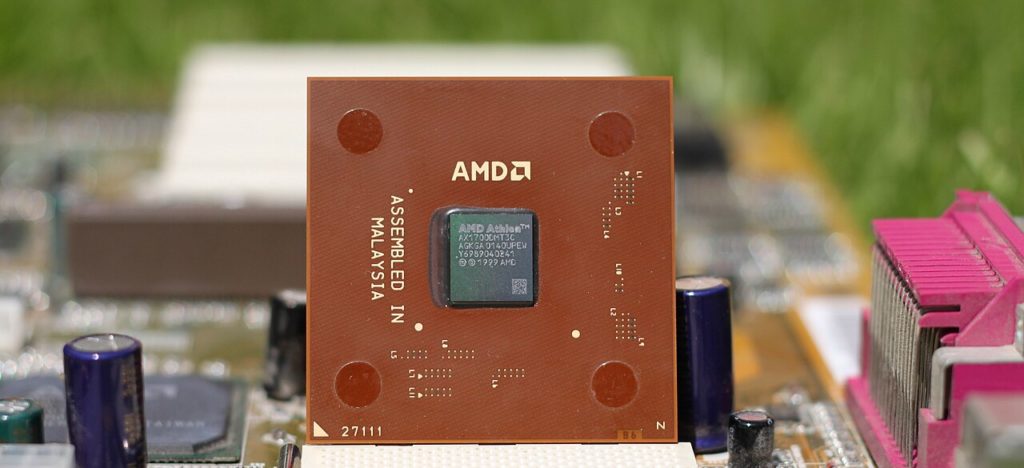
AMD was founded in 1969 by Jerry Sanders and a group of his fellow Fairchild Semiconductor colleagues. The company's early products were primarily memory chips and other computer components. In 1975, AMD entered the microprocessor market, competing with Intel, its main rival in the industry, by reverse-engineering Intel's 8080. This led to the initial cross-license agreement allowing AMD to build legal clones of Intel processors, including the x86 family of processors from 1981. The two companies fought a seven-year legal battle after Intel refused to share the blueprint of their i386 with AMD, ending in the latter's favor in 1994 but requiring AMD to develop their own x86 microprocessors in-house. In the early 2000s, AMD experienced significant growth and success, partly due to its strong position in the PC market and its Athlon and Opteron processors. The company faced challenges in the late 2000s and early 2010s, as it struggled to compete with Intel.
In the late 2010s, AMD regained market share by pursuing a penetration pricing strategy for its Ryzen processors, offering a competitive performance and lower costs than Intel microprocessors. In 2022, AMD surpassed Intel by market capitalization for the first time.
Contents
History
Foundational years
Advanced Micro Devices was formally incorporated by Jerry Sanders, along with seven of his colleagues from Fairchild Semiconductor—Ed Turney; John Carey; Sven Simonsen; Jack Gifford, and three members of his team: Frank Botte, Jim Giles, and Larry Stenger, on May 1, 1969. Sanders, an electrical engineer who was the director of marketing at Fairchild, had, like many of its executives, grown frustrated with the increasing lack of support, opportunity, and flexibility within the company. He later decided to leave to start his own semiconductor company, following the footsteps of Robert Noyce (developer of the first silicon integrated circuit at Fairchild in 1959) and Gordon Moore, who together founded the semiconductor company Intel in July 1968.
In September 1969, AMD moved from its temporary location in Santa Clara to its new $500,000 15,000sqft headquarters at 901 Thompson Place, Sunnyvale, which housed the entire company, including the 8-mask, 7 μm feature size, 2-inch diameter wafer production. To immediately secure a customer base, AMD initially became a second source supplier of microchips designed by Fairchild (the 5 V TTL "9300" logic series) and National Semiconductor. AMD first focused on producing logic chips. The company guaranteed quality control to United States Military Standard, an advantage in the early computer industry since unreliability in microchips was a distinct problem that customers – including computer manufacturers, the telecommunications industry, and instrument manufacturers – wanted to avoid.
In November 1969, the company manufactured its first product: the Am9300, a 4-bit MSI shift register, which began selling in 1970. Also in 1970, AMD produced its first proprietary product, the Am2501 logic counter, which was highly successful. Its bestselling product in 1971 was the Am2505, the fastest multiplier available.
In 1971, AMD entered the RAM chip market, beginning with the Am3101, a 64-bit bipolar RAM. That year AMD also greatly increased the sales volume of its linear integrated circuits, and by year-end the company's total annual sales reached US$4.6 million.
AMD went public in September 1972. The company was a second source for Intel MOS/LSI circuits by 1973, with products such as Am14/1506 and Am14/1507, dual 100-bit dynamic shift registers. By 1975, AMD was producing 212 products – of which 49 were proprietary, including the Am9102 (a static N-channel 1024-bit RAM) and three low-power Schottky MSI circuits: Am25LS07, Am25LS08, and Am25LS09.
Intel partnership
Intel had introduced the first x86 microprocessors in 1978. In 1981, IBM created its personal computer, and wanted Intel's x86 processors, but only under the condition that Intel would also provide a second-source manufacturer for its patented x86 microprocessors. Intel and AMD entered into a 10-year technology exchange agreement, first signed in October 1981 and formally executed in February 1982. The terms of the agreement were that each company could acquire the right to become a second-source manufacturer of semiconductor products developed by the other; that is, each party could "earn" the right to manufacture and sell a product developed by the other, if agreed to, by exchanging the manufacturing rights to a product of equivalent technical complexity. The technical information and licenses needed to make and sell a part would be exchanged for a royalty to the developing company. The 1982 agreement also extended the 1976 AMD–Intel cross-licensing agreement through 1995. The agreement included the right to invoke arbitration of disagreements, and after five years the right of either party to end the agreement with one year's notice. The main result of the 1982 agreement was that AMD became a second-source manufacturer of Intel's x86 microprocessors and related chips, and Intel provided AMD with database tapes for its 8086, 80186, and 80286 chips. However, in the event of a bankruptcy or takeover of AMD, the cross-licensing agreement would be effectively canceled.
Beginning in 1982, AMD began volume-producing second-source Intel-licensed 8086, 8088, 80186, and 80188 processors, and by 1984, its own Am286 clone of Intel's 80286 processor, for the rapidly growing market of IBM PCs and IBM clones. It also continued its successful concentration on proprietary bipolar chips.
The company continued to spend greatly on research and development, and created the world's first 512K EPROM in 1984. That year, AMD was listed in the book The 100 Best Companies to Work for in America, and later made the Fortune 500 list for the first time in 1985.
By mid-1985, the microchip market experienced a severe downturn, mainly due to long-term aggressive trade practices (dumping) from Japan, but also due to a crowded and non-innovative chip market in the United States. AMD rode out the mid-1980s crisis by aggressively innovating and modernizing, devising the Liberty Chip program of designing and manufacturing one new chip or chipset per week for 52 weeks in fiscal year 1986, and by heavily lobbying the U.S. government until sanctions and restrictions were put in place to prevent predatory Japanese pricing. During this time, AMD withdrew from the DRAM market, and made some headway into the CMOS market, which it had lagged in entering, having focused instead on bipolar chips.
2006–2019
On July 24, 2006, AMD announced its acquisition of the Canadian 3D graphics card company ATI Technologies. AMD paid $4.3 billion and 58 million shares of its capital stock, for approximately $5.4 billion. The transaction was completed on October 25, 2006. On August 30, 2010, AMD announced that it would retire the ATI brand name for its graphics chipsets in favor of the AMD brand name.
In October 2008, AMD announced plans to spin off manufacturing operations in the form of GlobalFoundries Inc., a multibillion-dollar joint venture with Advanced Technology Investment Co., an investment company formed by the government of Abu Dhabi. The partnership and spin-off gave AMD an infusion of cash and allowed it to focus solely on chip design. To assure the Abu Dhabi investors of the new venture's success, AMD's CEO Hector Ruiz stepped down in July 2008, while remaining executive chairman, in preparation for becoming chairman of GlobalFoundries in March 2009. President and COO Dirk Meyer became AMD's CEO. Recessionary losses necessitated AMD cutting 1,100 jobs in 2009.
In August 2011, AMD announced that former Lenovo executive Rory Read would be joining the company as CEO, replacing Meyer. In November 2011, AMD announced plans to lay off more than 10% (1,400) of its employees from across all divisions worldwide. In October 2012, it announced plans to lay off an additional 15% of its workforce to reduce costs in the face of declining sales revenue. The inclusion of AMD chips into the PlayStation 4 and Xbox One were later seen as saving AMD from bankruptcy.
AMD acquired the low-power server manufacturer SeaMicro in early 2012, with an eye to bringing out an Arm64 server chip.
On October 8, 2014, AMD announced that Rory Read had stepped down after three years as president and chief executive officer. He was succeeded by Lisa Su, a key lieutenant who had been chief operating officer since June.
On October 16, 2014, AMD announced a new restructuring plan along with its Q3 results. Effective July 1, 2014, AMD reorganized into two business groups: Computing and Graphics, which primarily includes desktop and notebook processors and chipsets, discrete GPUs, and professional graphics; and Enterprise, Embedded, and Semi-Custom, which primarily includes server and embedded processors, dense servers, semi-custom SoC products (including solutions for gaming consoles), engineering services, and royalties. As part of this restructuring, AMD announced that 7% of its global workforce would be laid off by the end of 2014.
2020–present
In October 2020, AMD announced that it was acquiring Xilinx, the market leader in field-programmable gate arrays and complex programmable logic devices (FPGAs and CPLDs) in an all-stock transaction. The acquisition was completed in February 2022, with an estimated acquisition price of $50 billion.
In January 2024, AMD announced it was discontinuing the production of all complex programmable logic devices (CPLDs) acquired through Xilinx.
In March 2024, a rally in semiconductor stocks pushed AMD's valuation above $300B for the first time.
In July 2024, AMD announced that it would acquire the Finnish-based artificial intelligence start-up company Silo AI in a $665 million all-cash deal in an attempt to better compete with AI chip market leader Nvidia.
In August 2024, AMD signed a deal to acquire ZT Systems for $4.9 billion. The company creates custom computing infrastructure that is used for AI tasks.
Since early 2024, AMD has made significant gains in the server CPU market, reducing the gap with Intel. Initial reports of a 50:50 market split drew on incorrect data and were later revised. As of July 2025, Intel holds 63.3% of the server CPU market, while AMD has reached 36.5%, showing a strong upward trend for AMD despite Intel's continuing lead.
In June 2025, AMD unveiled the AI server for 2026, the MI400 series of chips, which will be the basis of a new server called "Helios".
In October 2025, the company announced it had agreed a deal with OpenAI to sell six gigawatts of its AI processors over the next five years. As part of the deal, OpenAI has the option to acquire a 10 per cent stake in AMD: 160 million shares at a token price of $0.01 per share contingent on meeting undisclosed performance targets, the final tranche of options requiring AMD common stock to reach $600 per share.
Products
CPUs and APUs
In February 1982, AMD signed a contract with Intel, becoming a licensed second-source manufacturer of 8086 and 8088 processors. IBM wanted to use the Intel 8088 in its IBM PC, but its policy at the time was to require at least two sources for its chips. AMD later produced the Am286 under the same arrangement. In 1984, Intel internally decided to no longer cooperate with AMD in supplying product information to shore up its advantage in the marketplace, and delayed and eventually refused to convey the technical details of the Intel 80386. In 1987, AMD invoked arbitration over the issue, and Intel reacted by canceling the 1982 technological-exchange agreement altogether. After three years of testimony, AMD eventually won in arbitration in 1992, but Intel disputed this decision. Another long legal dispute followed, ending in 1994 when the Supreme Court of California sided with the arbitrator and AMD.
In 1990, Intel countersued AMD, renegotiating AMD's right to use derivatives of Intel's microcode for its cloned processors. In the face of uncertainty during the legal dispute, AMD was forced to develop clean room designed versions of Intel code for its x386 and x486 processors, the former long after Intel had released its own x386 in 1985. In March 1991, AMD released the Am386, its clone of the Intel 386 processor. By October of the same year it had sold one million units.
In 1993, AMD introduced the first of the Am486 family of processors, which proved popular with a large number of original equipment manufacturers, including Compaq, which signed an exclusive agreement using the Am486. The Am5x86, another Am486-based processor, was released in November 1995, and continued AMD's success as a fast, cost-effective processor.
Finally, in an agreement effective 1996, AMD received the rights to the microcode in Intel's x386 and x486 processor families, but not the rights to the microcode in the following generations of processors.
AMD's first in-house x86 processor was the K5, launched in 1996. The "K" in its name was a reference to Kryptonite, the only substance known to harm comic book character Superman. This itself was a reference to Intel's hegemony over the market, i.e., an anthropomorphization of them as Superman. The number "5" was a reference to the fifth generation of x86 processors; rival Intel had previously introduced its line of fifth-generation x86 processors as Pentium because the U.S. Trademark and Patent Office had ruled that mere numbers could not be trademarked.
Graphics products and GPUs
Lee Ka Lau, Francis Lau, Benny Lau, and Kwok Yuen Ho founded ATI in 1985 as Array Technology Incorporated, renamed later Array Technologies Incorporated and finally ATI Technologies.
Working primarily in the OEM field, ATI produced integrated graphics cards for PC manufacturers such as IBM and Commodore. By 1987, ATI had grown into an independent graphics-card retailer, introducing EGA Wonder and VGA Wonder card product lines that year. In the early nineties, they released products able to process graphics without the CPU: in May 1991, the Mach8, in 1992 the Mach32, which offered improved memory bandwidth and GUI acceleration. ATI Technologies went public in 1993, with shares listed on NASDAQ and on the Toronto Stock Exchange.
In 1994, the Mach64 accelerator debuted, powering the Graphics Xpression and Graphics Pro Turbo, offering hardware support for YUV-to-RGB colour space conversion in addition to hardware zoom; early techniques of hardware-based video acceleration.
ATI introduced its first combination of 2D and 3D accelerator under the name 3D Rage. This chip was based on the Mach 64, but it featured elemental 3D acceleration. The ATI Rage line powered almost the entire range of ATI graphics products. In particular, the Rage Pro was one of the first viable 2D-plus-3D alternatives to 3dfx's 3D-only Voodoo chipset. 3D acceleration in the Rage line advanced from the basic functionality within the initial 3D Rage to a more advanced DirectX 6.0 accelerator in 1999 Rage 128.
The All-in-Wonder product line, introduced in 1996, was the first combination of integrated graphics chip with TV tuner card and the first chip that enabled display of computer graphics on a TV set. The cards featured 3D acceleration powered by ATI's 3D Rage II, 64-bit 2D performance, TV-quality video acceleration, analogue video capture, TV tuner functionality, flicker-free TV-out and stereo TV audio reception.
ATI entered the mobile computing sector by introducing 3D-graphics acceleration to laptops in 1996. The Mobility product line had to meet requirements different from those of desktop PCs, such as minimized power usage, reduced heat output, TMDS output capabilities for laptop screens, and maximized integration. In 1997, ATI acquired Tseng Labs's graphics assets, which included 40 engineers.
Semi-custom and game console products
In 2012, AMD's then CEO Rory Read began a program to offer semi-custom designs. Rather than AMD simply designing and offering a single product, potential customers could work with AMD to design a custom chip based on AMD's intellectual property. Customers pay a non-recurring engineering fee for design and development, and a purchase price for the resulting semi-custom products. In particular, AMD noted its unique position of offering both x86 and graphics intellectual property. These semi-custom designs would have design wins as the APUs in the PlayStation 4 and Xbox One and the subsequent PlayStation 4 Pro, Xbox One S, Xbox One X, Xbox Series X/S, and PlayStation 5. Financially, these semi-custom products would represent a majority of the company's revenue in 2016. In November 2017, AMD and Intel announced that Intel would market a product combining in a single package an Intel Core CPU, a semi-custom AMD Radeon GPU, and HBM2 memory.
Other hardware
Before the launch of Athlon 64 processors in 2003, AMD designed chipsets for its processors spanning the K6 and K7 processor generations. The chipsets include the AMD-640, AMD-751, and the AMD-761 chipsets. The situation changed in 2003 with the release of Athlon 64 processors, and AMD chose not to further design its own chipsets for its desktop processors while opening the desktop platform to allow other firms to design chipsets. This was the "Open Platform Management Architecture" with ATI, VIA and SiS developing its own chipset for Athlon 64 processors and later Athlon 64 X2 and Athlon 64 FX processors, including the Quad FX platform chipset from Nvidia.
The initiative went further with the release of Opteron server processors as AMD stopped the design of server chipsets in 2004 after releasing the AMD-8111 chipset, and again opened the server platform for firms to develop chipsets for Opteron processors. As of today, Nvidia and Broadcom are the sole designing firms of server chipsets for Opteron processors.
As the company completed the acquisition of ATI Technologies in 2006, the firm gained the ATI design team for chipsets which previously designed the Radeon Xpress 200 and the Radeon Xpress 3200 chipsets. AMD then renamed the chipsets for AMD processors under AMD branding (for instance, the CrossFire Xpress 3200 chipset was renamed as AMD 580X CrossFire chipset). In February 2007, AMD announced the first AMD-branded chipset since 2004 with the release of the AMD 690G chipset (previously under the development codename RS690), targeted at mainstream IGP computing. It was the industry's first to implement a HDMI 1.2 port on motherboards, shipping for more than a million units. While ATI had aimed at releasing an Intel IGP chipset, the plan was scrapped and the inventories of Radeon Xpress 1250 (codenamed RS600, sold under ATI brand) was sold to two OEMs, Abit and ASRock. Although AMD stated the firm would still produce Intel chipsets, Intel had not granted the license of 1333 MHz FSB to ATI.
On November 15, 2007, AMD announced a new chipset series portfolio, the AMD 7-Series chipsets, covering from the enthusiast multi-graphics segment to the value IGP segment, to replace the AMD 480/570/580 chipsets and AMD 690 series chipsets, marking AMD's first enthusiast multi-graphics chipset. Discrete graphics chipsets were launched on November 15, 2007, as part of the codenamed Spider desktop platform, and IGP chipsets were launched at a later time in spring 2008 as part of the codenamed Cartwheel platform.
Current product lines
AMD's portfolio of CPUs and APUs as of 2020
Athlon – brand of entry level CPUs (Excavator) and APUs (Ryzen)
A-series – Excavator-class consumer desktop and laptop APUs
G-series – Excavator- and Jaguar-class low-power embedded APUs
Ryzen – brand of consumer CPUs and APUs
Ryzen Threadripper – brand of prosumer/professional CPUs
R-series – Excavator class high-performance embedded APUs
Epyc – brand of server CPUs
Opteron – brand of microserver APUs
AMD's portfolio of dedicated graphics processors as of 2017
Radeon – brand for consumer line of graphics cards; the brand name originated with ATI.
Mobility Radeon offers power-optimized versions of Radeon graphics chips for use in laptops.
Radeon Pro – Workstation graphics card brand. Successor to the FirePro brand.
Radeon Instinct – brand of server and workstation targeted machine learning and GPGPU products
Radeon-branded products
In 2011, AMD began selling Radeon branded DDR3 SDRAM to support the higher bandwidth needs of AMD's APUs. While the RAM is sold by AMD, it was manufactured by Patriot Memory and VisionTek. This was later followed by higher speeds of gaming oriented DDR3 memory in 2013. Radeon branded DDR4 SDRAM memory was released in 2015, despite no AMD CPUs or APUs supporting DDR4 at the time. AMD noted in 2017 that these products are "mostly distributed in Eastern Europe" and that it continues to be active in the business.
AMD announced in 2014 that it would sell Radeon branded solid-state drives manufactured by OCZ with capacities up to 480 GB and using the SATA interface.
Technologies
CPU hardware
As of 2017 technologies found in AMD CPU/APU and other products include:
HyperTransport – a high-bandwidth, low-latency system bus used in AMD's CPU and APU products
Infinity Fabric – a derivative of HyperTransport used as the communication bus in AMD's Zen microarchitecture
Graphics hardware
As of 2017 technologies found in AMD GPU products include:
AMD Eyefinity – facilitates multi-monitor setup of up to 6 monitors per graphics card
AMD FreeSync – display synchronization based on the VESA Adaptive Sync standard
AMD TrueAudio – acceleration of audio calculations
AMD XConnect – allows the use of External GPU enclosures through Thunderbolt 3
AMD CrossFire – multi-GPU technology allowing the simultaneous use of multiple GPUs
Unified Video Decoder (UVD) – acceleration of video decompression (decoding)
Video Coding Engine (VCE) – acceleration of video compression (encoding)
Software
AMD has taken actions towards opening its software tools above the firmware level in the past decade.
Software not explicitly stated as being free can be assumed to be proprietary.
AMD Radeon Software is the default channel for official software distribution from AMD. It includes both free and proprietary software components, and supports both Microsoft Windows and Linux.
AOCC is AMD's optimizing proprietary C/C++ compiler based on LLVM and available for Linux.
AMDuProf is AMD's CPU performance and Power profiling tool suite, available for Linux and Windows.
AMD has also taken an active part in developing coreboot, an open-source project aimed at replacing the proprietary BIOS firmware. This cooperation ceased in 2013, but AMD has indicated recently that it is considering releasing source code so that Ryzen can be compatible with coreboot in the future.
Most notable public AMD software is on the GPU side.
AMD has opened both its graphic and compute stacks:
GPUOpen is AMD's graphics stack, which includes for example FidelityFX Super Resolution.
ROCm (Radeon Open Compute platform) is AMD's compute stack for machine learning and high-performance computing, based on the LLVM compiler technologies. Under the ROCm project, AMDgpu is AMD's open-source device driver supporting the GCN and following architectures, available for Linux. This latter driver component is used both by the graphics and compute stacks.
AMD conducts open research on heterogeneous computing.
Fabrication
Previously, AMD produced its chips at company-owned semiconductor foundries. AMD pursued a strategy of collaboration with other semiconductor manufacturers IBM and Motorola to co-develop production technologies. AMD's founder Jerry Sanders termed this the "Virtual Gorilla" strategy to compete with Intel's significantly greater investments in fabrication. Two former fabrication sites in Sunnyvale are listed as a Superfund site, added in 1986 and 1990 when volatile organic compounds were discovered in groundwater. Acid neutralization system (ANS) tank vaults were discovered with holes when excavated with the contaminated soil.
In 2008, AMD spun off its chip foundries into an independent company named GlobalFoundries. This breakup of the company was attributed to the increasing costs of each process node. The Emirate of Abu Dhabi purchased the newly created company through its subsidiary Advanced Technology Investment Company (ATIC), purchasing the final stake from AMD in 2009.
With the spin-off of its foundries, AMD became a fabless semiconductor manufacturer, designing products to be produced at for-hire foundries. Part of the GlobalFoundries spin-off included an agreement with AMD to produce some number of products at GlobalFoundries. Both prior to the spin-off and after, AMD has pursued production with other foundries including TSMC and Samsung. It has been argued that this would reduce risk for AMD by decreasing dependence on any one foundry which has caused issues in the past.
In 2018, AMD started shifting the production of its CPUs and GPUs to TSMC, following GlobalFoundries' announcement that it was halting development of its 7 nm process. AMD revised its wafer purchase requirement with GlobalFoundries in 2019, allowing AMD to freely choose foundries for 7 nm nodes and below, while maintaining purchase agreements for 12 nm and above through 2021.
Corporate affairs
Business trends
The key trends for AMD are (as of the financial year ending in late December):
Partnerships
AMD uses strategic industry partnerships to further its business interests and to rival Intel's dominance and resources:
A partnership between AMD and Alpha Processor Inc. developed HyperTransport, a point-to-point interconnect standard which was turned over to an industry standards body for finalization. It is now used in modern motherboards that are compatible with AMD processors.
AMD also formed a strategic partnership with IBM, under which AMD gained silicon on insulator (SOI) manufacturing technology, and detailed advice on 90 nm implementation. AMD announced that the partnership would extend to 2011 for 32 nm and 22 nm fabrication-related technologies.
To facilitate processor distribution and sales, AMD is loosely partnered with end-user companies, such as HP, Dell, Asus, Acer, and Microsoft.
In 1993, AMD established a 50–50 partnership with Fujitsu called FASL, and merged into a new company called FASL LLC in 2003. The joint venture went public under the name Spansion and ticker symbol SPSN in December 2005, with AMD shares dropping 37%. AMD no longer directly participates in the Flash memory devices market now as AMD entered into a non-competition agreement on December 21, 2005, with Fujitsu and Spansion, pursuant to which it agreed not to directly or indirectly engage in a business that manufactures or supplies standalone semiconductor devices (including single-chip, multiple-chip or system devices) containing only Flash memory.
On May 18, 2006, Dell announced that it would roll out new servers based on AMD's Opteron chips by year's end, thus ending an exclusive relationship with Intel. In September 2006, Dell began offering AMD Athlon X2 chips in its desktop lineup.
In June 2011, HP announced new business and consumer notebooks equipped with the latest versions of AMD APUs – accelerated processing units. AMD will power HP's Intel-based business notebooks as well.
In the spring of 2013, AMD announced that it would be powering all three major next-generation consoles. The Xbox One and Sony PlayStation 4 are both powered by a custom-built AMD APU, and the Nintendo Wii U is powered by an AMD GPU. According to AMD, having its processors in all three of these consoles will greatly assist developers with cross-platform development to competing consoles and PCs and increased support for its products across the board.
Litigation with Intel
AMD has a long history of litigation with former (and current) partner and x86 creator Intel.
In 1986, Intel broke an agreement it had with AMD to allow them to produce Intel's microchips for IBM; AMD filed for arbitration in 1987 and the arbitrator decided in AMD's favor in 1992. Intel disputed this, and the case ended up in the Supreme Court of California. In 1994, that court upheld the arbitrator's decision and awarded damages for breach of contract.
In 1990, Intel brought a copyright infringement action alleging illegal use of its 287 microcode. The case ended in 1994 with a jury finding for AMD and its right to use Intel's microcode in its microprocessors through the 486 generation.
In 1997, Intel filed suit against AMD and Cyrix Corp. for misuse of the term MMX. AMD and Intel settled, with AMD acknowledging MMX as a trademark owned by Intel, and with Intel granting AMD rights to market the AMD K6 MMX processor.
In 2005, following an investigation, the Japan Federal Trade Commission found Intel guilty of a number of violations. On June 27, 2005, AMD won an antitrust suit against Intel in Japan, and on the same day, AMD filed a broad antitrust complaint against Intel in the U.S. Federal District Court in Delaware. The complaint alleges systematic use of secret rebates, special discounts, threats, and other means used by Intel to lock AMD processors out of the global market. Since the start of this action, the court has issued subpoenas to major computer manufacturers including Acer, Dell, Lenovo, HP and Toshiba.
In November 2009, Intel agreed to pay AMD $1.25 billion and renew a five-year patent cross-licensing agreement as part of a deal to settle all outstanding legal disputes between them.
Guinness World Record achievement
On August 31, 2011, in Austin, Texas, AMD achieved a Guinness World Record for the "Highest frequency of a computer processor": 8.429 GHz. The company ran an 8-core FX-8150 processor with only one active module (two cores), and cooled with liquid helium. The previous record was 8.308 GHz, with an Intel Celeron 352 (one core).
On November 1, 2011, geek.com reported that Andre Yang, an overclocker from Taiwan, used an FX-8150 to set another record: 8.461 GHz.
On November 19, 2012, Andre Yang used an FX-8350 to set another record: 8.794 GHz.
Corporate responsibility
In its 2022 report, AMD stated that it aimed to embed environmental sustainability across its business, promote safe and responsible workplaces in its global supply chain and advance stronger communities.
In 2022, AMD achieved a 19 percent reduction in its Scope 1 and 2 GHG emissions compared to 2020. Based on AMD calculations that are third-party verified (limited level assurance).
Other initiatives
The Green Grid, founded by AMD together with other founders, such as IBM, Sun and Microsoft, to seek lower power consumption for grids
Sponsorships
AMD's sponsorship of Formula 1 racing began in 2002, and since 2020 has sponsored the Mercedes-AMG Petronas team. AMD was also a sponsor of the BMW Sauber and Scuderia Ferrari Formula 1 teams together with Intel, Vodafone, AT&T, Pernod Ricard and Diageo. On 18 April 2018, AMD began a multi-year sponsorship with Scuderia Ferrari. In February 2020, just prior to the start of the 2020 race season, the Mercedes Formula 1 team announced it was adding AMD to its sponsorship portfolio.
AMD began a sponsorship deal with Victory Five (V5) for the League of Legends Pro League (LPL) in 2022. AMD was a sponsor of the Chinese Dota Pro Circuit together with Perfect World.
In February 2024, AMD was a Diamond sponsor for the World Artificial Intelligence Cannes Festival (WAICF).
AMD was a Platinum sponsor for the HPE Discover 2024, an event hosted by Hewlett Packard Enterprise to showcase technology for government and business customers. The event was held from 17 to 20 June 2024 in Las Vegas.