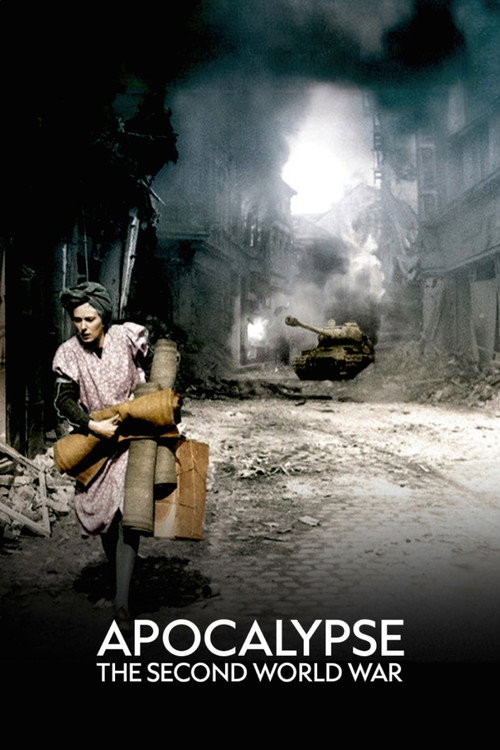
Apocalypse: The Second World War (French: Apocalypse, la 2e Guerre mondiale) (2009) is a six-part French documentary by Daniel Costelle and Isabelle Clarke about the Second World War. The music of the documentary was composed by Kenji Kawai.
The documentary is composed exclusively of actual footage of the war as filmed by war correspondents, soldiers, resistance fighters and private citizens. The series is shown in color, with the black-and-white footage being fully colorized, save for some original color footage. The only exception to the treatment are most Holocaust scenes, which are presented in the original black and white.
It was first aired in 2009 from August 20 and 27 and September 3 on the French-speaking Belgian RTBF, then on August 23 and 30 and September 6 on the French-speaking Swiss TSR, and finally on September 8 to September 22 on France 2 channel. It was narrated in French by actor/director Mathieu Kassovitz. The documentary was shown on the Smithsonian Channel in the United States, where it was narrated by actor Martin Sheen, on the National Geographic Channel and Channel 4 in the United Kingdom, where it was narrated by actor Jonathan Booth, Canada, the Netherlands, Poland, Australia, Romania and Asia, on YLE Teema in Finland, on Rete 4 in Italy, on IBA, the national public channel in Israel, on RTP2, the national public channel in Portugal, and on La 2, the national public channel in Spain.
Contents
Episodes
Aggression (1933–1939): rise of Nazism and the invasion of Poland, Phoney war
Crushing Defeat (1939–1940): Battle of Dunkirk and Battle of France, Battle of Britain
Shock (1940–1941): the North African Campaign, Invasion of Yugoslavia, Battle of Greece and Battle of Crete, Operation Barbarossa, Battle of Smolensk and Battle of Moscow
World Ablaze (1941–1942): Pearl Harbor, Midway and Guadalcanal, Operation Fall Blau
The Great Landings/The Noose (1942–1943): first failures of the Axis, Battle of Stalingrad, El Alamein, Operation Torch, Tunisia, Kursk and Italian campaign
Inferno (1944–1945): liberation of France, invasion of Germany, surrender of Germany, atomic bombing of Hiroshima and Nagasaki, and surrender of Japan
Depictions
The documentary includes a series of portraits of the main leaders of World War II.
Germans
Adolf Hitler
Hermann Göring
Konstantin von Neurath
Joachim von Ribbentrop
Rudolf Hess
Joseph Goebbels
Martin Bormann
Heinrich Himmler
Reinhard Heydrich
Albert Speer
Eva Braun
Magda Goebbels
Karl Dönitz
Wilhelm Keitel
Fedor von Bock
Heinz Guderian
Friedrich Paulus
Erwin Rommel
Erich von Manstein
Walther von Brauchitsch
French
Charles de Gaulle
Philippe Leclerc de Hauteclocque
Philippe Pétain
Paul Reynaud
Maurice Gamelin
Maxime Weygand
Henri Giraud
Albert Lebrun
Jean de Lattre de Tassigny
Charles Huntziger
Émile Muselier
British
Neville Chamberlain
Winston Churchill
Bernard Montgomery
Arthur Harris
Americans
Franklin D. Roosevelt
Dwight Eisenhower
Douglas MacArthur
Chester Nimitz
George Patton
Charles A. Lindbergh
Henry Ford
Joseph P. Kennedy
John F. Kennedy
Harry S. Truman
Soviets
Joseph Stalin
Vyacheslav Molotov
Georgy Zhukov
Lavrentiy Beria
Semyon Timoshenko
Nikita Khrushchev
Andrey Vlasov
Italians
Benito Mussolini
Galeazzo Ciano
Japanese
Hirohito
Hideki Tōjō
Tomoyuki Yamashita
Isoroku Yamamoto
Chinese
Chiang Kai-shek
Miscellaneous
Some of the people documented in the series:
Rose Gowlland – A British child who was a year old when the war broke out. On the last day of the war, she painted 'The End' on a bomb.
Gaston Sirec – A French truck driver who was imprisoned in a stalag when the Germans defeated France.
Lt. August Graf Kageneck – A German Tank commander who personifies a typical Wehrmacht soldier as he writes in his journal or to his mother.
While a lot of males are mentioned in this documentary series, cell block guards and nurses who were female also contributed to WWII. A novel by Elizabeth Wein displays some of this torment done in women concentration camps.


.jpg?width=400)