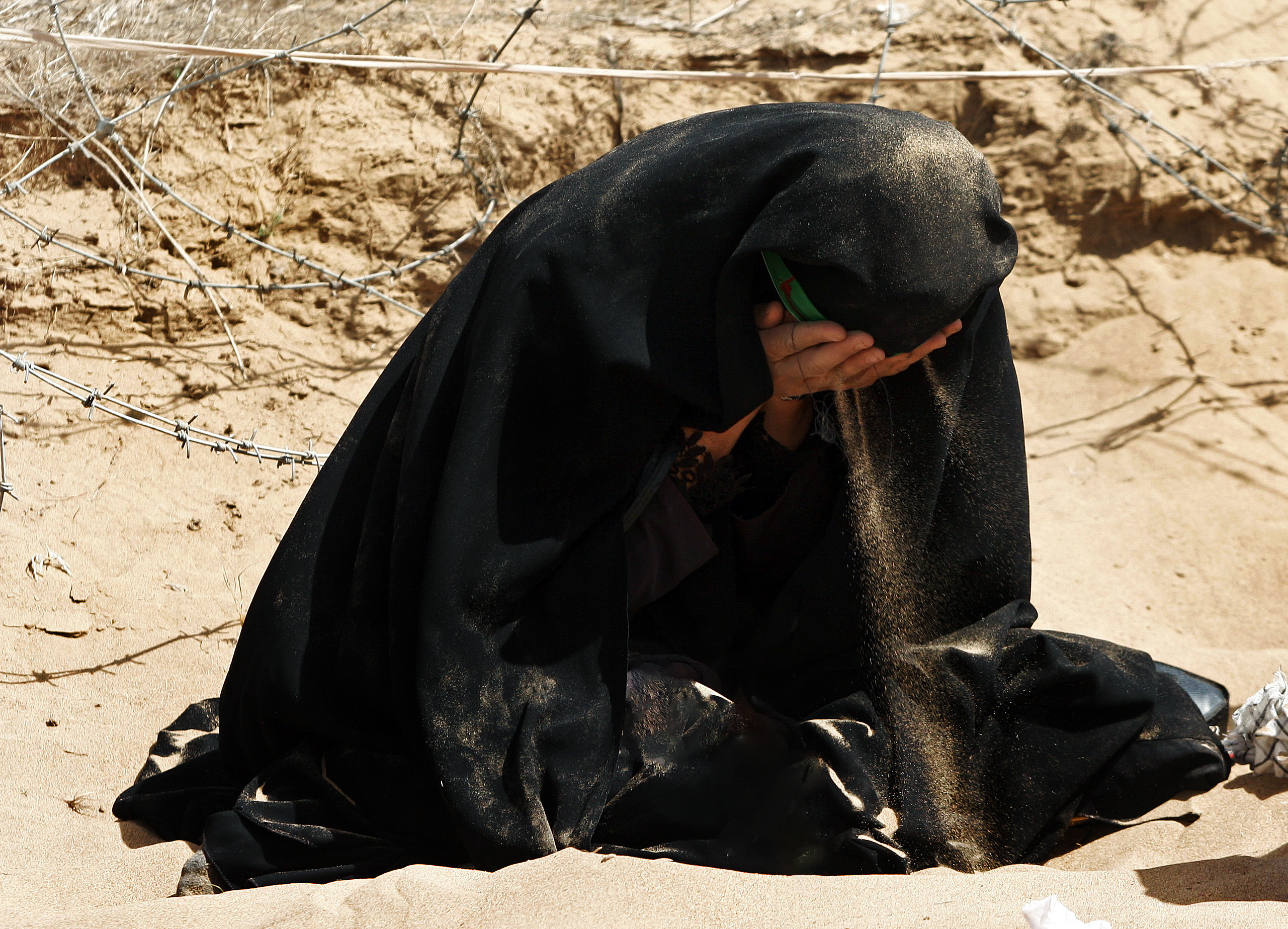
Apostasy in Islam (Arabic: ردة, romanized: ridda or ارتداد, irtidād) is commonly defined as the abandonment of all or part of Islam by a current or former Muslim, in thought, word, or through deed. It includes not only explicit apostasy, renunciations of the Islamic faith by converting to another religion or abandoning religion altogether, but also blasphemy or heresy by those who consider themselves Muslims, through any action or utterance which implies unbelief, including those who deny a "fundamental tenet or creed" of Islam. An apostate from Islam is known as a murtadd (مرتدّ).
While Islamic jurisprudence traditionally calls for the death penalty for those who refuse to repent of apostasy from Islam, what statements or acts qualify as apostasy, and whether or how they should be punished, are disputed among Muslim scholars, with liberal Islamic movements rejecting physical punishment for apostasy altogether. The penalty of killing of apostates is in conflict with international human rights norms which provide for the freedom of religions, as demonstrated in human rights instruments such as the Universal Declaration of Human Rights, the International Covenant on Civil and Political Rights, and the International Covenant on Economic, Social, and Cultural Rights.
Until the late 19th century, the majority of Sunni and Shia jurists held the view that for adult men, apostasy from Islam was a crime as well as a sin, punishable by the death penalty, but also allowed for a number of options for leniency (such as a waiting period to allow time for repentance or enforcement only in cases involving politics), depending on the era, the legal standards, and the particular school of law. In the late 19th century, the use of legal criminal penalties for apostasy fell into disuse, although civil penalties were still applied.
As of 2021, there were ten Muslim-majority countries where apostasy from Islam was punishable by death, but legal executions are rare.
Most punishment is extrajudicial/vigilante in nature, and most executions are perpetrated by jihadist and takfiri insurgents (al-Qaeda, the Islamic State, the GIA, and the Taliban). Another thirteen countries have penal or civil penalties for apostates – such as imprisonment, the annulment of their marriages, the loss of their rights of inheritance and the loss of custody of their children. In the contemporary Muslim world, public support for capital punishment varies from 78% in Afghanistan to less than 1% in Kazakhstan; among Islamic jurists, the majority of them continue to regard apostasy as a crime which should be punishable by death. Those who disagree argue that its punishment should be less than death and should occur in the afterlife, as human punishment is considered to be inconsistent with Quranic injunctions against compulsion in belief, or that it should be applied only in cases of public disobedience and disorder (fitna). Despite potentially grave and life-threatening consequences, some Muslims in these areas continue to leave the Islamic religion, either becoming irreligious (atheism, agnosticism, etc.) or converting to other religions, mostly to Christianity.
Contents
Etymology and terminology
Apostasy is called irtidād or ridda (which means "relapse" or "regress") in Islamic literature. An apostate is called murtadd, which means "one who turns back" from Islam. The Oxford Islamic Studies Online defines murtadd as "not just any kāfir (non-believer)" but "a particularly heinous type". Ridda can also refer to "secession" in a political context. A person born to a Muslim father who later rejects Islam is called a murtadd fitri, and a person who converted to Islam and later rejects the religion is called a murtadd milli. Takfīr (Arabic: تكفير) is the act of one Muslim excommunicating another, declaring them a kāfir, an apostate. The act which precipitates takfīr is termed mukaffir.
Scriptural references
Quran
The Quran references apostasy (2:108, 66; 10:73; 3:90; 4:89, 137; 5:54; 9:11–12, 66; 16:06; 88:22–24) in the context of attitudes associated with impending punishment, divine anger, and the rejection of repentance for individuals who commit this act. Traditionally, these verses are thought to "appear to justify coercion and severe punishment" for apostates (according to Dale F. Eickelman), including the traditional capital punishment. Other scholars, by contrast, have pointed to a lack of any Quranic passage requiring the implementation of force to return apostates to Islam, nor any specific corporal punishment to apply to apostates in this world – let alone commands to kill apostates – either explicitly or implicitly. Some verses have been cited as emphasizing mercy and a lack of compulsion with respect to religious belief (2:256; 4:137; 10:99; 11:28; 18:29; 88:21–22).
Hadith
The classical shariah punishment for apostasy comes from Sahih ("authentic") Hadith rather than the Quran. Writing in the Encyclopedia of Islam, Heffening holds that contrary to the Quran, "in traditions [i.e. hadith], there is little echo of these punishments in the next world... and instead, we have in many traditions a new element, the death penalty."
Allah's Apostle said, "The blood of a Muslim who confesses that none has the right to be worshipped but Allah and that I am His Apostle, cannot be shed except in three cases: In Qisas for murder, a married person who commits illegal sexual intercourse and the one who reverts from Islam (apostate), leaving the community.
Ali burnt some people and this news reached Ibn 'Abbas, who said, "Had I been in his place I would not have burnt them, as the Prophet said, 'Don't punish (anybody) with Allah's Punishment.' No doubt, I would have killed them, for the Prophet said, 'If somebody (a Muslim) discards his religion, kill him.'"
A man embraced Islam and then reverted back to Judaism. Mu'adh bin Jabal came and saw the man with Abu Musa. Mu'adh asked, "What is wrong with this (man)?" Abu Musa replied, "He embraced Islam and then reverted back to Judaism." Mu'adh said, "I will not sit down unless you kill him (as it is) the verdict of Allah and His Apostle."
Other hadith give differing statements about the fate of apostates; that they were spared execution by repenting, by dying of natural causes or by leaving their community (the last case sometimes cited as an example of open apostasy that was left unpunished).
A man from among the Ansar accepted Islam, then he apostatized and went back to Shirk. Then he regretted that, and sent word to his people (saying): 'Ask the Messenger of Allah [SAW], is there any repentance for me?' His people came to the Messenger of Allah [SAW] and said: 'So and so regrets (what he did), and he has told us to ask you if there is any repentance for him?' Then the Verses: 'How shall Allah guide a people who disbelieved after their Belief up to His saying: Verily, Allah is Oft-Forgiving, Most Merciful' was revealed. So he sent word to him, and he accepted Islam.
Definition of apostasy in Islam
Scholars of Islam differ as to what constitutes apostasy in that religion and under what circumstances an apostate is subject to the death penalty.
Conditions of apostasy in classical Islam
Al-Shafi'i listed three necessary conditions to pass capital punishment on a Muslim for apostasy in his Kitab al-Umm. (In the words of Frank Griffel) these are:
"first, the apostate had to once have had faith (which, according to Al-Shafi'i's definition, means publicly professing all tenets of Islam);
secondly, there had to follow unbelief (meaning the public declaration of a breaking-away from Islam), (having done these two the Muslim is now an unbeliever but not yet an apostate and thus not eligible for punishment);
"third, there had to be the omission or failure to repent after the apostate was asked to do so."
Three centuries later, Al-Ghazali wrote that one group, known as "secret apostates" or "permanent unbelievers" (aka zandaqa), should not be given a chance to repent, eliminating Al-Shafi'i's third condition for them although his view was not accepted by his Shafi'i madhhab.
Characteristics
Describing what qualifies as apostasy or unbelief in Islam, religion scholar Christine Schirrmacher writes:
[...] there is widespread consensus that apostasy undoubtedly exists where the truth of the Koran is denied, where blasphemy is committed against God, Islam, or Muhammad, and where breaking away from the Islamic faith in word or deed occurs. The lasting, willful non-observance of the five pillars of Islam, in particular the duty to pray, clearly count as apostasy for most [Muslim] theologians. Additional distinguishing features are a change of religion, confessing atheism, nullifying the Sharia as well as judging what is allowed to be forbidden and judging what is forbidden to be allowed. Fighting against Muslims and Islam (Arabic: muḥāraba) also counts as unbelief or apostasy;
Kamran Hashemi classifies apostasy or unbelief in Islam into three different "phenomena":
Converting from Islam to another religion (or abandoning religion altogether), also described as "explicit" apostasy. (Hashemi gives the example of Abdul Rahman, an Afghan who was arrested in February 2006 and threatened with the death penalty in a lower court in Kabul for converting to Christianity).
Blaspheming (sabb) (by a Muslim) against God, Islam, its laws or its prophet, which can be defined, in practice, as any objection to the authenticity of Islam, its laws or its prophet.
Heresy; or "implicit" apostasy (by a Muslim), where the alleged apostate does not formally renounce Islam, but has (in the eyes of their accusers) verbally denied some principle of belief prescribed by Qur'an or a Hadith; deviated from approved Islamic tenets (ilhad). (Accusations of heresy, or takfir, often involve public thinkers and theologians – Mahmoud Mohammed Taha, Nasr Abu Zayd, Hashem Aghajari – but can involve the collective takfir of a large group and mass killings – takfir of Algerians who did not support the Armed Islamic Group of Algeria in 1997, takfir of Shia by Abu Musab al-Zarqawi in 2005).
Issues in defining heresy
While identifying someone who publicly converted to another religion as an apostate was straightforward, determining whether a diversion from orthodox doctrine qualified as heresy, blasphemy, or something permitted by God could be less so. Traditionally, Islamic jurists did not formulate general rules for establishing unbelief, instead, compiled sometimes lengthy lists of statements and actions which in their view implied apostasy or were incompatible with Islamic "theological consensus". Al-Ghazali, for example, devoting "chapters to dealing with takfir and the reasons for which one can be accused of unbelief" in his work Faysal al-Tafriqa bayn al-Islam wa-l-Zandaqa ("The Criterion of Distinction between Islam and Clandestine Unbelief").
Some heretical or blasphemous acts or beliefs listed in classical manuals of Islamic jurisprudence and other scholarly works (i.e. works written by Islamic scholars) that allegedly demonstrate apostasy include:
to deny the obligatory character of something considered obligatory by ijma (legal consensus of Islamic scholars);
revile, question, wonder, doubt, mock, and/or deny the existence of God or Muhammad, or that Muhammad was sent by God;
belief that things in themselves or by their nature have a cause independent of the will of God;
to assert the createdness of the Quran and/or to translate the Quran in any language other than Arabic;
to ridicule Islamic scholars or address them in a derisive manner, to reject the validity of sharīʿah courts;
to pay respect to non-Muslims, to celebrate Nowruz the Iranian New Year;
to express uncertainty such as "'I do not know why God mentioned this or that in the Quran'...";
Punishment
There are differences of opinion among Islamic scholars about whether, when and especially how apostasy in Islam should be punished.
From 11th century onwards, apostasy from Islam was forbidden by Islamic law; earlier apostasy law was only applicable if a certain number of witnesses testified that there was apostasy, which for the most part was impractical. Apostasy was punishable by death and also by civil liabilities such as seizure of property, children, annulment of marriage, loss of inheritance rights. (A subsidiary law, also applied throughout the history of Islam, forbade non-Muslims from proselytizing Muslims to leave Islam and join another religion, since it meant encouraging Muslims to commit a crime.) With Western colonial influence, starting in the 19th century, the legal code of many Muslim states no longer included apostasy as a capital crime; very much disapproving of this change, Islamic scholars called for vigilante justice of hisbah to execute the offenders (see Apostasy in Islam#Colonial era and after).
In contemporary times, the majority of Muslim legal scholars still regard apostasy from Islam as a crime deserving the death penalty, according to Abdul Rashied Omar, while Javaid Rehman and other scholars regard this view as being fundamentally contradictory and inconsistent with the right to "freedom of religion" as expressed in the Quranic injunctions Quran 88:21-88:22 and Quran 2:256 ("there is no compulsion in religion"), and a relic of the early Islamic community, in a time when apostasy from Islam was treated either as an act of desertion or treason.
Still others support a "centrist or moderate position" of executing only those whose apostasy is "unambiguously provable" such as if two just Muslim eyewitnesses testify; and/or reserving the death penalty for those who make their apostacy public. According to Christine Schirrmacher, "a majority of theologians" embrace this stance.
Who qualifies for judgement for the crime of apostasy
As mentioned above, there are numerous doctrinal fine points outlined in fiqh manuals whose violation should render a (self-proclaimed) Muslim an apostate, but there are also hurdles and exacting requirements that spare violators of doctrine a conviction for apostasy in classical fiqh.
One motive for caution is that it is an act of apostasy (in Shafi'i and other fiqh) for a Muslim to accuse or describe another innocent Muslim of being an unbeliever, based on the hadith where Muhammad is reported to have said: "If a man says to his brother, 'You are an infidel,' then one of them is right."
According to sharia, to be found guilty the accused must at the time of apostasizing be exercising free will (that is did not convert to or from Islam under duress), an adult, and of sound mind, and have refused to repent when given a period of time to do so (not all schools include this last requirement).
Some of these requirements have served as "loopholes" to exonerate apostates (apostasy charges against Abdul Rahman, were dropped on the grounds he was "mentally unfit").
Death penalty
Traditional Sunnī and Shīʿa Islamic jurisprudence (fiqh) and their respective schools (maḏāhib) agree on some issues – that male apostates should be executed, and that most but not all perpetrators should not be given a chance to repent; among the excluded are those who practice sorcery (subhar), treacherous heretics (zanādiqa), and "recidivists". They disagree on issues such as whether women can be executed, whether apostasy is a violation of "the rights of God", whether apostates who were born Muslims may be spared if they repent, whether conviction requires the accused be a practicing Muslim, or whether it is enough to simply intend to commit apostasy rather than actually doing it.
Ḥanafī school – recommends three days of imprisonment before the execution, although the delay before killing the apostates is not mandatory. Apostasy from Islam is not considered a hudud crime. Unlike in other schools, it is not obligatory to call on the apostate to repent. Apostate males are to be killed, while apostate females are to be held in solitary confinement and beaten every three days till they recant and return to Islam. Apostasy from Islam is not sufficient grounds for execution in the Ḥanafī school. Apostates must also be guilty of causing aggravated robbery or grand larceny (ḥirābah).
Mālikī school – allows up to ten days for recantation, after which the apostates must be killed. Apostasy from Islam is considered a hudud crime. Both male and female apostates deserve the death penalty for leaving Islam, according to the traditional view of the Mālikī school. Unlike other schools, the apostates must have a history of being "good" (i.e., practicing) Muslims.
Shāfiʿī school – waiting period of three days is required to allow the apostates time to repent and return to Islam. Failing repentance, death penalty is the recommended form of punishment for both male and female apostates for leaving Islam. Apostasy from Islam is not considered a hudud crime.
Ḥanbalī school – a waiting period not necessary, but may be granted. Apostasy from Islam is considered a hudud crime. Death penalty is the traditional form of punishment for both male and female apostates for leaving Islam.
Jaʿfari or Imāmī school – Male apostates must be executed, while female apostates must be held in solitary confinement until they repent and return to Islam. Apostasy from Islam is considered a hudud crime. The "mere intention of unbelief" without expression, also qualifies as apostasy. Unlike the other schools, repentance will not save a defendant from execution, unless they are "national apostates" who were not born Muslims but converted to Islam before apostasizing, although it is disputed by some Muslim scholars. "Innate" apostates, who grew up Muslims and remained Muslim after puberty and until converting to another religion, should be executed.
Civil liabilities
In Islam, apostasy has traditionally had both criminal and civil penalties. In the late 19th century, when the use of criminal penalties for apostasy fell into disuse, civil penalties were still applied. The punishment for the criminal penalties such as murder includes death or prison, while In all madhhabs of Islam, the civil penalties include:
(a) the property of the apostate is seized and distributed to his or her Muslim relatives;
(b) his or her marriage annulled (faskh) (as in the case of Nasr Abu Zayd);
(1) if they were not married at the time of apostasy they could not get married
(c) any children removed and considered ward of the Islamic state.
(d) In case the entire family has left Islam, or there are no surviving Muslim relatives recognized by Sharia, the apostate's inheritance rights are lost and property is liquidated by the Islamic state (part of fay, الْفيء).
(e) In case the apostate is not executed – such as in case of women apostates in Hanafi school – the person also loses all inheritance rights. Hanafi Sunni school of jurisprudence allows waiting till execution, before children and property are seized; other schools do not consider this wait as mandatory but mandates time for repentance.
Social liabilities
The conversion of a Muslim to another faith is often considered a "disgrace" and "scandal" as well as a sin, so in addition to penal and civil penalties, loss of employment, ostracism and proclamations by family members that they are "dead", is not at all "unusual". For those who wish to remain in the Muslim community but who are considered unbelievers by other Muslims, there are also "serious forms of ostracism". These include the refusal of other Muslims to pray together with or behind a person accused of kufr, the denial of the prayer for the dead and burial in a Muslim cemetery, boycott of whatever books they have written, etc.
Supporters and opponents of death penalty
Support among contemporary preachers and scholars
"The vast majority of Muslim scholars both past as well as present" consider apostasy "a crime deserving the death penalty", according to Abdul Rashided Omar, writing circa 2007. Some notable contemporary proponents include:
Ahmed el-Tayeb, Grand Imam of Al-Azhar (2010–Present) and Grand Mufti of Egypt (2002–2003).
Abul A'la Maududi (1903–1979), who "by the time of his death had become the most widely read Muslim author of our time", according to one source.
Mohammed al-Ghazali (1917–1996), considered an Islamic "moderate" and "preeminent" faculty member of Egypt's preeminent Islamic institution – Al Azhar University − as well as a valuable ally of the Egyptian government in its struggle against the "growing tide of Islamic fundamentalism", was "widely credited" with contributing to the 20th century Islamic revival in the largest Arabic country, Egypt. (Al-Ghazali was on record as declaring all those who opposed the implementation of sharia law to be apostates who should ideally be punished by the state, but "when the state fails to punish apostates, somebody else has to do it".
Yusuf al-Qaradawi (1926-2022), another "moderate" Islamist, chairman of the International Union of Muslim Scholars, who as of 2009 was "considered one of the most influential" Islamic scholars living.
Zakir Naik, Indian Islamic televangelist and preacher, whose Peace TV channel, reaches a reported 100 million viewers, and whose debates and talks are widely distributed, supports the death penalty only for those apostates who "propagate the non-Islamic faith and speak against Islam" as he considers it treason.
Muhammad Saalih Al-Munajjid, a Syrian Islamic scholar, considered a respected scholar in the Salafi movement (according to Al Jazeera); and founder of the fatwa website IslamQA, one of the most popular Islamic websites, and (as of November 2015 and according to Alexa.com) the world's most popular website on the topic of Islam generally (apart from the website of an Islamic bank).
Rationale, arguments, criticism for and against killing apostates
The question of whether apostates should be killed, has been "a matter for contentious dispute throughout Islamic history".
For the death penalty
Throughout Islamic history the Muslim community, scholars, and schools of fiqh have agreed that scripture prescribes this penalty; scripture must take precedence over reason or modern norms of human rights, as Islam is the one true religion; "no compulsion in religion" (Q.2:256) does not apply to this punishment; apostasy is "spiritual and cultural" treason; it hardly ever happens and so is not worth talking about.
Abul A'la Maududi said that among early Muslims, among the schools of fiqh both Sunni and Shia, among scholars of shari'ah "of every century ... available on record", there is unanimous agreement that the punishment for apostate is death, and that "no room whatever remains to suggest" that this penalty has not "been continuously and uninterruptedly operative" through Islamic history; evidence from early texts that Muhammad called for apostates to be killed, and that companions of Muhammad and early caliphs ordered beheadings and crucifixions of apostates and has never been declared invalid over the course of the history of Islamic theology (Christine Schirrmacher).
"Many hadiths", not just "one or two", call for the killing of apostates (Yusuf al-Qaradawi).
Verse Q.2:217 – "hindering ˹others˺ from the Path of Allah, rejecting Him, and expelling the worshippers from the Sacred Mosque is ˹a˺ greater ˹sin˺ in the sight of Allah" – indicates the punishment for apostasy from Islam is death (Mohammad Iqbal Siddiqi), Quranic verses in general "appear to justify coercion and severe punishment" for apostates (Dale F. Eickelman).
If this doctrine is called into question, what's next? Ritual prayer (salat)? Fasting (sawm)? Even Muhammad's mission? (Abul A'la Maududi).
It "does not merit discussion" because [the advocates maintain] apostasy from Islam is so rare (Ali Kettani), (Mahmud Brelvi); before the modern era, there was virtually no apostasy from Islam (Syed Barakat Ahmad).
Middle way
At least some conservative jurists and preachers have attempted to reconcile following the traditional doctrine of death for apostasy while addressing the principle of freedom of religion. Some of whom argue apostasy should have a lesser penalty than death.
At a 2009-human rights conference at Mofid University in Qom, Iran, Ayatollah Mohsen Araki, stated that "if an individual doubts Islam, he does not become the subject of punishment, but if the doubt is openly expressed, this is not permissible." As one observer (Sadakat Kadri) noted, this "freedom" has the advantage that "state officials could not punish an unmanifested belief even if they wanted to".
Zakir Naik, the Indian Islamic televangelist and preacher takes a less strict line (mentioned above), stating that only those Muslims who "propagate the non-Islamic faith and speak against Islam" after converting from Islam should be put to death.
While not speaking to the issue of executing apostates, Dar al-Ifta al-Misriyyah, an Egyptian Islamic advisory, justiciary and governmental body, issued a fatwa in the case of an Egyptian Christian convert to Islam but "sought to return to Christianity", stating: "Those who embraced Islam voluntarily and without coercion cannot later deviate from the public order of society by revealing their act of apostasy because such behavior would discourage other people from embracing Islam." (The Egyptian court followed the fatwa.)
In practice: historical impact
From the Middle Ages to the early modern period
The charge of apostasy has often been used by religious authorities to condemn and punish skeptics, dissidents, and minorities in their communities. From the earliest times of the history of Islam, the crime of apostasy and execution for apostasy has driven major events in the development of the Islamic religion. For example, the Ridda wars (civil wars of apostasy) shook the Muslim community in 632–633 AD, immediately after the death of Muhammad. Later, sectarian wars caused the split between the two major sects of Islam: Sunnis and Shias, and numerous deaths on both sides. Sunni and Shia sects of Islam have long accused each other of apostasy.
The charge of apostasy dates back to the early history of Islam with the emergence of the Kharijites in the 7th century CE. The original schism between Kharijites, Sunnis, and Shias among Muslims was disputed over the political and religious succession to the guidance of the Muslim community (Ummah) after the death of Muhammad. From their essentially political position, the Kharijites developed extreme religious doctrines that set them apart from both mainstream Sunni and Shia Muslims. Shias believe ʿAlī ibn Abī Ṭālib is the true successor to Muhammad, while Sunnis consider Abu Bakr to hold that position. The Kharijites broke away from both the Shias and the Sunnis during the First Fitna (the first Islamic Civil War); they were particularly noted for adopting a radical approach to takfīr (excommunication), whereby they declared both Sunni and Shia Muslims to be either infidels (kuffār) or false Muslims (munāfiḳūn), and therefore deemed them worthy of death for their perceived apostasy (ridda).
Christian populations living in the lands invaded by the Arab Muslim armies between the 7th and 10th centuries AD suffered religious persecution and violence multiple times at the hands of Arab Muslim officials and rulers, including Christian converts to Islam who reportedly reverted to Christianity following their apostasy from the Islamic religion. Many were executed under the Islamic death penalty for defending their Christian faith through dramatic acts of resistance such as refusing to convert to Islam, repudiation of the Islamic religion, and subsequent reconversion to Christianity, as well as blasphemy towards Muslim beliefs. Between 850 and 859 CE, the Martyrs of Córdoba were executed under the rule of Abd al-Rahman II and Muhammad I in the Emirate of Córdoba for capital violations of Islamic law, including blasphemy towards Muslim beliefs and apostasy from Islam.
Colonial era and after
From around 1800 up until 1970, there were only a few cases of executions of apostates in the Muslim world, including the strangling of a woman in Ottoman Egypt (sometime between 1825 and 1835), and the beheading of an Armenian youth in the Ottoman Empire in 1843. Western powers campaigned intensely for a prohibition on the execution of apostates in the Ottoman Empire. British envoy to the court of Sultan Abdulmejid I (1839–1861), Stratford Canning, led diplomatic representatives from Austria, Russia, Prussia, and France in a "tug of war" with the Ottoman government. In the end (following the execution of the Armenian), the Sublime Porte agreed to allow "complete freedom of Christian missionaries" to try to convert Muslims in the Empire. The death sentence for apostasy from Islam was abolished by the Edict of Toleration, and substituted with other forms of punishment by the Ottoman government in 1844. The implementation of this ban was resisted by religious officials and proved difficult. A series of edicts followed during the Ottoman Reformist period, such as the 1856 Reform Edict.
This was also the time that Islamic modernists like Muhammad Abduh (d. 1905) argued that to be executed, it was not enough to be an apostate, the perpetrator had to pose a real threat to public safety. Islamic scholars like Muhammad Rashid Rida (d. 1935) and Muhammad al-Ghazzali (d. 1996), on the other hand, asserted that public, explicit apostasy automatically threatened public order, and hence should be punishable by death. These scholars reconciled the Qur'anic verse "There is no compulsion in religion" by arguing that freedom of religion in Islam doesn't extend for Muslims who seek to change their religion. Other authors like 'Abd al-Muta'ali al-Sa'idi, S. A. Rahman, etc. assert that capital punishment for apostasy is contradictory to freedom of religion and need to be banished.
Despite these edicts on apostasy, there was constant pressure on non-Muslims to convert to Islam, and apostates from Islam continued to be persecuted, punished and threatened with execution, particularly in eastern and Levant parts of the then Ottoman Empire. The Edict of Toleration ultimately failed when Sultan Abdul Hamid II assumed power, re-asserted pan-Islamism with sharia as Ottoman state philosophy, and initiated the Hamidian massacres and late Ottoman genocides in 1894 against Christians, particularly the genocides of Armenians, Greeks, Assyrians, and crypto-Christian apostates from Islam in Turkey.
In the colonial era, the death penalty for apostasy was abolished in Islamic countries that had come under Western rule or in places, such as the Ottoman Empire, Western powers could apply enough pressure to abolish it. Writing in the mid-1970s, Rudolph Peters and Gert J. J. De Vries stated that "apostasy no longer falls under criminal law" in the Muslim world, but that some Muslims (such as 'Adb al-Qadir 'Awdah) were preaching that "the killing of an apostate" had "become a duty of individual Moslems" (rather than a less important collective duty in hisbah doctrine) and giving advice on how to plead in court after being arrested for such a murder to avoid punishment.
In practice in the recent past
While as of 2004 apostasy from Islam is a capital offence in only eight majority-Muslim states, in other states that do not directly execute apostates, apostate killing is sometimes facilitated through extrajudicial killings performed by the apostate's family, particularly if the apostate is vocal. In some countries, it is not uncommon for "vigilante" Muslims to kill or attempt to kill apostates or alleged apostates, in the belief they are enforcing sharia law that the government has failed to.
Background
More than 20 Muslim-majority states have laws that punish apostasy by Muslims to be a crime some de facto other de jure. As of 2014, apostasy was a capital offense in Afghanistan, Brunei, Mauritania, Qatar, Saudi Arabia, Sudan, the United Arab Emirates, and Yemen. Executions for religious conversion have been infrequent in recent times, with four cases reported since 1985: one in Sudan in 1985; two in Iran, in 1989 and 1998; and one in Saudi Arabia in 1992. In Mauritania, Saudi Arabia, Jordan, and Yemen apostasy laws have been used to charge persons for acts other than conversion. In addition, some predominantly Islamic countries without laws specifically addressing apostasy have prosecuted individuals or minorities for apostasy using broadly defined blasphemy laws. In many nations, the Hisbah doctrine of Islam has traditionally allowed any Muslim to accuse another Muslim or ex-Muslim for beliefs that may harm Islamic society, i.e. violate the norms of sharia (Islamic law). This principle has been used in countries such as Egypt, Pakistan and others to bring blasphemy charges against apostates.
The source of most violence or threats of violence against apostate has come from outside of state judicial systems in the Muslim world in recent years, either from extralegal acts by government authorities or from other individuals or groups operating unrestricted by the government. There has also been social persecution for Muslims converting to Christianity. For example, the Christian organisation Barnabas Fund reports:
The field of apostasy and blasphemy and related "crimes" is thus obviously a complex syndrome within all Muslim societies which touches a raw nerve and always arouses great emotional outbursts against the perceived acts of treason, betrayal and attacks on Islam and its honour. While there are a few brave dissenting voices within Muslim societies, the threat of the application of the apostasy and blasphemy laws against any who criticize its application is an efficient weapon used to intimidate opponents, silence criticism, punish rivals, reject innovations and reform, and keep non-Muslim communities in their place.
Similar views are expressed by the non-theistic International Humanist and Ethical Union. Author Mohsin Hamid points out that the logic of widely accepted claim that anyone helping an apostate is themselves an apostate, is a powerful weapon in spreading fear among those who oppose the killings (in at least the country of Pakistan). It means that a doctor who agrees to treat an apostate wounded by attacker(s), or a police officer who has agreed to protect that doctor after they have been threatened is also an apostate – "and on and on".
Apostate communities
Christian apostates from Islam
Regarding Muslim converts to Christianity, Duane Alexander Miller (2016) identified two different categories:
'Muslim followers of Jesus Christ', 'Jesus Muslims' or 'Messianic Muslims' (analogous to Messianic Jews), who continue to self-identify as 'Muslims', or at least say Islam is (part of) their 'culture' rather than religion, but "understand themselves to be following Jesus as he is portrayed in the Bible".
'Christians from a Muslim background' (abbreviated CMBs), also known as 'ex-Muslim Christians', who have completely abandoned Islam in favour of Christianity.
Miller introduced the term 'Muslim-background believers' (MBBs) to encompass both groups, adding that the latter group are generally regarded as apostates from Islam, but orthodox Muslims' opinions on the former group is more mixed (either that 'Muslim followers of Jesus' are 'heterodox Muslims', 'heretical Muslims' or 'crypto-Christian liars').
Atheist apostates from Islam
Writing in 2015, Ahmed Benchemsi argued that while Westerners have great difficulty even conceiving of the existence of an Arab atheist, "a generational dynamic" is underway with "large numbers" of young people brought up as Muslims "tilting away from ... rote religiosity" after having "personal doubts" about the "illogicalities" of the Quran and Sunnah. Immigrant apostates from Islam in Western countries "converting" to Atheism have often gathered for comfort in groups such as Women in Secularism, Ex-Muslims of North America, Council of Ex-Muslims of Britain, sharing tales of the tension and anxieties of "leaving a close-knit belief-based community" and confronting "parental disappointment", "rejection by friends and relatives", and charges of "trying to assimilate into a Western culture that despises them", often using terminology first uttered by the LGBT community – "'coming out,' and leaving 'the closet'". Atheists in the Muslim world maintain a lower profile, but according to the Editor-in-chief of FreeArabs.com:
When I recently searched Facebook in both Arabic and English, combining the word 'atheist' with names of different Arab countries I turned up over 250 pages or groups, with memberships ranging from a few individuals to more than 11,000. And these numbers only pertain to Arab atheists (or Arabs concerned with the topic of atheism) who are committed enough to leave a trace online.
Public opinion
A survey based on face-to-face interviews conducted in 80 languages by the Pew Research Center between 2008 and 2012 among thousands of Muslims in many countries, found varied views on the death penalty for those who leave Islam to become an atheist or to convert to another religion. In some countries (especially in Central Asia, Southeast Europe, and Turkey), support for the death penalty for apostasy was confined to a tiny fringe; in other countries (especially in the Arab world and South Asia) majorities and large minorities support the death penalty.
In the survey, Muslims who favored making Sharia the law of the land were asked for their views on the death penalty for apostasy from Islam. The results are summarized in the table below. (Note that values for Group C have been derived from the values for the other two groups and are not part of the Pew report.)
Overall, the figures in the 2012 survey suggest that the percentage of Muslims in the countries surveyed who approve the death penalty for Muslims who leave Islam to become an atheist or convert to another religion varies widely, from 0.4% (in Kazakhstan) to 78.2% (in Afghanistan). The Governments of the Gulf Cooperation Council (Saudi Arabia, UAE, Oman, Qatar, Bahrain and Kuwait) did not permit Pew Research to survey nationwide public opinion on apostasy in 2010 or 2012. The survey also did not include China, India, Syria, or West African countries such as Nigeria.
By country
The situation for apostates from Islam varies markedly between Muslim-minority and Muslim-majority regions. In Muslim-minority countries "any violence against those who abandon Islam is already illegal". But in Muslim-majority countries, violence is sometimes "institutionalised", and (at least in 2007) "hundreds and thousands of closet apostates" live in fear of violence and are compelled to live lives of "extreme duplicity and mental stress."
Universal Declaration of Human Rights
Laws prohibiting religious conversion run contrary to Article 18 of the United Nations' Universal Declaration of Human Rights, which states the following:
Everyone has the right to freedom of thought, conscience and religion; this right includes freedom to change his religion or belief, and freedom, either alone or in community with others and in public or private, to manifest his religion or belief in teaching, practice, worship and observance.
Afghanistan, Egypt, Iran, Iraq, Pakistan and Syria voted in favor of the Declaration. The governments of other Muslim-majority countries have responded by criticizing the Declaration as an attempt by the non-Muslim world to impose their values on Muslims, with a presumption of cultural superiority, and by issuing the Cairo Declaration on Human Rights in Islam – a joint declaration of the member states of the Organisation of the Islamic Conference made in 1990 in Cairo, Egypt. The Cairo Declaration differs from the Universal Declaration in affirming Sharia as the sole source of rights, and in limits of equality and behavior in religion, gender, sexuality, etc. Islamic scholars such as Muhammad Rashid Rida in Tafsir al-Minar, argue that the "freedom to apostatize", is different from freedom of religion on the grounds that apostasy from Islam "infringes on the freedom of others" and the respect due the religion of Islam.