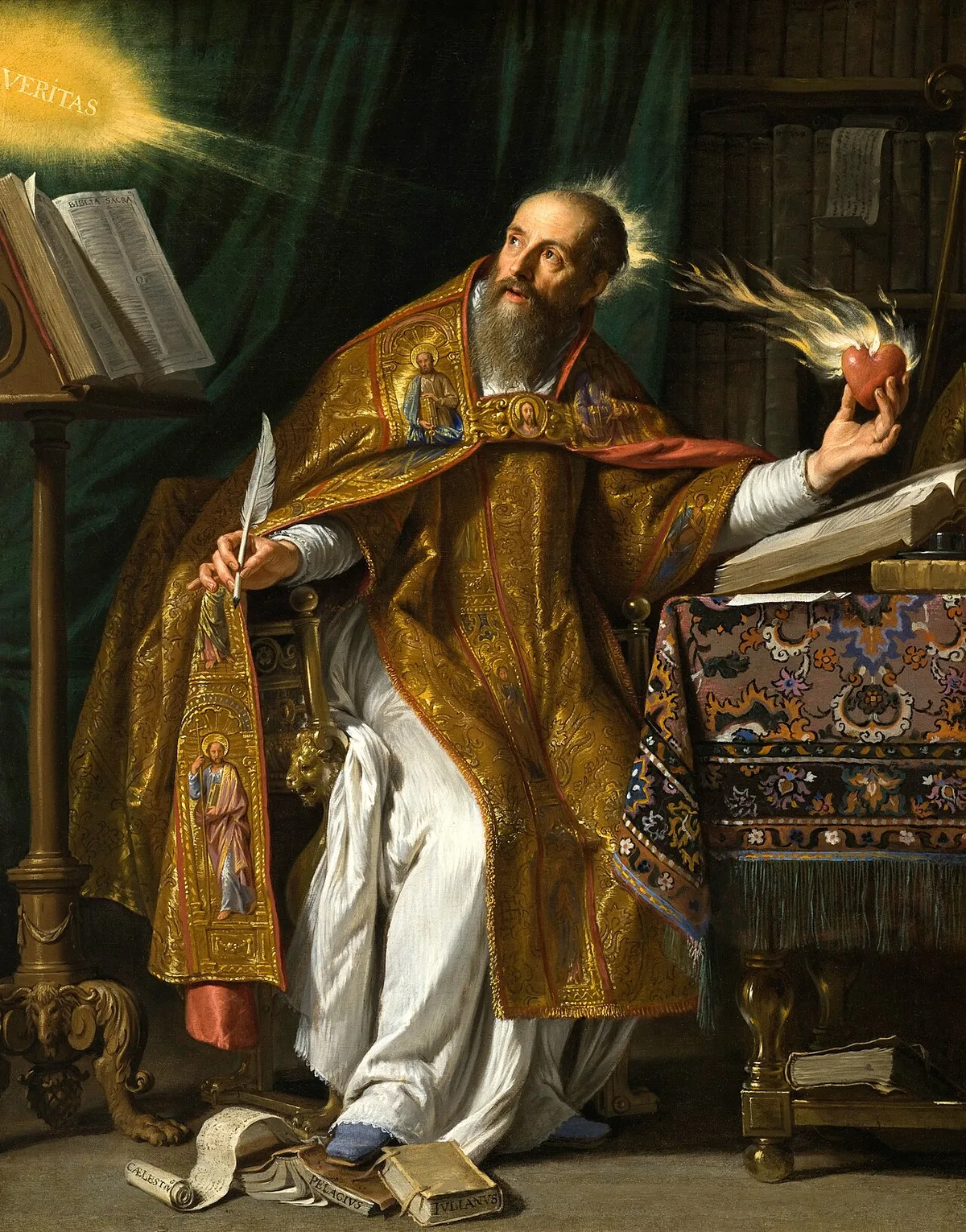
Augustine of Hippo ( aw-GUST-in, US also AW-gə-steen; Latin: Aurelius Augustinus Hipponensis; 13 November 354 – 28 August 430), also well-known as Saint Augustine, was a Christian theologian and philosopher from Thagaste, Numidia Cirtensis and the Bishop of Hippo Regius. He is generally regarded as one of the most influential philosophers in the history of the Western world, and he is viewed as one of the most important Church Fathers of the Latin Church in the Patristic Period.
In his youth he was drawn to the Manichaean faith, and later to the Hellenistic philosophy of Neoplatonism. After his conversion to Christianity and baptism in 386 by Saint Ambrose, Augustine developed his own approach to philosophy and theology, making significant contributions in a wide variety of areas. He is known as Doctor Gratiae ("Doctor of Grace") for the vast influence of his views on the necessity of unmerited, prevenient grace, for salvation and the nature of original sin.
Additionally, he made important contributions in ecclesiology, noting the validity of sacraments regardless of the merit of the celebrant against the views of the Donatists. In his book The City of God, Augustine imagined the Church as a spiritual City, distinct from the material Earthly City, against the backdrop of the fall of the Western Roman Empire. He is also widely recognized for his contributions to just war theory. His other notable works include On the Trinity, On Christian Doctrine, and Confessions, the latter of which was the first Western autobiography.
Augustine is recognized as a saint in the Catholic Church, the Eastern Orthodox Church, the Lutheran churches, and the Anglican Communion. Generally regarded as one of the greatest theologians and philosophers in the history of the Catholic Church, he is one of the four Great Latin Church Fathers, along with Ambrose, Jerome, and Pope Gregory I. His thoughts profoundly influenced the Medieval worldview, and he was the most cited author in the Summa Theologiae of St. Thomas Aquinas. Many Protestants, especially Calvinists and Lutherans, consider him one of the theological fathers of the Protestant Reformation due to his teachings on salvation and divine grace, although this interpretation is disputed by the Catholic Church. In Eastern Orthodoxy, he remains highly venerated, but some of his teachings, including the filioque, are more disputed.
Contents
Biography
Name
Augustine of Hippo, also known as Saint Augustine or Saint Austin, is known by various cognomens throughout the many denominations of the Christian world, including Blessed Augustine and the Doctor of Grace (Latin: Doctor gratiae).
Childhood and education
Augustine was born in 354 in the municipium of Thagaste (now Souk Ahras, Algeria) in the Roman province of Numidia. His mother, Monica or Monnica, was a devout Christian; his father Patricius was a pagan who converted to Christianity on his deathbed. He had a brother named Navigius and a sister whose name is lost but is conventionally remembered as Perpetua.
Scholars generally agree that Augustine and his family were Berbers, an ethnic group indigenous to North Africa, but were heavily Romanized, speaking only Latin at home as a matter of pride and dignity. In his writings, Augustine mentions in passing his identity as a Roman African. For example, he refers to Ponticianus as "a country man of ours, insofar as being African," and to Faustus of Mileve as "an African Gentleman". He writes that Apuleius "as an African is better known to us Africans".
Augustine's family name, Aurelius, suggests his father's ancestors were freedmen of the gens Aurelia given full Roman citizenship by the Edict of Caracalla in 212. Augustine's family had been Roman, from a legal standpoint, for at least a century when he was born. It is assumed that his mother, Monica, was of Berber origin, on the basis of her name, but as his family were honestiores, an upper class of citizens known as honorable men, Augustine's first language was likely Latin.
At the age of 11, Augustine was sent to school at Madaurus (now M'Daourouch), a small Numidian city about 31 kilometres (19 miles) south of Thagaste. There he became familiar with Latin literature, as well as pagan beliefs and practices. His first insight into the nature of sin occurred when he and a number of friends stole pears from a neighbourhood garden. He tells this story in his autobiography, Confessions. He realises that the pears were "tempting neither for its colour nor its flavour" – he was neither hungry nor poor, and he had enough of fruit which were "much better". Over the next few chapters, Augustine agonises over this past sin of his, recognising that one does not desire evil for evil's sake. Rather, "through an inordinate preference for these goods of a lower kind, the better and higher are neglected". In other words, man is drawn to sin when grossly choosing the lesser good over a greater good. Eventually, Augustine concludes that it was the good of the "companionship" between him and his accomplices that allowed him to delight in this theft.
Move to Carthage, Rome, and Milan
Augustine taught grammar at Thagaste between 373 and 374. The following year he moved to Carthage to conduct a school of rhetoric and remained there for the next nine years. Disturbed by unruly students in Carthage, he moved to establish a school in Rome, where he believed the best and brightest rhetoricians practised, in 383. However, Augustine was disappointed with the apathetic reception. It was the custom for students to pay their fees to the professor on the last day of the term, and many students attended faithfully all term, and then did not pay.
Manichaean friends introduced him to the prefect of the City of Rome, Symmachus, who had been asked by the imperial court at Milan to provide a rhetoric professor. Augustine won the job and headed north to take his position in Milan in late 384. At thirty years old, he had won the most visible academic position in the Latin world at a time when such posts gave ready access to political careers.
Although Augustine spent ten years as a Manichaean, he was never an initiate or "elect", but an "auditor", the lowest level in this religion's hierarchy. While still at Carthage a disappointing meeting with the Manichaean bishop, Faustus of Mileve, a key exponent of Manichaean theology, started Augustine's scepticism of Manichaeanism. In Rome, he reportedly turned away from Manichaeanism, embracing the scepticism of the New Academy movement. Because of his education, Augustine had great rhetorical prowess and was very knowledgeable of the philosophies behind many faiths. At Milan, his mother's religiosity, Augustine's own studies in Neoplatonism, and his friend Simplicianus all urged him towards Christianity. This was shortly after the Roman emperor Theodosius I declared Christianity to be the only legitimate religion for the Roman Empire on 27 February 380 by the Edict of Thessalonica and then issued a decree of death for all Manichaean monks in 382. Initially, Augustine was not strongly influenced by Christianity and its ideologies, but after coming in contact with Ambrose of Milan, Augustine reevaluated himself and was forever changed.
Augustine arrived in Milan and visited Ambrose, having heard of his reputation as an orator. Like Augustine, Ambrose was a master of rhetoric, but older and more experienced. Soon, their relationship grew, as Augustine wrote, "And I began to love him, of course, not at the first as a teacher of the truth, for I had entirely despaired of finding that in thy Church – but as a friendly man." Augustine was very much influenced by Ambrose, even more than by his own mother and others he admired. In his Confessions, Augustine states, "That man of God received me as a father would, and welcomed my coming as a good bishop should." Ambrose adopted Augustine as a spiritual son after the death of Augustine's father.
Conversion to Christianity and priesthood
In late August of 386, at the age of 31, having heard of Ponticianus's and his friends' first reading of the life of Anthony of the Desert, Augustine converted to Christianity. As Augustine later told it, his conversion was prompted by hearing a child's voice say "take up and read" (Latin: tolle, lege). Resorting to the sortes biblicae, he opened a book of St. Paul's writings (Confessiones 8.12.29) at random and read Romans 13:13–14: "Not in rioting and drunkenness, not in chambering and wantonness, not in strife and envying, but put on the Lord Jesus Christ, and make no provision for the flesh to fulfil the lusts thereof."
He later wrote an account of his conversion in his Confessions (Latin: Confessiones), which has since become a classic of Christian theology and a key text in the history of autobiography. This work is an outpouring of thanksgiving and penitence. Although it is written as an account of his life, the Confessions also talks about the nature of time, causality, free will, and other important philosophical topics. The following is taken from that work:
Ambrose baptized Augustine and his son Adeodatus, in Milan on Easter Vigil, 24–25 April 387. A year later, in 388, Augustine completed his apology On the Holiness of the Catholic Church. That year, also, Adeodatus and Augustine returned home to Africa. Augustine's mother Monica died at Ostia, Italy, as they prepared to embark for Africa. Upon their arrival, they began a life of aristocratic leisure at Augustine's family's property. Soon after, Adeodatus, too, died. Augustine then sold his patrimony and gave the money to the poor. He only kept the family house, which he converted into a monastic foundation for himself and a group of friends. Furthermore, while he was known for his major contributions to Christian rhetoric, another major contribution was his preaching style.
After converting to Christianity, Augustine turned against his profession as a rhetoric professor in order to devote more time to preaching. In 391 Augustine was ordained a priest in Hippo Regius (now Annaba), in Algeria. He was especially interested in discovering how his previous rhetorical training in Italian schools would help the Christian Church achieve its objective of discovering and teaching the different scriptures in the Bible. He became a famous preacher (more than 350 preserved sermons are believed to be authentic), and was noted for combating the Manichaean religion, to which he had formerly adhered. He preached around 6,000 to 10,000 sermons when he was alive; however, there are only around 500 sermons that are accessible today. When Augustine preached his sermons, they were recorded by stenographers. Some of his sermons would last over one hour and he would preach multiple times throughout a given week. When talking to his audience, he would stand on an elevated platform; however, he would walk towards the audience during his sermons. When he was preaching, he used a variety of rhetorical devices that included analogies, word pictures, similes, metaphors, repetition, and antithesis when trying to explain more about the Bible. In addition, he used questions and rhymes when talking about the differences between people's life on Earth and Heaven as seen in one of his sermons that was preached in 412 AD. Augustine believed that the preachers' ultimate goal is to ensure the salvation of their audience.
Death and sainthood
Shortly before Augustine's death, the Vandals, a Germanic tribe that had converted to Arianism, invaded Roman Africa. The Vandals besieged Hippo in the spring of 430 when Augustine entered his final illness. According to Possidius, one of the few miracles attributed to Augustine, the healing of an ill man, took place during the siege. Spending his final days in prayer and repentance, he requested the penitential Psalms of David be hung on his walls so he could read them, which led him to "[weep] freely and constantly" according to Possidius's biography. He directed the library of the church in Hippo and all the books therein should be carefully preserved. He died on 28 August 430. Shortly after his death, the Vandals lifted the siege of Hippo, but they returned soon after and burned the city. They destroyed all but Augustine's cathedral and library, which they left untouched.
Augustine was canonized by popular acclaim, and recognized as a Doctor of the Church in 1298 by Pope Boniface VIII. His feast day is 28 August. He is considered the patron saint of brewers, printers, theologians, and a number of cities and dioceses. He is invoked against sore eyes.
Augustine is remembered in the Church of England's calendar of saints with a lesser festival on 28 August.
According to Bede's True Martyrology, Augustine's body was later translated to Cagliari, Sardinia, by the Catholic bishops expelled from North Africa by Huneric. Around 720, his remains were transported again by Peter, bishop of Pavia and uncle of the Lombard king Liutprand, to the church of San Pietro in Ciel d'Oro in Pavia, to save them from frequent coastal raids by Saracens. In January 1327, Pope John XXII issued the papal bull Veneranda Santorum Patrum, appointing the Augustinians guardians of the tomb of Augustine, called the Arca. It was remade in 1362 and elaborately carved with bas-reliefs of scenes from Augustine's life, created by Giovanni di Balduccio.
In October 1695, some workmen in the Church of San Pietro in Ciel d'Oro in Pavia discovered a marble box containing human bones (including part of a skull). A dispute arose between the Augustinian hermits (Order of Saint Augustine) and the regular canons (Canons Regular of Saint Augustine) as to whether these were the bones of Augustine. The hermits did not believe so; the canons affirmed they were. Pope Benedict XIII (1724–1730) directed the Bishop of Pavia, Monsignor Pertusati, to make a determination. The bishop declared that, in his opinion, the bones were those of Augustine.
Theology
Augustine's large contribution of writings covered diverse fields including theology, philosophy and sociology. Along with John Chrysostom, Augustine was among the most prolific scholars of the early church by quantity.
Christian anthropology
Augustine was one of the first Christian ancient Latin authors with a very clear vision of theological anthropology. He saw the human being as a perfect unity of soul and body. In his late treatise On Care to Be Had for the Dead, section 5 (420) he exhorted respect for the body on the grounds it belonged to the very nature of the human person. Augustine's favourite figure to describe body–soul unity is marriage: caro tua, coniunx tua – your body is your wife.
Augustine believed that though initially the two elements of body and soul were in perfect harmony, after the fall of humanity they came into dramatic combat with one another. He wrote of them as two categorically different things: the body as a three-dimensional object composed of the four elements, and the soul as spatially dimensionless. He further defined the soul as a kind of substance, participating in reason, fit for ruling the body.
Augustine was not preoccupied, as Plato and Descartes were, in detailed efforts to explain the metaphysics of the soul-body union. It sufficed for him to admit they are metaphysically distinct: to be a human is to be a composite of soul and body, with the soul superior to the body. The latter statement is grounded in his hierarchical classification of things into those that merely exist, those that exist and live, and those that exist, live, and have intelligence or reason.
Sermons directed at Manichaeism focused on their error of teaching the soul was part of God instead of admission that the soul is 'full of illusions'.
Like other Church Fathers such as Athenagoras, Tertullian, Clement of Alexandria and Basil of Caesarea, Augustine "vigorously condemned the practice of induced abortion", and although he disapproved of abortion during any stage of pregnancy, he made a distinction between early and later abortions. He acknowledged the distinction between "formed" and "unformed" fetuses mentioned in the Septuagint translation of Exodus 21:22–23, which incorrectly translates the word "harm" (from the original Hebrew text) as "form" in the Koine Greek of the Septuagint. His view was based on the Aristotelian distinction "between the fetus before and after its supposed 'vivification'". Therefore, he did not classify the abortion of an "unformed" fetus as murder since he thought it could not be known with certainty the fetus had received a soul.
Creation
In City of God, Augustine rejected both the contemporary ideas of ages (such as those of certain Greeks and Egyptians) that differed from the Church's sacred writings. In The Literal Interpretation of Genesis, Augustine argued that God had created everything in the universe simultaneously and not over a period of six days. He argued the six-day structure of creation presented in the Book of Genesis represents a logical framework, rather than the passage of time in a physical way – it would bear a spiritual, rather than physical, meaning, which is no less literal. One reason for this interpretation is the passage in Sirach 18:1, creavit omnia simul ("He created all things at once"), which Augustine took as proof that the days of Genesis 1 had to be taken non-literalistically. As additional support for describing the six days of creation as a heuristic device, Augustine thought the actual event of creation would be incomprehensible by humans and therefore needed to be translated.
Augustine also does not envision original sin as causing structural changes in the universe, and even suggests that the bodies of Adam and Eve were already created mortal before the Fall. Apart from his specific views, Augustine recognized that interpreting the creation story was difficult, and remarked that interpretations could change should new information come up.
Ecclesiology
Augustine developed his doctrine of the Church principally in reaction to the Donatist sect. He taught there is one Church, but within this Church there are two realities, namely, the visible aspect (the institutional hierarchy, the Catholic sacraments, and the laity) and the invisible (the souls of those in the Church, who are either dead, sinful members or elect predestined for Heaven). The former is the institutional body established by Christ on earth which proclaims salvation and administers the sacraments, while the latter is the invisible body of the elect, made up of genuine believers from all ages, who are known only to God. The Church, which is visible and societal, will be made up of "wheat" and "tares", that is, good and wicked people (as per Mat. 13:30), until the end of time. This concept countered the Donatist claim that only those in a state of grace were the "true" or "pure" church on earth, and that priests and bishops who were not in a state of grace had no authority or ability to confect the sacraments.
Augustine's ecclesiology was more fully developed in City of God. There he conceives of the church as a heavenly city or kingdom, ruled by love, which will ultimately triumph over all earthly empires which are self-indulgent and ruled by pride. Augustine followed Cyprian in teaching that bishops and priests of the Church are the successors of the Apostles, and their authority in the Church is God-given.
The concept of Church invisible was advocated by Augustine as part of his refutation of the Donatist sect, though he, as other Church Fathers before him, saw the invisible Church and visible Church as one and the same thing, unlike the later Protestant reformers who did not identify the Catholic Church as the true church. He was strongly influenced by the Platonist belief that true reality is invisible and that, if the visible reflects the invisible, it does so only partially and imperfectly (see Theory of Forms). Others question whether Augustine really held to some form of an "invisible true Church" concept.
Eschatology
Augustine originally believed in premillennialism, namely that Christ would establish a literal 1,000-year kingdom prior to the general resurrection, but later rejected the belief, viewing it as carnal. During the medieval period, the Catholic Church built its system of eschatology on Augustinian amillennialism, where Christ rules the earth spiritually through his triumphant church.
During the Reformation, theologians such as John Calvin accepted amillennialism. Augustine taught that the eternal fate of the soul is determined at death, and that purgatorial fires of the intermediate state purify only those who died in communion with the Church. His teaching provided fuel for later theology.
Mariology
Although Augustine did not develop an independent Mariology, his statements on Mary surpass in number and depth those of other early writers. Even before the Council of Ephesus, he defended the Ever-Virgin Mary as the Mother of God, believing her to be "full of grace" (following earlier Latin writers such as Jerome) on account of her sexual integrity and innocence. Likewise, he affirmed that the Virgin Mary "conceived as virgin, gave birth as virgin and stayed virgin forever".
Natural knowledge and biblical interpretation
Augustine took the view that, if a literal interpretation contradicts science and humans' God-given reason, the biblical text should be interpreted metaphorically. While each passage of Scripture has a literal sense, this "literal sense" does not always mean the Scriptures are mere history; at times they are rather an extended metaphor.
Original sin
Augustine taught that the sin of Adam and Eve was either an act of foolishness (insipientia) followed by pride and disobedience to God or that pride came first. The first couple disobeyed God, who had told them not to eat of the Tree of the knowledge of good and evil (Gen 2:17). The tree was a symbol of the order of creation. Self-centeredness made Adam and Eve eat of it, thus failing to acknowledge and respect the world as it was created by God, with its hierarchy of beings and values.
Augustine wrote that Adam and Eve would not have fallen into pride and lack of wisdom if Satan had not sown into their senses "the root of evil" (radix Mali). Their nature was wounded, according to Augustine, by concupiscence or libido, which affected human intelligence and will, as well as affections and desires, including sexual desire. In terms of metaphysics, Augustine found concupiscence to be not a state of being but a bad quality, the privation of good or a wound.
Augustine's understanding of the consequences of original sin and the necessity of redeeming grace was developed in the struggle against Pelagius and his Pelagian disciples, Caelestius and Julian of Eclanum, who had been inspired by Rufinus of Syria, a disciple of Theodore of Mopsuestia. They refused to agree original sin wounded human will and mind, insisting human nature was given the power to act, to speak, and to think when God created it. Human nature cannot lose its moral capacity for doing good, but a person is free to act or not act in a righteous way. Pelagius gave an example of eyes: they have capacity for seeing, but a person can make either good or bad use of it.
Pelagians insisted human affections and desires were not touched by the fall either. In the Pelagian view, immorality, e.g. fornication, is exclusively a matter of will, i.e. a person does not use natural desires in a proper way. In opposition, Augustine pointed out the apparent disobedience of the flesh to the spirit, and explained it as one of the results of original sin, punishment of Adam and Eve's disobedience to God.
Augustine had served as a "Hearer" for the Manichaeans for about nine years, who taught that the original sin was carnal knowledge. But his struggle to understand the cause of evil in the world started before that, at the age of nineteen. By malum (evil) he understood most of all concupiscence, which he interpreted as a vice dominating people and causing in men and women moral disorder. Agostino Trapè insists Augustine's personal experience cannot be credited for his doctrine about concupiscence. He considers Augustine's marital experience to be quite normal, and even exemplary, aside from the absence of Christian wedding rites. As J. Brachtendorf showed, Augustine used Ciceronian Stoic concept of passions, to interpret Paul's doctrine of universal sin and redemption.
Predestination
Augustine taught that God orders all things while preserving human freedom. Prior to 396, he believed predestination was based on God's foreknowledge of whether individuals would believe in Christ, that God's grace was "a reward for human assent". Later, in response to Pelagius, Augustine said that the sin of pride consists in assuming "we are the ones who choose God or that God chooses us (in his foreknowledge) because of something worthy in us", and argued that God's grace causes the individual act of faith.
Scholars are divided over whether Augustine's teaching implies double predestination, or the belief God chooses some people for damnation as well as some for salvation. Catholic scholars tend to deny he held such a view while some Protestants and secular scholars have held that Augustine did believe in double predestination. About 412, Augustine became the first Christian to understand predestination as a divine unilateral pre-determination of individuals' eternal destinies independently of human choice, although his prior Manichaean sect did teach this concept. Some Protestant theologians, such as Justo L. González and Bengt Hägglund, interpret Augustine's teaching that grace is irresistible, results in conversion, and leads to perseverance.
In On Rebuke and Grace (De correptione et gratia), Augustine wrote: "And what is written, that He wills all men to be saved, while yet all men are not saved, may be understood in many ways, some of which I have mentioned in other writings of mine; but here I will say one thing: He wills all men to be saved, is so said that all the predestinated may be understood by it, because every kind of men is among them."
Speaking of the twins Jacob and Esau, Augustine wrote in his book On the Gift of Perseverance, "[I]t ought to be a most certain fact that the former is of the predestinated, the latter is not."
Sacramental theology
Also in reaction to the Donatists, Augustine developed a distinction between the "regularity" and "validity" of the sacraments. Regular sacraments are performed by clergy of the Catholic Church, while sacraments performed by schismatics are considered irregular. Nevertheless, the validity of the sacraments does not depend upon the holiness of the priests who perform them (ex opere operato); therefore, irregular sacraments are still accepted as valid provided they are done in the name of Christ and in the manner prescribed by the Church. On this point, Augustine departs from the earlier teaching of Cyprian, who taught that converts from schismatic movements must be re-baptised. Augustine taught that sacraments administered outside the Catholic Church, though true sacraments, avail nothing. However, he also stated that baptism, while it does not confer any grace when done outside the Church, does confer grace as soon as one is received into the Catholic Church.
Augustine believed that in a real presence of Christ in the Eucharist, saying that Christ's statement, "This is my body" referred to the bread he carried in his hands, and that Christians must have faith the bread and wine are in fact the body and blood of Christ, despite what they see with their eyes. For instance, he stated that "He [Jesus] walked here in the same flesh, and gave us the same flesh to be eaten unto salvation. But no one eats that flesh unless first he adores it; and thus it is discovered how such a footstool of the Lord's feet is adored; and not only do we not sin by adoring, we do sin by not adoring." Presbyterian professor and author John Riggs argued that Augustine held that Christ is really present in the elements of the Eucharist, but not in a bodily manner, because his body remains in Heaven.
Against the Pelagians, Augustine strongly stressed the importance of infant baptism. About the question whether baptism is an absolute necessity for salvation, however, Augustine appears to have refined his beliefs during his lifetime, causing some confusion among later theologians about his position. He said in one of his sermons that only the baptized are saved. This belief was shared by many early Christians. However, a passage from his City of God, concerning the Apocalypse, may indicate Augustine did believe in an exception for children born to Christian parents.
Philosophy
Astrology
Augustine's contemporaries often believed astrology to be an exact and genuine science. Its practitioners were regarded as true men of learning and called mathematici. Astrology played a prominent part in Manichaean doctrine, and Augustine himself was attracted by their books in his youth, being particularly fascinated by those who claimed to foretell the future. Later, as a bishop, he warned that one should avoid astrologers who combine science and horoscopes. (Augustine's term "mathematici", meaning "astrologers", is sometimes mistranslated as "mathematicians".) According to Augustine, they were not genuine students of Hipparchus or Eratosthenes but "common swindlers".
Epistemology
Epistemological concerns shaped Augustine's intellectual development. His early dialogues Contra academicos (386) and De Magistro (389), both written shortly after his conversion to Christianity, reflect his engagement with sceptical arguments and show the development of his doctrine of divine illumination. The doctrine of illumination claims God plays an active and regular part in human perception and understanding by illuminating the mind so human beings can recognize intelligible realities God presents (as opposed to God designing the human mind to be reliable consistently, as in, for example, Descartes's idea of clear and distinct perceptions). According to Augustine, illumination is obtainable to all rational minds and is different from other forms of sense perception. It is meant to be an explanation of the conditions required for the mind to have a connection with intelligible entities.
Augustine also posed the problem of other minds throughout different works, most famously perhaps in On the Trinity (VIII.6.9), and developed what has come to be a standard solution: the argument from analogy to other minds. In contrast to Plato and other earlier philosophers, Augustine recognized the centrality of testimony to human knowledge and argued that what others tell us can provide knowledge even if we do not have independent reasons to believe their testimonial reports.
Just war theory
Augustine asserted Christians should be pacifists as a personal, philosophical stance. However, peacefulness in the face of a grave wrong that could only be stopped by violence would be a sin. Defence of one's self or others could be a necessity, especially when authorized by a legitimate authority. While not breaking down the conditions necessary for war to be just, Augustine coined the phrase in his work The City of God. In essence, the pursuit of peace must include the option of fighting for its long-term preservation. Such a war could not be pre-emptive, but defensive, to restore peace. Thomas Aquinas, centuries later, used the authority of Augustine's arguments in an attempt to define the conditions under which a war could be just.
Free will
Included in Augustine's earlier theodicy is the claim God created humans and angels as rational beings possessing free will. Free will was not intended for sin, meaning it is not equally predisposed to both good and evil. A will defiled by sin is not considered as "free" as it once was because it is bound by material things, which could be lost or be difficult to part with, resulting in unhappiness. Sin impairs free will, while grace restores it. Only a will that was once free can be subjected to sin's corruption. After 412, Augustine changed his theology, teaching that humanity had no free will to believe in Christ but only a free will to sin: "I in fact strove on behalf of the free choice of the human 'will,' but God's grace conquered" (Retract. 2.1).
The early Christians opposed the deterministic views (e.g., fate) of Stoics, Gnostics, and Manichaeans prevalent in the first four centuries. Christians championed the concept of a relational God who interacts with humans rather than a Stoic or Gnostic God who unilaterally foreordained every event (yet Stoics still claimed to teach free will). Patristics scholar Ken Wilson argues that every early Christian author with extant writings who wrote on the topic prior to Augustine of Hippo (412) advanced human free choice rather than a deterministic God. According to Wilson, Augustine taught traditional free choice until 412, when he reverted to his earlier Manichaean and Stoic deterministic training when battling the Pelagians. Only a few Christians accepted Augustine's view of free will until the Protestant Reformation when both Luther and Calvin embraced Augustine's deterministic teachings wholeheartedly.
The Catholic Church considers Augustine's teaching to be consistent with free will. He often said that anyone can be saved if they wish. While God knows who will and will not be saved, with no possibility for the latter to be saved in their lives, this knowledge represents God's perfect knowledge of how humans will freely choose their destinies.
Ethics
Augustine was among the earliest to examine the legitimacy of the laws of man, and attempt to define the boundaries of what laws and rights occur naturally, instead of being arbitrarily imposed by mortals. All who have wisdom and conscience, he concludes, are able to use reason to recognize the lex naturalis, natural law. Mortal law should not attempt to force people to do what is right or avoid what is wrong, but simply to remain just. Therefore "an unjust law is no law at all". People are not obligated to obey laws that are unjust, those that their conscience and reason tell them violate natural law and rights.
Augustine led many clergy under his authority at Hippo to free their slaves as a "pious and holy" act. He boldly wrote a letter urging the emperor to set up a new law against slave traders and was very much concerned about the sale of children. Christian emperors of his time for 25 years had permitted the sale of children, not because they approved of the practice, but as a way of preventing infanticide when parents were unable to care for a child. Augustine noted that the tenant farmers in particular were driven to hire out or to sell their children as a means of survival.
In his book, The City of God, he presents the development of slavery as a product of sin and as contrary to God's divine plan. He wrote that God "did not intend that this rational creature, who was made in his image, should have dominion over anything but the irrational creation – not man over man, but man over the beasts". Thus he wrote that righteous men in primitive times were made shepherds of cattle, not kings over men. "The condition of slavery is the result of sin", he declared. In The City of God, Augustine wrote he felt the existence of slavery was a punishment for the existence of sin, even if an individual enslaved person committed no sin meriting punishment. He wrote: "Slavery is, however, penal, and is appointed by that law which enjoins the preservation of the natural order and forbids its disturbance." Augustine believed slavery did more harm to the slave owner than the enslaved person himself: "the lowly position does as much good to the servant as the proud position does harm to the master." Augustine proposes as a solution to sin a type of cognitive reimagining of one's situation, where slaves "may themselves make their slavery in some sort free, by serving not in crafty fear, but in faithful love," until the end of the world eradicated slavery for good: "until all unrighteousness pass away, and all principality and every human power be brought to nothing, and God be all in all."
Works
Augustine was one of the most prolific Latin authors in terms of surviving works, and the list of his works consists of more than one hundred separate titles. They include apologetic works against the heresies of the Arians, Donatists, Manichaeans and Pelagians; texts on Christian doctrine, notably De Doctrina Christiana (On Christian Doctrine); exegetical works such as commentaries on Genesis, the Psalms and Paul's Letter to the Romans; many sermons and letters; and the Retractationes, a review of his earlier works which he wrote near the end of his life.
Apart from those, Augustine is probably best known for his Confessions, which is a personal account of his earlier life, and for De civitate Dei (The City of God, consisting of 22 books), which he wrote to restore the confidence of his fellow Christians, which was badly shaken by the sack of Rome by the Visigoths in 410. His On the Trinity, in which he developed what has become known as the 'psychological analogy' of the Trinity, is also considered to be among his masterpieces, and arguably of more doctrinal importance than the Confessions or the City of God. He also wrote On Free Choice of the Will (De libero arbitrio), addressing why God gives humans free will that can be used for evil.
Legacy
In both his philosophical and theological reasoning, Augustine was greatly influenced by Stoicism, Platonism and Neoplatonism, particularly by the work of Plotinus, author of the Enneads, probably through the mediation of Porphyry and Victorinus (as Pierre Hadot has argued). Some Neoplatonic concepts are still visible in Augustine's early writings. His early and influential writing on the human will, a central topic in ethics, would become a focus for later philosophers such as Schopenhauer, Kierkegaard, and Nietzsche. He was also influenced by the works of Virgil (known for his teaching on language), and Cicero (known for his teaching on argument). Augustine, along with Ambrose, Jerome and pope Gregory the Great, is considered one of the four Great Latin Church Fathers.
In philosophy
Philosopher Bertrand Russell was impressed by Augustine's meditation on the nature of time in the Confessions, comparing it favourably to Kant's version of the view that time is subjective. Catholic theologians generally subscribe to Augustine's belief that God exists outside of time in the "eternal present"; that time only exists within the created universe because only in space is time discernible through motion and change. His meditations on the nature of time are closely linked to his consideration of the human ability of memory. Frances Yates in her 1966 study The Art of Memory argues that a brief passage of the Confessions, 10.8.12, in which Augustine writes of walking up a flight of stairs and entering the vast fields of memory clearly indicates that the ancient Romans were aware of how to use explicit spatial and architectural metaphors as a mnemonic technique for organizing large amounts of information.
Augustine's philosophical method, especially demonstrated in his Confessions, had a continuing influence on Continental philosophy throughout the 20th century. His descriptive approach to intentionality, memory, and language as these phenomena are experienced within consciousness and time anticipated and inspired the insights of modern phenomenology and hermeneutics. Edmund Husserl writes: "The analysis of time-consciousness is an age-old crux of descriptive psychology and theory of knowledge. The first thinker to be deeply sensitive to the immense difficulties to be found here was Augustine, who laboured almost to despair over this problem."
Martin Heidegger refers to Augustine's descriptive philosophy at several junctures in his influential work Being and Time. Hannah Arendt began her philosophical writing with a dissertation on Augustine's concept of love, Der Liebesbegriff bei Augustin (1929): "The young Arendt attempted to show that the philosophical basis for vita socialis in Augustine can be understood as residing in neighbourly love, grounded in his understanding of the common origin of humanity."
Jean Bethke Elshtain in Augustine and the Limits of Politics tried to associate Augustine with Arendt in their concept of evil: "Augustine did not see evil as glamorously demonic but rather as absence of good, something which paradoxically is really nothing. Arendt ... envisioned even the extreme evil which produced the Holocaust as merely banal [in Eichmann in Jerusalem]." Augustine's philosophical legacy continues to influence contemporary critical theory through the contributions and inheritors of these 20th-century figures. Seen from a historical perspective, there are three main perspectives on the political thought of Augustine: first, political Augustinianism; second, Augustinian political theology; and third, Augustinian political theory.
In theology
The historian Diarmaid MacCulloch has written: "Augustine's impact on Western Christian thought can hardly be overstated; only his beloved example, Paul of Tarsus, has been more influential, and Westerners have generally seen Paul through Augustine's eyes."
Thomas Aquinas was influenced heavily by Augustine. On the topic of original sin, Aquinas proposed a more optimistic view of man than that of Augustine in that his conception leaves to the reason, will, and passions of fallen man their natural powers even after the Fall, without "supernatural gifts". While in his pre-Pelagian writings Augustine taught that Adam's guilt as transmitted to his descendants much enfeebles, though does not destroy, the freedom of their will, Protestant reformers Martin Luther and John Calvin affirmed that Original Sin completely destroyed liberty (see total depravity).
According to Leo Ruickbie, Augustine's arguments against magic, differentiating it from a miracle, were crucial in the early Church's fight against paganism and became a central thesis in the later denunciation of witches and witchcraft. According to Professor Deepak Lal, Augustine's vision of the heavenly city has influenced the secular projects and traditions of the Enlightenment, Marxism, Freudianism and eco-fundamentalism. Post-Marxist philosophers Antonio Negri and Michael Hardt rely heavily on Augustine's thoughts, particularly The City of God, in their book of political philosophy Empire.
Augustine has influenced many modern-day theologians and authors such as John Piper. Hannah Arendt, an influential 20th-century political theorist, wrote her doctoral dissertation in philosophy on Augustine, and continued to rely on his thought throughout her career. Ludwig Wittgenstein extensively quotes Augustine in Philosophical Investigations for his approach to language, both admiringly, and as a sparring partner to develop his own ideas, including an extensive opening passage from the Confessions. Contemporary linguists have argued that Augustine has significantly influenced the thought of Ferdinand de Saussure, who did not 'invent' the modern discipline of semiotics, but rather built upon Aristotelian and Neoplatonic knowledge from the Middle Ages, via an Augustinian connection: "as for the constitution of Saussurian semiotic theory, the importance of the Augustinian thought contribution (correlated to the Stoic one) has also been recognized. Saussure did not do anything but reform an ancient theory in Europe, according to the modern conceptual exigencies."
Oratorio, music
Marc-Antoine Charpentier, Motet "Pour St Augustin mourant", H.419, for 2 voices and continuo (1687), and "Pour St Augustin", H.307, for 2 voices and continuo (1670s).
Much of Augustine's conversion is dramatized in the oratorio La conversione di Sant'Agostino (1750) composed by Johann Adolph Hasse. The libretto for this oratorio, written by Duchess Maria Antonia of Bavaria, draws upon the influence of Metastasio (the finished libretto having been edited by him) and is based on an earlier five-act play Idea perfectae conversionis dive Augustinus written by the Jesuit priest Franz Neumayr. In the libretto Augustine's mother Monica is presented as a prominent character that is worried that Augustine might not convert to Christianity. As Dr. Andrea Palent says: Maria Antonia Walpurgis revised the five-part Jesuit drama into a two-part oratorio liberty in which she limits the subject to the conversion of Augustine and his submission to the will of God. To this was added the figure of the mother, Monica, so as to let the transformation appear by experience rather than the dramatic artifice of deus ex machina.
In popular art
In his poem "Confessional", Frank Bidart compares the relationship between Augustine and his mother, Saint Monica, to the relationship between the poem's speaker and his mother.
In the 2010 TV miniseries Restless Heart: The Confessions of Saint Augustine, Augustine is played by Matteo Urzia (aged 15), Alessandro Preziosi (aged 25) and Franco Nero (aged 76).
In 1967, American singer-songwriter Bob Dylan released a song entitled "I Dreamed I Saw St. Augustine" as part of his album John Wesley Harding. The song has been covered by several artists including Joan Baez, Vic Chesnutt, Eric Clapton, John Doe, Thea Gilmore, Adam Selzer and Dirty Projectors.
In 2016, the band The Chairman Dances released "Augustine", a response song to Bob Dylan's "I Dreamed I Saw St. Augustine".
English pop/rock musician, singer and songwriter Sting wrote a song related to Saint Augustine entitled "Saint Augustine in Hell" which was part of his fourth solo studio album Ten Summoner's Tales released in 1993.