




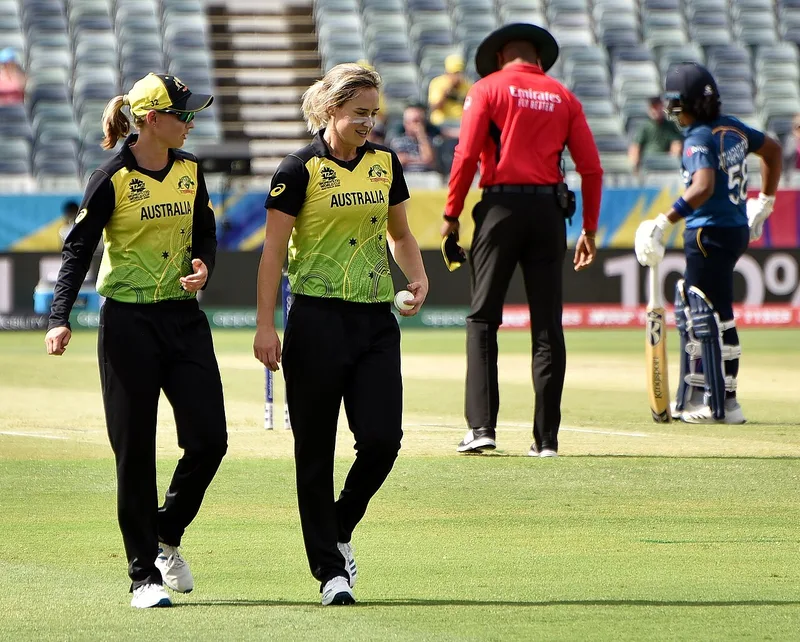

The Australian women's national cricket team, formerly known as the Southern Stars, represent Australia in international cricket. Currently captained by Sophie Molineux and coached by Shelley Nitschke, they are the top team in all world rankings assigned by the International Cricket Council.
Australia played their first Test match in 1934–35 against England. The two teams now compete biennially for the Women's Ashes. A rich history with New Zealand stretches back almost as far while strong rivalries have also developed more recently with India and the West Indies, manifesting predominantly via limited overs cricket. In the 50-over format of the game, Australia have won more World Cups than all other teams combined—capturing the 1978, 1982, 1988, 1997, 2005, 2013 and 2022 titles. They have achieved similarly emphatic success in Twenty20 cricket by winning the ICC Women's T20 World Cup in 2010, 2012, 2014, 2018, 2020, 2023 and 2026.
In 2003, Women's Cricket Australia (WCA) and the Australian Cricket Board (ACB) merged to form a single governing body, known as Cricket Australia (CA), which remains to this day. CA has expressed a major goal of the organisation is for cricket to be Australia's leading sport for women and girls, citing the performance and exposure of the national team—which is heavily dependent on its increasingly professional domestic structures, namely the Women's National Cricket League (WNCL) and the Women's Big Bash League (WBBL)—as a key factor to achieving such an aspiration.
A survey conducted by TrueNorth Research in April 2020 showed the national women's cricket team have the strongest emotional connection with Australian sports fans.
Contents
History
Early years
Organised cricket has been played by women in Australia since no later than 1874 when the first recorded match took place in Bendigo. Competitions have existed at state level since the early-1900s and at national level since 1931–32. The Australian Women's Cricket Council (AWCC) was formed in March 1931 to administer and develop the game at the national level. The original members of the AWCC were Victoria, New South Wales and Queensland. South Australia and Western Australia joined in 1934, while ACT and Tasmania affiliated in 1977 and 1982 respectively.
England became the first international women's cricket team to visit Australia, touring in the summer of 1934–35 to compete in a series against an Australian team captained by Margaret Peden. Three Test matches—the first-ever involving women—were played during the series which received significant public and media interest. Men, in particular, were eager and curious to see the women play. The famous SCG barracker Yabba was quoted at the time: "The ladies are playing alright for me. This is cricket, this is… Leave the girls alone!" Following two losses, Australia eked out a draw in the third Test at the MCG with the spin bowling duo of Anne Palmer and Peggy Antonio proving to be among the team's standout performers.
After raising their own funds to travel to the United Kingdom, the Australian women's team embarked on a maiden overseas voyage in 1937. They proceeded to play 16 tour matches across England including three Tests—the first resulting in a narrow win which saw leg spinner Peggy Antonio dominate with the ball again while Kath Smith played a crucial all-round role. With the series level at 1–1, the third Test was played at The Oval and attracted a crowd of over 6,000 people. The match ended in a draw. Soon after Australia's landmark tour, the momentum of the burgeoning women's game was halted by the events of World War II.
1947–1958: Wilson era
International cricket resumed toward the end of the 1947–48 season when Australia visited New Zealand for the first time, comprehensively defeating the hosts in the only Test of the tour. The following summer, England returned to Australian shores and suffered their first series loss. Having already affirmed herself as a star of the team with a ten-wicket haul and an innings of 90 against New Zealand, all-rounder Betty Wilson led Australia to a 186-run victory in the first Test of the 1948–49 series over England, claiming match figures of 9/62 as well as scoring a century.
Australia's 1951 tour of England included one of the closest finishes to a women's Test match in the 20th century. The second Test, played in Worcester, was a tight battle as the Mollie Dive-led Australian team overcame a 39-run first innings deficit to successfully chase down a target of 160 on the final day of play with two wickets in hand. Though Wilson contributed key runs and wickets as anticipated, it was ultimately the all-round performance of fast bowler Norma Whiteman (who finished the match with a defiant knock of 36 not out) which guided the team across the line. Both players were also standouts in the Third test, though England nevertheless triumphed by 137 runs to end the three-match series at 1–1.
England's next tour of Australia produced several notable milestones, particularly during the first Test of the drawn 1957–58 series. The match, played at the Junction Oval in Melbourne, marked the first time international cricket was broadcast on Australian television. Betty Wilson was once again an inimitable force throughout the topsy-turvy contest, which ultimately ended in a draw, becoming the first player to take ten wickets and score a century in the same Test. In another historic breakthrough, Faith Thomas made her debut in the match, becoming the first Indigenous person to represent Australia in any national sporting team.
1958–1973: Establishment of the IWCC
Australia became a member of the International Women's Cricket Council (IWCC) at its inception in 1958, helping to form the governing body alongside England, the Netherlands, New Zealand and South Africa. Lack of funds and low public interest throughout the 1960s caused the women's game, once again, to decline. The on-field fortunes of the Australian team were simultaneously grim, as they finished the decade with a streak of eleven winless Test matches.
They were not successful in the early-1970s and had their first-ever Test mach loss to New Zealand. Mary Allitt, who captained the national team for the 1963 tour of England, was awarded the Medal of the Order of Australia in June 2007. When she died in 2013, Cricket Australia CEO James Sutherland said Allitt helped to "pave the way for today's elite players" and that she "holds a significant place in the history of women's cricket."
One of the longest-serving players and administrators for women's cricket during this period was Lorna Thomas. Retiring as a cricketer in the late 1950s, Thomas took up team management which included overseeing four tours abroad. She retired from her position as manager of the New South Wales and Australian teams in the 1970s and was awarded an MBE for services to cricket.
1973–1991: Introduction of One Day cricket
The team attracted sponsors with the help of the first World Cup in 1973, which served as an introduction to the One Day International (ODI) format for women's cricket. Australia finished the tournament as runners-up, losing to host nation England in the final. The number of tours, both overseas and at home, increased soon thereafter. Healthy finances allowed for investment in more suitable training and coaching, and these initiatives were vindicated with the team achieving global domination by the 1980s.
India paid a maiden visit in 1976–77, playing one Test match in Perth which resulted in Australia's first victory in the longest form of the game in nearly two decades, marking the beginning of the team's turnaround. The following year, at the 1978 World Cup, Australia defeated England in the final to claim a breakthrough world championship. Captain Margaret Jennings led the team in its triumphant campaign while Sharon Tredrea had a significant impact with bat and ball throughout the tournament which was held in India before crowds of up to 40,000 people.
Australia successfully defended their crown at the 1982 World Cup, held in New Zealand, by beating England in the final again. Making their ODI debuts at the start of the tournament, batter Jill Kennare was the leading run-scorer for the team while Lyn Fullston took the most wickets of all players. A talented all-rounder who also represented her country in netball, Fullston was a notable embodiment of two Australian team member archetypes: the prolific left-arm orthodox spinner (paralleled by several successors, including Shelley Nitschke and Jess Jonassen) and the elite dual-sport athlete (further exemplified by the likes of Ellyse Perry and Jess Duffin).
A dogged English team toured in 1984–85, pulling ahead early in a five-match Test series with a come-from-behind five-run win. Not only did Australia respond resoundingly throughout the remainder of the summer to wrap up a 2–1 series victory, it would take more than 20 years to pass before England would record another Test match victory against their arch-rivals. The fifth Test, played at Queen Elizabeth Oval, saw Australian captain Raelee Thompson—in her last season with the national team—take 5/33 on the first day of play to help set up a seven-wicket win for her country. Jill Kennare and Denise Emerson were key performers with the bat throughout the series.
1991–2005: Clark era
The decade-long global dominance of Australia had undoubtedly petered out by the 1993 World Cup when the team finished the group stage in third place, thus failing to qualify for the final. The ultimate blow arguably occurred in their last pool match, suffering a brutal ten-wicket loss to New Zealand after being bowled out for 77. In many respects, however, it also signified the start of an even more fruitful chapter in the team's history. While several core group members, such as Lyn Larsen and Denise Annetts, retired from international cricket at the conclusion of the tournament or soon after, the next generation of stars had already begun to cement themselves at the top level—most famously Belinda Clark and Zoe Goss. The following year, Goss also helped spark an unprecedented amount of attention around the women's game when she dismissed Brian Lara during a charity match at the Sydney Cricket Ground.
By 1995, with Clark having taken the reins of captaincy in the previous year, more cornerstones of a soon-to-be-ominous outfit had been added in batter Karen Rolton and coach John Harmer. A biomechanics expert by trade, Harmer advocated for an exciting and enjoyable approach from his players: "After my first tour of New Zealand, I took them aside and said, 'This is so boring, sitting here, watching you lot play. You're scoring at 1.5 an over. That's not cricket. Make runs, take wickets, make the play and do it with a smile on your face.'" In another shift for the game, the inaugural Women's National Cricket League (WNCL) season was held in the summer of 1996–97. Superseding the Australian Women's Cricket Championships which had taken place in a two-week tournament format since 1930–31, the annual WNCL competition enabled a much greater amount of cricket between the country's state teams in order to better develop players and maximise their chances of achieving success at international level.
Australia completed one of their most devastating line-ups ever with the emergence of fast bowler Cathryn Fitzpatrick. Having drifted in and out of the team during the early and mid 1990s, Fitzpatrick found the beginning of a rich and extensive vein of form just in time for the 1997 World Cup in India. The Australians went through the group matches of the tournament undefeated, thrashing teams regardless of their historical strength on the world stage. Not only did they defeat Denmark by 363 runs (which included a record innings of 229 not out by Belinda Clark) and bowled out Pakistan for 27, they also chased down totals set by England and South Africa with half-an-innings to spare. The knockout stage proved to be more closely contested, though Australia nevertheless accounted for India and then New Zealand to reclaim the world championship. The final, played at Eden Gardens, attracted an estimated crowd of at least 50–60,000 people. Triumphant captain Clark has cited the scenes in the aftermath of the match as a career highlight: "Our victory lap is still etched in my memory, because we were being cheered like a home team. For us to win there was extremely special."
2005–2015: Introduction of Twenty20 cricket
The IWCC was officially integrated with the International Cricket Council (ICC) after the 2005 World Cup, promising to result in "greater media exposure and publicity" for the women's game than ever before. Later that year, Australia's 15-match undefeated streak in Tests against England was broken when they lost by six wickets in Worcester. The team's tour of the United Kingdom concluded in Taunton by playing in their first-ever Twenty20 International (T20I) fixture. An innings of 96 not out by Karen Rolton helped the Australians to recover from 3/6, successfully chasing down a target of 153 with seven wickets in hand and 14 balls remaining.
Following the retirement of Belinda Clark, the unsurprising appointment of Karen Rolton as the new Australian captain occurred in early 2006. Rolton's tenure oversaw a challenging transition period in the team's history as the careers of several players from the '90s zenith line-up came to a close—in particular, Cathryn Fitzpatrick made her last appearance for Australia in the final of the 2006–07 Quadrangular Series. Fitzpatrick retired as the world's leading wicket-taker in Women's ODIs at the time and as her country's second-most prolific wicket-taker in Women's Tests behind Betty Wilson. Searching to fill the immense void left by the departure of their premier fast bowler, selectors looked to the future by turning to a 16-year-old Ellyse Perry who would play her first ODI for the team in July 2007. Headlines around Perry's record-breaking debut age were quickly followed up with news of her debut for the national women's soccer team just two weeks later, though interest in the young all-rounder reached a new high in February 2008 when she delivered a Player of the Match performance against England in her maiden T20I.
Australia hosted the 2009 World Cup and entered the tournament as favourites, but their performance fell well short of expectations and the team finished in fourth place. Later in the year, at the inaugural Women's T20 World Cup held in England, they were defeated by the host nation in the semi-finals. The following month, Karen Rolton made her last appearance for Australia during the only Test of the 2009 Women's Ashes. After making a duck in the first innings, Rolton compiled 31 on the third day of play to become the only Australian woman to score 1,000 career runs in Test cricket. The match ended in a draw despite a commanding innings of 139 by Jodie Fields, who had already assumed the captaincy from Rolton at the conclusion of the World Twenty20 tournament.
2015–present: Beginning of the professional era
Ahead of the 2015 Women's Ashes, Matthew Mott was appointed as the team's new coach. Australia won the series for the first time since the introduction of the points system, set up by an impressive Test win at the St Lawrence Ground. Jess Jonassen starred with the bat while Ellyse Perry tore through the English line-up with the ball on the last day of play to help record a 161-run victory. Back home, increased investment in the game began to take hold with the establishment of the Women's Big Bash League (WBBL). Domestic women's T20 cricket in the country had previously been played via the Australian Women's Twenty20 Cup in which state squads were drawn from the seven-team WNCL competition. Cricket Australia made the strategic decision to pivot and expand to a women's T20 equivalent of the eight-team model that had already been introduced to the men's game in the form of the Big Bash League (BBL), aiming to further heighten the profile and professionalism of elite-level female cricket.
Despite initial promising signs, the Mott–Lanning regime was soon on shaky ground after the team suffered shock defeats at two major events in as many years. They lost a tightly contested final to the West Indies at the 2016 World Twenty20, and were then unceremoniously knocked out of the 2017 World Cup via a semi-final upset at the hands of India. Australia's troubles were exacerbated by a shoulder injury to Lanning, who missed several games of the latter tournament and would undergo surgery soon after, sidelining her for six months.
With Lanning set to miss the 2017–18 Women's Ashes, Rachael Haynes stepped in as acting captain and the team retained the trophy via an inconsistent performance across the drawn series. As part of the series, the first-ever women's day/night Test was held at North Sydney Oval, which ended in a draw. The match was also particularly notable for Ellyse Perry's record-breaking innings of 213 not out, the highest score by an Australian in women's Tests.
Continuing to overhaul its approach to the women's game, Cricket Australia announced in June 2017 that the Southern Stars moniker—an official title of the team for several years—would be discontinued, thereby mirroring the nickname-free national men's team. Then, in August, CA announced it would increase total female player payments from $7.5 million to $55.2 million, with the deal hailed as the biggest pay rise in the history of women's sport in Australia. The on-field performance of the national team began to skyrocket in the wake of this watershed moment.
Uniform
For most of the 20th century, the typical playing attire for female cricketers included skirts or culottes worn with long socks. This deviation from the men's game, in which trousers were standard issue, ended in 1997. The existence and subsequent extinction of the now-infamous culottes, paired with the players previously having to pay out of their own pocket for the unfortunate fashion trend, has been cited as a symbol of the shift from the amateur to professional era in women's cricket.
The uniform of the Australian women's team now usually closely resembles that of the national men's team—classic cricket whites and a baggy green cap for Tests, the iconic canary yellow outfit for ODIs (though a predominantly green design was worn for a period in the early 2000s), and often a mostly black ensemble for T20Is—with the main differences found in subtle tapering to better fit the female form where necessary, as well as relevant changes to sponsor logos. An additional small difference can be spotted on the coat of arms (which appears on the baggy green among other items of apparel), wherein the colours of the scroll and the "Australia" motto are reversed from red and gold for the men's team to gold and red for the women's team.
In February 2020, for the first time, the team wore an Indigenous-themed uniform design (featuring artwork created by Aboriginal artists) in a T20I match against England.
Team song
The team song is sung by the players after every victory. Unlike the men's team, which sings Under the Southern Cross I Stand, the women sing their own song to the tune of the Notre Dame Victory March.
Players
Former players
Commonly known players include Meg Lanning, Belinda Clark, Cathryn Fitzpatrick, and Ellyse Perry. Clark and Fitzpatrick are both in the ICC hall of fame, while Lanning and Clark captained Australia. Perry is a Double international, having represented Australia in both cricket and soccer.
For a list of all players in ICC hall of fame, see ICC Cricket Hall of Fame
National captains
The current national captain of Australia is Sophie Molineux and the current vice captains of Australia are Tahlia McGrath and Ashleigh Gardner, but they have been many appointed captains for Australia over the years.
Current squad
A minimum of 18 players are offered a Cricket Australia women's contract each year. The program is conducted over a twelve-month period in which the athletes attend approximately three camps per year at the National Cricket Centre and undergo specialist training sessions within their home state.
Individual programs are developed for each squad member by the women's team head coach in consultation with the state coaches and the player. The player progress is monitored via testing, coach state visits, training diaries and communication with the athlete's coaches (state and satellite) by the head coach with assistance from the Australian team support staff and relevant state coach.
The table below lists the players awarded a national women's team contract with Cricket Australia on 8 April 2026, as well as any active player to make an appearance for the team within the last 12 months. Players not named on the initial list can be upgraded during the following twelve-month period by accruing twelve national team selection points to earn a contract—appearances at Test level are worth four points, while ODIs and T20Is are worth two each.
Key
Forms – This refers to the forms they've played for Australia in the past year, not over their whole Australia career
S/N – Shirt number
C – Contracted to Cricket Australia (Y = Holds contract)
Coaching staff
The current coaching staff of the Australian women's cricket team includes:
Shelley Nitschke – Head Coach
Jude Coleman – Assistant Coach
Dan Marsh – Assistant Coach
Meg Lanning – Assistant Coach/Mentor
Alex Kuntouris – Physio
Source:
Selection panel
The members of the current National Selection Panel for the Australian women's cricket team are:
Shawn Flegler – Chairman
Shelley Nitschke – Head Coach
Julie Hayes
Avril Fahey
Source:
Tournament history
Honours
ICC
Women's World Cup:
Champions (7): 1978, 1982, 1988, 1997, 2005, 2013, 2022
Runners-up (2): 1973, 2000
Women's T20 World Cup:
Champions (7): 2010, 2012, 2014, 2018, 2020, 2023, 2026
Runners-up (1): 2016
Other
Commonwealth Games
Gold medal (1): 2022
Records and statistics
Tests
Highest team total: 9/575 dec. vs South Africa on 15 February 2024 at the WACA
Highest individual score in an innings: 213* – Ellyse Perry vs England on 9 November 2017 at North Sydney Oval
Best bowling figures in an innings: 8/66 – Ashleigh Gardner vs England on 22 June 2023 at Trent Bridge
One Day Internationals
Highest team total: 3/412 vs Denmark on 16 December 1997 at Middle Income Group Club Ground
Highest individual score in an innings: 229* – Belinda Clark vs Denmark on 16 December 1997 at Middle Income Group Club Ground
Best bowling figures in an innings: 7/18 – Alana King vs South Africa on 25 October 2025 at Holkar Stadium, Indore
Twenty20 Internationals
Highest team total:
3/226 vs England, 26 July 2019 at Essex County Ground
2/226 vs Sri Lanka, 2 October 2019 at North Sydney Oval
Highest individual score in an innings: 148* – Alyssa Healy vs Sri Lanka, 2 October 2019 at North Sydney Oval
Best bowling figures in an innings: 5/10 – Molly Strano vs New Zealand, 19 February 2017 at Kardinia Park