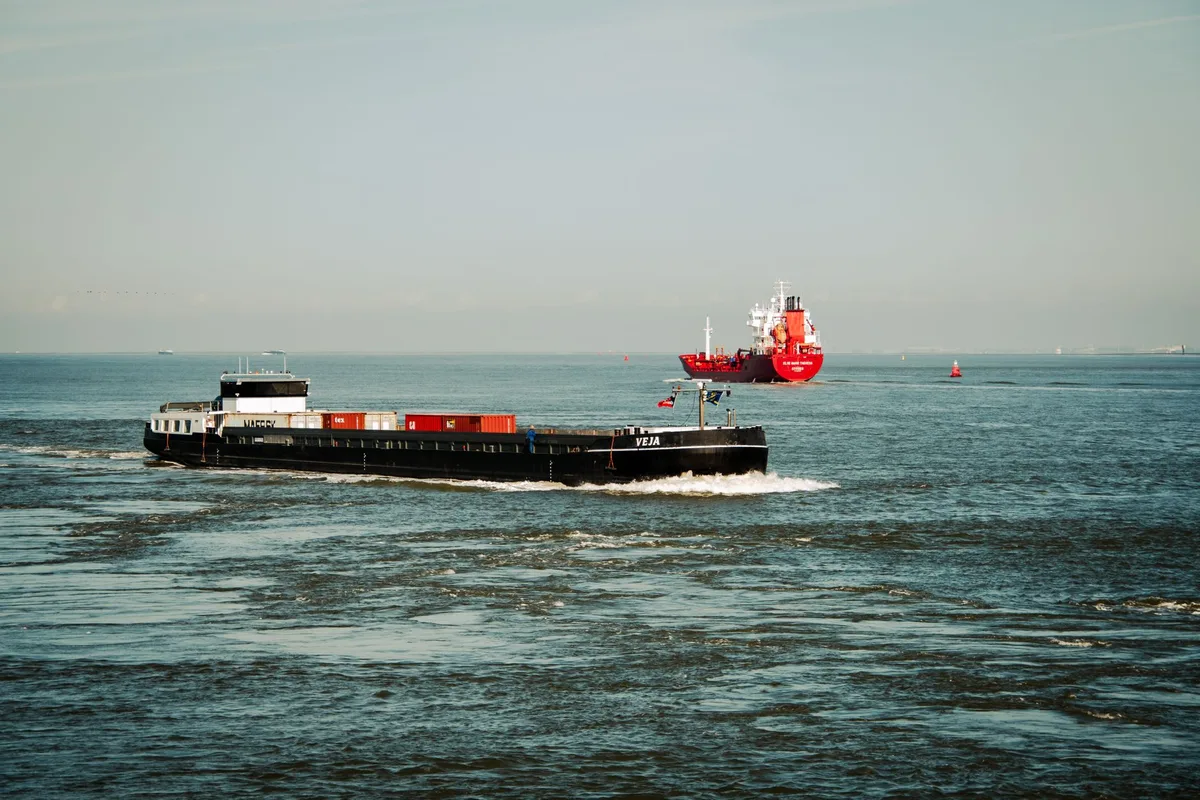
The Bab-el-Mandeb is a strait and a major global chokepoint between Yemen on the Arabian Peninsula and Djibouti and Eritrea in the Horn of Africa, connecting the Red Sea to the Gulf of Aden and the Indian Ocean.
Contents
Etymology
In Bab-el-Mandeb, Bab means "gate" or "door" while Mandeb means "lamentation" or "grief". The strait derives its name from the dangers attending its navigation or, according to an Arab legend, from the numbers who were drowned by an earthquake that separated the Arabian Peninsula from the Horn of Africa.
History
Paleo-environmental and tectonic events in the Miocene epoch created the Danakil Isthmus, a land bridge forming a broad connection between Yemen and Ethiopia. During the last 100,000 years, eustatic sea level fluctuations have led to alternate opening and closing of the straits. According to the recent single origin hypothesis, the straits of Bab-el-Mandeb were probably witness to the earliest migrations of modern humans across continents. It is presumed that the oceans were then much lower and the straits were much shallower or dry, which allowed a series of emigrations along the southern coast of Asia.
In Arab tradition it is reported that in ancient times Asia and Africa were joined together, until
they were split at the Bab-el-Mandeb. Yaqut al-Hamawi associates the name Bab-el-Mandeb with the 6th century crossing of the Aksumites over the sea to Yemen. Two Sabaean inscriptions of the early 6th century mention silsilat al-Mandab in connection with the conflict between Dhu Nuwas and the Aksumites.
The British East India Company unilaterally seized the island of Perim in 1799 on behalf of its Indian empire. The government of Britain asserted its ownership in 1857 and erected a lighthouse there in 1861, using it to command the Red Sea and the trade routes through the Suez Canal. It was used as a coaling station to refuel steamships until 1935 when the reduced use of coal as fuel rendered the operation unprofitable.
The British presence continued until 1967 when the island became part of the People's Republic of South Yemen. Before the handover, the British government had put forward before the United Nations a proposal for the island to be internationalized as a way to ensure the continued security of passage and navigation in the Bab-el-Mandeb, but this was refused.
In 2008 a company owned by Tarek bin Laden unveiled plans to build a bridge named Bridge of the Horns across the strait, linking Yemen with Djibouti. Middle East Development LLC issued a notice to construct a bridge passing across the Red Sea that would be the longest suspended passing in the world. The project was assigned to two Danish companies: engineering company COWI in collaboration with architect studio Dissing+Weitling. However, the announced delay to Phase 1 in 2010 and the lack of any further updates since makes this a defunct project.
Significance in the maritime trade route
The Bab-el-Mandeb acts as a strategic link between the Indian Ocean and the Mediterranean Sea via the Red Sea and the Suez Canal. Most exports of petroleum and natural gas from the Persian Gulf that transit the Suez Canal or the SUMED Pipeline pass through both the Bab el-Mandeb and the Strait of Hormuz. While the narrow width of the strait requires vessels to travel through the territorial sea of adjacent states, under the purview of Article 37 of the United Nations Convention on the Law of the Sea, the legal concept of transit passage applies to Bab el-Mandeb, although Eritrea (unlike the rest of coastal countries) is not a party to the convention.
Chokepoints are narrow channels along widely used global sea routes that are critical to global energy security. The Bab el-Mandeb Strait is 26 kilometres (14 nautical miles) wide at its narrowest point, limiting tanker traffic to two 2-mile-wide channels for inbound and outbound shipments.
Closure of the Bab el-Mandeb Strait could keep tankers originating in the Persian Gulf from transiting the Suez Canal or reaching the SUMED Pipeline, forcing them to divert around the southern tip of Africa, which would increase transit time and shipping costs.
In 2006, an estimated 3.3 million barrels (520,000 m3) of oil passed through the strait per day, out of a world total of about 43 million barrels per day (6,800,000 m3/d) moved by tankers. (For in-between data, see.) This rose by 2014 to 5.1 million barrels per day (b/d) of crude oil, condensate and refined petroleum products headed toward Europe, the United States, and Asia, then an estimated 6.2 million b/d by 2018.
In 2017, total petroleum flows through the Bab el-Mandeb Strait accounted for about 9% of total seaborne-traded petroleum (crude oil and refined petroleum products) in 2017. About 3.6 million b/d moved north toward Europe; another 2.6 million b/d flowed in the opposite direction mainly to Asian markets such as Singapore, China, and India.
Significance for maritime security and geopolitics
The Bab-el-Mandeb is widely regarded to play a key role in international, regional and maritime security in the Middle East, East Africa, the Red Sea, and the Gulf of Aden. The strait is only "9¼ miles (16½ km)" wide at its narrowest point between Djibouti and Perim (the "Large Strait", as opposed to the "Small Strait" on the other side with Yemen), and is considered a choke point, which makes the Bab-el-Mandeb of economic and strategic interest. The Bab-el-Mandeb is an important corridor for geostrategic cables underneath the narrow strait passage at the Bab-el-Mandeb, including power cables and fibre-optic cables used for communication, which attracts the attention of intelligence services for surveillance.
Although the Bab-el-Mandeb, legally, is an international strait and a transit passage, its strategic position has made command of the sea over the strait key to military influence in the region. The Bab-el-Mandeb is often discussed alongside other major maritime chokepoints, such as the Suez Canal and the Strait of Hormuz, due to their shared importance for maritime security in the region.
The opening of the Suez Canal in 1869 made the Bab-el-Mandeb a strategic choke point. Since then, the strait has been subject to claims of control via land-based positions and naval presence. This has been evident between present-day Yemen and the island of Perim on the side of the Arabian Peninsula and Djibouti, Eritrea and the Seven Brothers Islands at the Horn of Africa site, and from sea the Gulf of Aden and the Red Sea.
On the Arabian Peninsula, the British Empire was present in Yemen and at Perim from 1799 until 1967, when the island came under control of People's Democratic Republic of Yemen after its independence from the Aden Protectorate. From 1967 to 1986, there was a strong Soviet presence at Perim and by the Bab-el-Mandeb. This presence slowly faded out until the end of the Cold War, after which the USSR withdrew their forces.
Today the Yemeni civil war (2014–present) influences the security of the Yemen site. The Iran-backed Houthis and the Yemeni National forces are the key land-based security actors around the Bab-el-Mandeb, with regional powers including Iran, Israel, Saudi Arabia, and United Arab Emirates trying to influence the conflict.
Geography
The distance across is about 26 kilometres (14 nmi) from Ras Menheli in Yemen to Ras Siyyan in Djibouti. The island of Perim divides the strait into two channels. The eastern, known as the Bab Iskender (Alexander's Strait), is 5.37 kilometres (2.90 nmi) wide and has a depth of 29 metres; 96 feet (16 fathoms). The western, or Dact-el-Mayun, has a width of 20.3 kilometres (11.0 nmi) and a depth of 310 metres; 1,020 feet (170 fathoms).
Near the coast of Djibouti lies a group of smaller islands known as the "Seven Brothers". There is a surface current inwards in the eastern channel, but a strong undercurrent outwards in the western channel. The width between the island of Perim (Yemen) and Big Island (Kaḏḏa Dâbali), Djibouti is just 17 kilometres (9.2 nmi).
Islands
Islands and archipelagos in and near the Bab-el-Mandeb include:
Doumeira Islands — islands between Djibouti and Eritrea.
Hanish Islands — Yemeni archipelago in the southern Red Sea.
Perim — Yemeni island dividing the strait into two channels.
Rocher Siyyan — Djiboutian islet near Ras Siyyan.
Seven Brothers Islands — Djiboutian archipelago in the Dact-el-Mayun.
Siyyan Himar — pair of small Djiboutian islands.
Population centers
The most significant towns and cities along both the Djiboutian and Yemeni sides of the Bab-el-Mandeb:
Djibouti
Khôr ʽAngar
Moulhoule
Fagal
Yemen
At Turbah
Cheikh Saïd
Perim