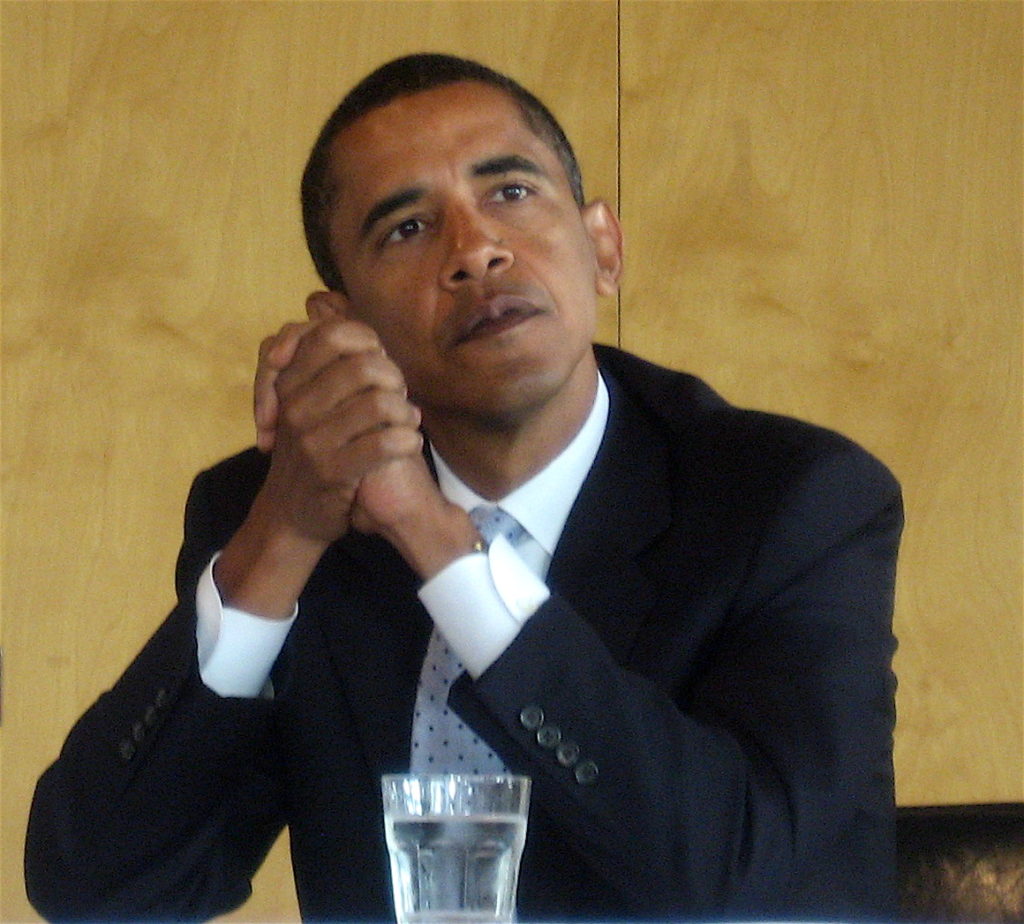
Barack Hussein Obama II (born August 4, 1961) is an American politician who served as the 44th president of the United States from 2009 to 2017. A member of the Democratic Party, he was the first African American to serve as president. Obama represented Illinois in the United States Senate from 2005 to 2008 and served as an Illinois state senator from 1997 to 2004.
Born in Honolulu, Obama graduated from Columbia University in 1983 and later worked as a community organizer in Chicago. In 1988, Obama enrolled at Harvard Law School, where he was the first Black president of the Harvard Law Review. He became a civil rights attorney and an academic, teaching constitutional law at the University of Chicago Law School from 1992 to 2004. In 1996, Obama was elected to represent the 13th district in the Illinois Senate. In 2000, Obama ran for Illinois's 1st congressional district, but came in second to the incumbent Representative, Bobby Rush. Following his loss in the House race, he kept his position he held in the State Senate until 2004, when he successfully ran for the U.S. Senate. In the 2008 presidential election, after a close primary campaign against Hillary Clinton, he was nominated by the Democratic Party for president. Obama selected Joe Biden as his running mate and defeated Republican nominee John McCain and his running mate Sarah Palin.
Obama was awarded the 2009 Nobel Peace Prize for efforts in international diplomacy, a decision that drew both praise and criticism. During his first term, his administration responded to the 2008 financial crisis with measures including the American Recovery and Reinvestment Act of 2009 to address the Great Recession; a partial extension of the Bush tax cuts; legislation to reform health care; and the Dodd–Frank Wall Street Reform and Consumer Protection Act, a major financial regulation reform bill. Obama also appointed Supreme Court justices Sonia Sotomayor and Elena Kagan, the former being the first Hispanic American on the Supreme Court. Obama also oversaw the end of the Iraq War and ordered Operation Neptune Spear, the raid that killed Osama bin Laden, who was the leader of al-Qaeda and was responsible for the September 11 attacks. He downplayed Bush's counterinsurgency model by expanding air strikes and making extensive use of special forces, while encouraging greater reliance on host-government militaries. Obama also ordered the 2011 military intervention in Libya to implement United Nations Security Council Resolution 1973, which contributed to the overthrow of Muammar Gaddafi.
Obama defeated Republican opponent Mitt Romney and his running mate Paul Ryan in the 2012 presidential election. In his second term, Obama advocated for gun control in the wake of the Sandy Hook Elementary School shooting, took steps to combat climate change by signing the Paris Agreement on climate change and an executive order to limit carbon emissions, and presided over the implementation of the Affordable Care Act and other legislation passed during his first term. Obama also initiated sanctions against Russia following its invasion in Ukraine and again after Russian interference in the 2016 U.S. elections. He ordered military intervention in Iraq after gains made by ISIL following the 2011 withdrawal from Iraq, negotiated the Joint Comprehensive Plan of Action (a nuclear agreement with Iran), and normalized relations with Cuba. The number of American soldiers in Afghanistan decreased during Obama's second term, though U.S. soldiers remained in the country throughout his presidency. He also promoted inclusion for LGBTQ Americans, becoming the first sitting U.S. president to publicly support same-sex marriage.
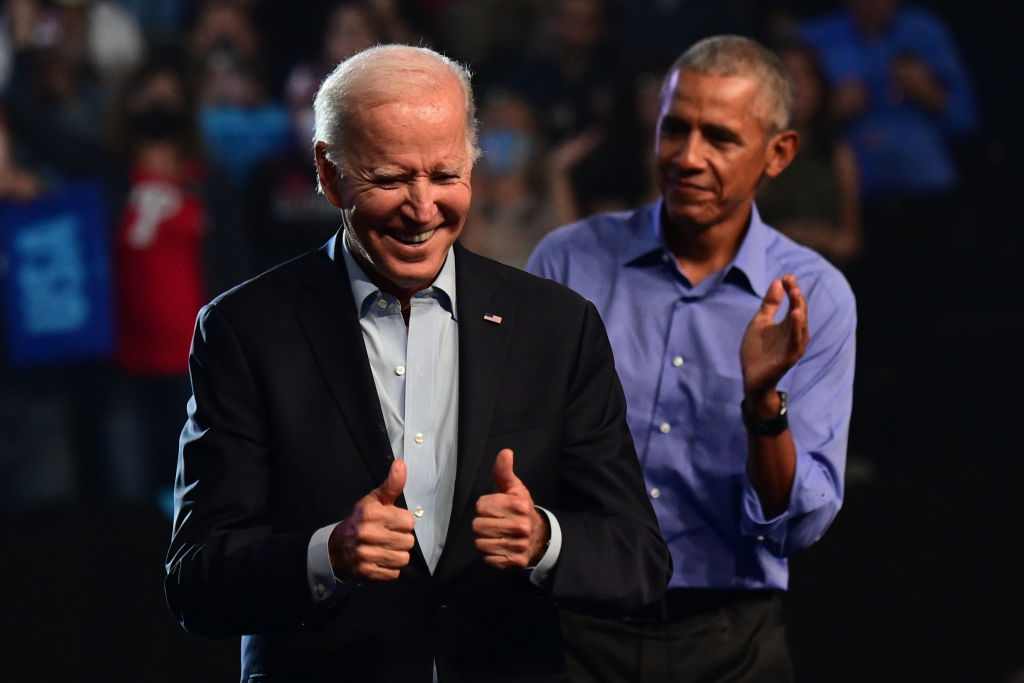
Obama has continued to be politically active since he left office in 2017, campaigning for candidates in American elections, including Biden's successful presidential bid in the 2020 presidential election. Outside politics, Obama has published three books: Dreams from My Father (1995), The Audacity of Hope (2006), and A Promised Land (2020). Historians and political scientists rank Obama highly in historical rankings of U.S. presidents. As of 2026, he is the youngest-living former U.S. president.
Contents
Early life and career
Barack Hussein Obama II was born on August 4, 1961, at Kapiolani Medical Center for Women and Children in Honolulu, Hawaii. He is the only president born outside the contiguous United States. He was born to an 18-year-old American mother and a 27-year-old Kenyan father. His mother, Ann Dunham (1942–1995), was born in Wichita, Kansas, and was of English, Welsh, German, Swiss, and Irish descent. In 2007 it was discovered her great-great-grandfather Falmouth Kearney emigrated from the village of Moneygall, Ireland to the U.S. in 1850. In July 2012, Ancestry.com found a strong likelihood that Dunham was descended from John Punch, an enslaved African man who lived in the Colony of Virginia during the seventeenth century. Obama has described the ancestors of his grandparents as Scotch-Irish mostly. Obama's father, Barack Hussein Obama (1934–1982), was a married Luo Kenyan from Nyang'oma Kogelo. His last name, Obama, was derived from his Luo descent. Obama's parents met in 1960 in a Russian language class at the University of Hawaiʻi at Mānoa, where his father was a foreign student on a scholarship. The couple married in Wailuku, Hawaii, on February 2, 1961, six months before Obama was born.
In late August 1961, a few weeks after he was born, Barack and his mother moved to the University of Washington in Seattle, where they lived for a year. During that time, Barack's father completed his undergraduate degree in economics in Hawaii, graduating in June 1962. He left to attend graduate school on a scholarship at Harvard University, where he earned a Master of Arts in economics. Obama's parents divorced in March 1964. Obama Sr. returned to Kenya in 1964, where he married for a third time and worked for the Kenyan government as the senior economic analyst in the Ministry of Finance. He visited his son in Hawaii only once, at Christmas 1971, before he was killed in an automobile accident in 1982, when Obama was 21 years old. Recalling his early childhood, Obama said: "That my father looked nothing like the people around me—that he was black as pitch, my mother white as milk—barely registered in my mind." He described his struggles as a young adult to reconcile social perceptions of his multiracial heritage.
In 1963, Dunham met Lolo Soetoro at the University of Hawaiʻi; he was an Indonesian East–West Center graduate student in geography. The couple married on Molokai on March 15, 1965. After two one-year extensions of his J-1 visa, Lolo returned to Indonesia in 1966. His wife and stepson followed sixteen months later in 1967. The family initially lived in the Menteng Dalam neighborhood in the Tebet district of South Jakarta. From 1970, they lived in a wealthier neighborhood in the Menteng district of Central Jakarta.
Education
When he was six years old, Obama and his mother moved to Indonesia to join his stepfather. From age six to ten, he was registered in school as "Barry" and attended local Indonesian-language schools: Sekolah Dasar Katolik Santo Fransiskus Asisi (St. Francis of Assisi Catholic Elementary School) for two years and Sekolah Dasar Negeri Menteng 01 (State Elementary School Menteng 01) for one and a half years, supplemented by English-language Calvert School homeschooling by his mother. As a result of his four years in Jakarta, he was able to speak Indonesian fluently as a child. During his time in Indonesia, Obama's stepfather taught him to be resilient and gave him "a pretty hardheaded assessment of how the world works".
In 1971, Obama returned to Honolulu to live with his maternal grandparents, Madelyn and Stanley Dunham. He attended Punahou School—a private college preparatory school—with the aid of a scholarship from fifth grade until he graduated from high school in 1979. In high school, Obama continued to use the nickname "Barry" which he kept until making a visit to Kenya in 1980. Obama lived with his mother and half-sister, Maya Soetoro, in Hawaii for three years from 1972 to 1975 while his mother was a graduate student in anthropology at the University of Hawaii. Obama chose to stay in Hawaii when his mother and half-sister returned to Indonesia in 1975, so his mother could begin anthropology field work. His mother spent most of the next two decades in Indonesia, divorcing Lolo Soetoro in 1980 and earning a PhD degree in 1992, before dying in 1995 in Hawaii following unsuccessful treatment for ovarian and uterine cancer.
Of his years in Honolulu, Obama wrote: "The opportunity that Hawaii offered — to experience a variety of cultures in a climate of mutual respect — became an integral part of my world view, and a basis for the values that I hold most dear." Obama has also written and talked about using alcohol, marijuana, and cocaine during his teenage years to "push questions of who I was out of my mind". Obama was also a member of the "Choom Gang" (the slang term for smoking marijuana), a self-named group of friends who spent time together and smoked marijuana.
After graduating from high school in 1979, Obama moved to Los Angeles to attend Occidental College on a full scholarship. In February 1981, Obama made his first public speech, calling for Occidental to participate in the disinvestment from South Africa in response to that nation's policy of apartheid. In mid-1981, Obama traveled to Indonesia to visit his mother and half-sister Maya and visited the families of college friends in Pakistan for three weeks. Later in 1981, he transferred to Columbia University in New York City as a junior, where he majored in political science with a specialty in international relations and in English literature and lived off-campus on West 109th Street. He graduated with a Bachelor of Arts degree in 1983 and a 3.7 GPA. After graduating, Obama worked for about a year at the Business International Corporation, where he was a financial researcher and writer, then as a project coordinator for the New York Public Interest Research Group on the City College of New York campus for three months in 1985.
Family and personal life
In a 2006 interview, Obama highlighted the diversity of his extended family: "It's like a little mini-United Nations," he said. "I've got relatives who look like Bernie Mac, and I've got relatives who look like Margaret Thatcher." Obama has a half-sister with whom he was raised (Maya Soetoro-Ng) and seven other half-siblings from his Kenyan father's family. Obama's mother was survived by her Kansas-born mother, Madelyn Dunham, until her death on November 2, 2008, two days before his election to the presidency. Obama also has roots in Ireland; he met with his Irish cousins in Moneygall in May 2011. In Dreams from My Father, Obama ties his mother's family history to possible Native American ancestors and distant relatives of Jefferson Davis, President of the Confederate States of America during the American Civil War. He also shares distant ancestors in common with George W. Bush and Dick Cheney, among others.
While studying in California, Obama met Alexandra McNear. The pair wrote letters to each other while in a long-distance relationship between 1982 and 1984. The letters were acquired by Emory University's Rose Library in 2014 and made public in 2017. Obama wrote of his sense of isolation:Caught without a class, a structure, or a tradition to support me, in a sense the choice to take a different path is made for me... The only way to assuage my feelings of isolation are to absorb all the traditions, classes, make them mine, me theirs. In one of his letters Obama described homosexuality as "an attempt to remove oneself from the present, a refusal perhaps to perpetuate the endless farce of earthly life". Describing his own mind as "androgynous", he wrote "I make love to men daily, but in the imagination."
Obama lived with anthropologist Sheila Miyoshi Jager while he was a community organizer in Chicago in the 1980s. He proposed to her twice, but both Jager and her parents turned him down. The relationship was not made public until May 2017, several months after his presidency had ended.
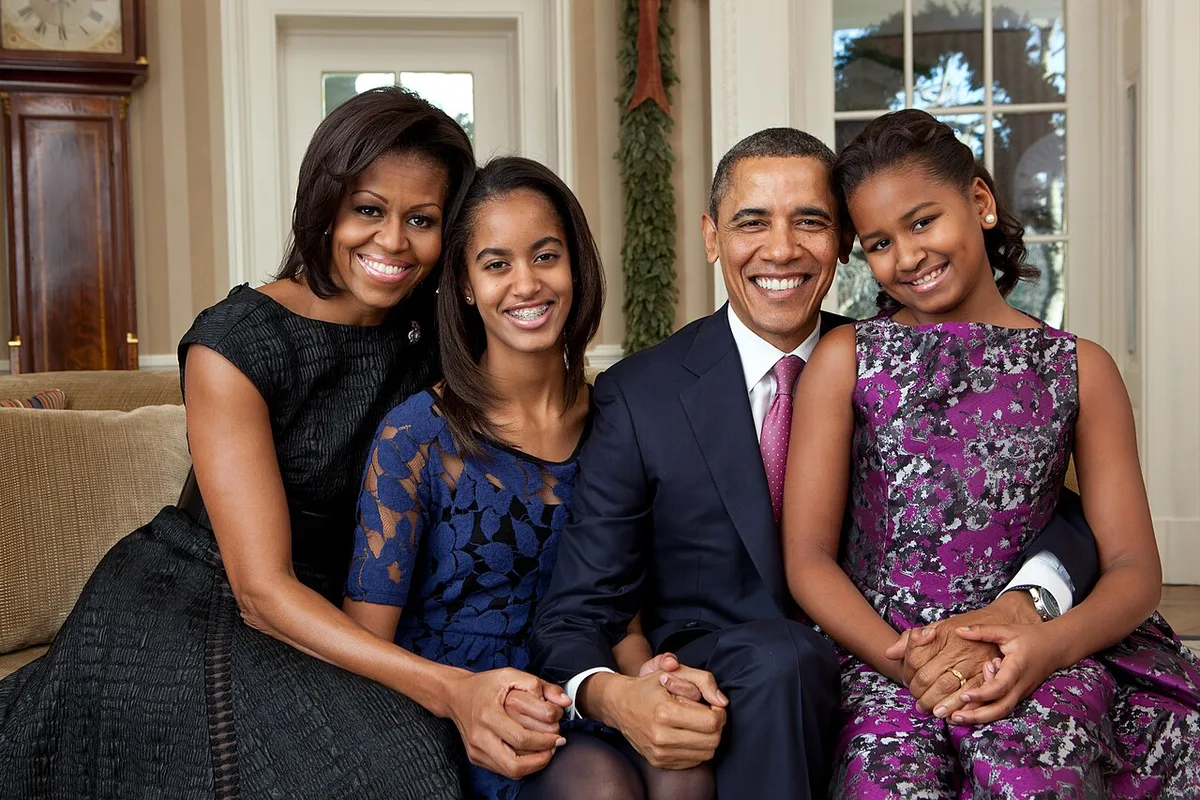
In June 1989, Obama met Michelle Robinson when he was employed at Sidley Austin. Robinson was assigned for three months as Obama's adviser at the firm, and she joined him at several group social functions but declined his initial requests to date. They began dating later that summer, became engaged in 1991, and were married on October 3, 1992. After suffering a miscarriage, Michelle underwent in vitro fertilization to conceive their children. The couple's first daughter, Malia Ann, was born in 1998, followed by a second daughter, Natasha ("Sasha"), in 2001. The Obama daughters attended the University of Chicago Laboratory Schools. When they moved to Washington, D.C., in January 2009, the girls started at the Sidwell Friends School. The Obamas had two Portuguese Water Dogs; the first, a male named Bo, was a gift from Senator Ted Kennedy. In 2013, Bo was joined by Sunny, a female. Bo died of cancer on May 8, 2021.
Religious views
Obama is a Protestant Christian whose religious views developed in his adult life. He wrote in The Audacity of Hope that he "was not raised in a religious household." He described his mother, raised by non-religious parents, as being detached from religion, yet "in many ways the most spiritually awakened person ... I have ever known", and "a lonely witness for secular humanism." He described his father as a "confirmed atheist" by the time his parents met, and his stepfather as "a man who saw religion as not particularly useful." Obama explained how, through working with black churches as a community organizer while in his twenties, he came to understand "the power of the African-American religious tradition to spur social change."
In January 2008, Obama told Christianity Today: "I am a Christian, and I am a devout Christian. I believe in the redemptive death and resurrection of Jesus Christ. I believe that faith gives me a path to be cleansed of sin and have eternal life." On September 27, 2010, Obama released a statement commenting on his religious views, saying:
I'm a Christian by choice. My family didn't—frankly, they weren't folks who went to church every week. And my mother was one of the most spiritual people I knew, but she didn't raise me in the church. So I came to my Christian faith later in life, and it was because the precepts of Jesus Christ spoke to me in terms of the kind of life that I would want to lead—being my brothers' and sisters' keeper, treating others as they would treat me.
Obama met Trinity United Church of Christ pastor Jeremiah Wright in October 1987 and became a member of Trinity in 1992. During Obama's first presidential campaign in May 2008, he resigned from Trinity after some of Wright's statements were criticized. Since moving to Washington, D.C., in 2009, the Obama family has attended several Protestant churches, including Shiloh Baptist Church and St. John's Episcopal Church, as well as Evergreen Chapel at Camp David, but the members of the family do not attend church on a regular basis.
In 2016, Obama said that he gets inspiration from a few items that remind him "of all the different people I've met along the way", adding: "I carry these around all the time. I'm not that superstitious, so it's not like I think I necessarily have to have them on me at all times." The items, "a whole bowl full", include rosary beads given to him by Pope Francis, a figurine of the Hindu deity Hanuman, a Coptic cross from Ethiopia, a small Buddha statue given by a monk, and a metal poker chip that used to be the lucky charm of a motorcyclist in Iowa.
Legal career
From 1994 to 2002, Obama served on the boards of directors of the Woods Fund of Chicago—which in 1985 had been the first foundation to fund the Developing Communities Project—and of the Joyce Foundation. He served on the board of directors of the Chicago Annenberg Challenge from 1995 to 2002, as founding president and chairman of the board of directors from 1995 to 1999. Obama's law license became inactive in 2007.
Legislative career
Illinois Senate (1997–2004)
Obama was elected to the Illinois Senate in 1996, succeeding Democratic state senator Alice Palmer from Illinois's 13th District, which, at that time, spanned Chicago South Side neighborhoods from Hyde Park–Kenwood south to South Shore and west to Chicago Lawn. Once elected, Obama gained bipartisan support for legislation that reformed ethics and health care laws. He sponsored a law that increased tax credits for low-income workers, negotiated welfare reform, and promoted increased subsidies for childcare. In 2001, as co-chairman of the bipartisan Joint Committee on Administrative Rules, Obama supported Republican governor George Ryan's payday loan regulations and predatory mortgage lending regulations aimed at averting home foreclosures.
He was reelected to the Illinois Senate in 1998, defeating Republican Yesse Yehudah in the general election, and was re-elected again in 2002. In 2000, he lost a Democratic primary race for Illinois's 1st congressional district in the United States House of Representatives to four-term incumbent Bobby Rush by a margin of two to one.
In January 2003, Obama became chairman of the Illinois Senate's Health and Human Services Committee when Democrats, after a decade in the minority, regained a majority. He sponsored and led unanimous, bipartisan passage of legislation to monitor racial profiling by requiring police to record the race of drivers they detained, and legislation making Illinois the first state to mandate videotaping of homicide interrogations. During his 2004 general election campaign for the U.S. Senate, police representatives credited Obama for his active engagement with police organizations in enacting death penalty reforms. Obama resigned from the Illinois Senate in November 2004 following his election to the U.S. Senate.
2004 U.S. Senate campaign in Illinois
In May 2002, Obama commissioned a poll to assess his prospects in a 2004 U.S. Senate race. He created a campaign committee, began raising funds, and lined up political media consultant David Axelrod by August 2002. Obama formally announced his candidacy in January 2003.
Obama was an early opponent of the George W. Bush administration's 2003 invasion of Iraq. On October 2, 2002, the day President Bush and Congress agreed on the joint resolution authorizing the Iraq War, Obama addressed the first high-profile Chicago anti-Iraq War rally, and spoke out against the war. He addressed another anti-war rally in March 2003 and told the crowd "it's not too late" to stop the war.
Decisions by Republican incumbent Peter Fitzgerald and his Democratic predecessor Carol Moseley Braun not to participate in the election resulted in wide-open Democratic and Republican primary contests involving 15 candidates. In the March 2004 primary election, Obama won in an unexpected landslide—which overnight made him a rising star within the national Democratic Party, started speculation about a presidential future, and led to the reissue of his memoir, Dreams from My Father. In July 2004, Obama delivered the keynote address at the 2004 Democratic National Convention, seen by nine million viewers. His speech was well received and elevated his status within the Democratic Party.
Obama's expected opponent in the general election, Republican primary winner Jack Ryan, withdrew from the race in June 2004. Six weeks later, Alan Keyes accepted the Republican nomination to replace Ryan. In the November 2004 general election, Obama won with 70 percent of the vote, the largest margin of victory for a Senate candidate in Illinois history. He took 92 of the state's 102 counties, including several where Democrats traditionally do not perform well.
U.S. Senate (2005–2008)
Obama was sworn in as a senator on January 3, 2005, becoming the only Senate member of the Congressional Black Caucus. He introduced two initiatives that bore his name: Lugar–Obama, which expanded the Nunn–Lugar Cooperative Threat Reduction concept to conventional weapons; and the Federal Funding Accountability and Transparency Act of 2006, which authorized the establishment of USAspending.gov, a web search engine on federal spending. On June 3, 2008, Senator Obama—along with Senators Tom Carper, Tom Coburn, and John McCain—introduced follow-up legislation: Strengthening Transparency and Accountability in Federal Spending Act of 2008. He also cosponsored the Secure America and Orderly Immigration Act.
In December 2006, President Bush signed into law the Democratic Republic of the Congo Relief, Security, and Democracy Promotion Act, marking the first federal legislation to be enacted with Obama as its primary sponsor. In January 2007, Obama and Senator Feingold introduced a corporate jet provision to the Honest Leadership and Open Government Act, which was signed into law in September 2007.
Later in 2007, Obama sponsored an amendment to the Defense Authorization Act to add safeguards for personality-disorder military discharges. This amendment passed the full Senate in the spring of 2008. He sponsored the Iran Sanctions Enabling Act supporting divestment of state pension funds from Iran's oil and gas industry, which was never enacted but later incorporated in the Comprehensive Iran Sanctions, Accountability, and Divestment Act of 2010; and co-sponsored legislation to reduce risks of nuclear terrorism. Obama also sponsored a Senate amendment to the State Children's Health Insurance Program, providing one year of job protection for family members caring for soldiers with combat-related injuries.
Obama held assignments on the Senate Committees for Foreign Relations, Environment and Public Works, and Veterans' Affairs through December 2006. In January 2007, he left the Environment and Public Works committee and took additional assignments with Health, Education, Labor and Pensions and Homeland Security and Governmental Affairs. He also became Chairman of the Senate's subcommittee on European Affairs. As a member of the Senate Foreign Relations Committee, Obama made official trips to Eastern Europe, the Middle East, Central Asia, and Africa. He met with Mahmoud Abbas before Abbas became President of the Palestinian National Authority and gave a speech at the University of Nairobi in which he condemned corruption within the Kenyan government. Obama resigned his Senate seat on November 16, 2008, to focus on his transition period for the presidency.
Presidential campaigns
2008 presidential candidacy
On February 10, 2007, Obama announced his candidacy for President of the United States in front of the Old State Capitol building in Springfield, Illinois. The choice of the announcement site was viewed as symbolic, as it was also where Abraham Lincoln delivered his "House Divided" speech in 1858. Obama emphasized issues of rapidly ending the Iraq War, increasing energy independence, and reforming the health care system.
Numerous candidates entered the Democratic Party presidential primaries. The field narrowed to Obama and Senator Hillary Clinton after early contests, with the race remaining close throughout the primary process, but Obama gained a steady lead in pledged delegates due to better long-range planning, superior fundraising, dominant organizing in caucus states, and better exploitation of delegate allocation rules.
On June 2, 2008, Obama had received enough votes to clinch his nomination. After an initial hesitation to concede, on June 7, Clinton ended her campaign and endorsed Obama. On August 23, 2008, Obama announced his selection of Delaware senator Joe Biden as his vice presidential running mate. Obama selected Biden from a field speculated to include former Indiana governor and senator Evan Bayh and Virginia governor Tim Kaine. At the Democratic National Convention in Denver, Colorado, Hillary Clinton called for her supporters to endorse Obama, and she and Bill Clinton gave convention speeches in his support. Obama delivered his acceptance speech at Invesco Field at Mile High stadium to a crowd of about eighty-four thousand; the speech was viewed by over three million people worldwide. During both the primary process and the general election, Obama's campaign set numerous fundraising records, particularly in the quantity of small donations. On June 19, 2008, Obama became the first major-party presidential candidate to turn down public financing in the general election since the system was created in 1976.
John McCain was nominated as the Republican candidate, and he selected Sarah Palin as his running mate. Obama and McCain engaged in three presidential debates in September and October 2008. On November 4, Obama won the presidency with 365 electoral votes to 173 received by McCain. Obama won 52.9 percent of the popular vote to McCain's 45.7 percent. He became the first African-American to be elected president. Obama delivered his victory speech before hundreds of thousands of supporters in Chicago's Grant Park. He is one of three United States senators who moved directly from the U.S. Senate to the White House, the others being Warren G. Harding and John F. Kennedy.
2012 presidential candidacy
On April 4, 2011, Obama filed election papers with the Federal Election Commission and then announced his reelection campaign for 2012 in a video titled "It Begins with Us" that he posted on his website. As the incumbent president, he ran virtually unopposed in the Democratic Party presidential primaries, and on April 3, 2012, Obama secured the 2778 convention delegates needed to win the Democratic nomination. At the Democratic National Convention in Charlotte, North Carolina, Obama and Joe Biden were formally nominated by former president Bill Clinton as the Democratic Party candidates for president and vice president in the general election. Their main opponents were Republicans Mitt Romney, the former governor of Massachusetts, and Representative Paul Ryan of Wisconsin.
On November 6, 2012, Obama won 332 electoral votes, exceeding the 270 required for him to be reelected as president. With 51.1 percent of the popular vote, Obama became the first Democratic president since Franklin D. Roosevelt to win the majority of the popular vote twice. Obama addressed supporters and volunteers at Chicago's McCormick Place after his reelection and said: "Tonight you voted for action, not politics as usual. You elected us to focus on your jobs, not ours. And in the coming weeks and months, I am looking forward to reaching out and working with leaders of both parties."
Presidency (2009–2017)
First 100 days
The inauguration of Barack Obama as the 44th president took place on January 20, 2009. In his first few days in office, Obama issued executive orders and presidential memoranda directing the U.S. military to develop plans to withdraw troops from Iraq. He ordered the closing of the Guantanamo Bay detention camp, but Congress prevented the closure by refusing to appropriate the required funds and preventing moving any Guantanamo detainee. Obama reduced the secrecy given to presidential records. He also revoked President George W. Bush's restoration of President Ronald Reagan's Mexico City policy which prohibited federal aid to international family planning organizations that perform or provide counseling about abortion.
Domestic policy
The first bill signed into law by Obama was the Lilly Ledbetter Fair Pay Act of 2009, relaxing the statute of limitations for equal-pay lawsuits. Five days later, he signed the reauthorization of the State Children's Health Insurance Program to cover an additional four million uninsured children. In March 2009, Obama reversed a Bush-era policy that had limited funding of embryonic stem cell research and pledged to develop "strict guidelines" on the research.
Obama appointed two women to serve on the Supreme Court in the first two years of his presidency. He nominated Sonia Sotomayor on May 26, 2009, to replace retiring associate justice David Souter. She was confirmed on August 6, 2009, becoming the first Supreme Court Justice of Hispanic descent. Obama nominated Elena Kagan on May 10, 2010, to replace retiring Associate Justice John Paul Stevens. She was confirmed on August 5, 2010, bringing the number of women sitting simultaneously on the Court to three for the first time in American history.
On March 11, 2009, Obama created the White House Council on Women and Girls, which formed part of the Office of Intergovernmental Affairs, having been established by Executive Order 13506 with a broad mandate to advise him on issues relating to the welfare of American women and girls. The council was chaired by Senior Advisor to the President Valerie Jarrett. Obama also established the White House Task Force to Protect Students from Sexual Assault through a government memorandum on January 22, 2014, with a broad mandate to advise him on issues relating to sexual assault on college and university campuses throughout the United States. The co-chairs of the Task Force were Vice President Joe Biden and Jarrett. The Task Force was a development out of the White House Council on Women and Girls and Office of the Vice President of the United States, and prior to that the 1994 Violence Against Women Act first drafted by Biden.
In July 2009, Obama launched the Priority Enforcement Program, an immigration enforcement program that had been pioneered by George W. Bush, and the Secure Communities fingerprinting and immigration status data-sharing program.
In a major space policy speech in April 2010, Obama announced a planned change in direction at NASA, the U.S. space agency. He ended plans for a return of human spaceflight to the moon and development of the Ares I rocket, Ares V rocket and Constellation program, in favor of funding earth science projects, a new rocket type, research and development for an eventual crewed mission to Mars, and ongoing missions to the International Space Station.
Foreign policy
In February and March 2009, Vice President Joe Biden and Secretary of State Hillary Clinton made separate overseas trips to announce a "new era" in U.S. foreign relations with Russia and Europe, using the terms "break" and "reset" to signal major changes from the policies of the preceding administration. Obama attempted to reach out to Arab leaders by granting his first interview to an Arab satellite TV network, Al Arabiya. On March 19, Obama continued his outreach to the Muslim world, releasing a New Year's video message to the people and government of Iran. On June 4, 2009, Obama delivered a speech at Cairo University in Egypt calling for "A New Beginning" in relations between the Islamic world and the United States and promoting Middle East peace. On June 26, 2009, Obama condemned the Iranian government's actions towards protesters following Iran's 2009 presidential election.
In 2011, Obama ordered a drone strike in Yemen which targeted and killed Anwar al-Awlaki, an American imam suspected of being a leading Al-Qaeda organizer. al-Awlaki became the first U.S. citizen to be targeted and killed by a U.S. drone strike. The Department of Justice released a memo justifying al-Awlaki's death as a lawful act of war, while civil liberties advocates described it as a violation of al-Awlaki's constitutional right to due process. The killing led to significant controversy. His teenage son and young daughter, also Americans, were later killed in separate U.S. military actions, although they were not targeted specifically.
In March 2015, Obama declared that he had authorized U.S. forces to provide logistical and intelligence support to the Saudis in their military intervention in Yemen, establishing a "Joint Planning Cell" with Saudi Arabia. In 2016, the Obama administration proposed a series of arms deals with Saudi Arabia worth $115 billion. Obama halted the sale of guided munition technology to Saudi Arabia after Saudi warplanes targeted a funeral in Yemen's capital Sanaa, killing more than 140 people.
In September 2016 Obama was snubbed by Xi Jinping and the Chinese Communist Party as he descended from Air Force One to the tarmac of Hangzhou International Airport for the 2016 G20 Hangzhou summit without the usual red carpet welcome.
Starting with information received from Central Intelligence Agency operatives in July 2010, the CIA developed intelligence over the next several months that determined what they believed to be the hideout of Osama bin Laden. He was living in seclusion in a large compound in Abbottabad, Pakistan, a suburban area 35 miles (56 km) from Islamabad. CIA head Leon Panetta reported this intelligence to President Obama in March 2011. Meeting with his national security advisers over the course of the next six weeks, Obama rejected a plan to bomb the compound, and authorized a "surgical raid" to be conducted by United States Navy SEALs. The operation took place on May 1, 2011, and resulted in the shooting death of bin Laden and the seizure of papers, computer drives and disks from the compound. DNA testing was one of five methods used to positively identify bin Laden's corpse, which was buried at sea several hours later. Within minutes of the President's announcement from Washington, DC, late in the evening on May 1, there were spontaneous celebrations around the country as crowds gathered outside the White House, and at New York City's Ground Zero and Times Square. Reaction to the announcement was positive across party lines, including from former presidents Bill Clinton and George W. Bush.
Post-presidency (2017–present)
Obama's presidential run finished on January 20, 2017, upon the inauguration of his successor, Donald Trump. The family moved to a house they rented in Kalorama, Washington, D.C. On March 2, the John F. Kennedy Presidential Library and Museum awarded the Profile in Courage Award to Obama "for his enduring commitment to democratic ideals and elevating the standard of political courage." His first public appearance since leaving the office was a seminar at the University of Chicago on April 24, where he appealed for a new generation to participate in politics. On September 7, Obama partnered with former presidents Jimmy Carter, George H. W. Bush, Bill Clinton, and George W. Bush to work with One America Appeal to help the victims of Hurricane Harvey and Hurricane Irma in the Gulf Coast and Texas communities. From October 31 to November 1, Obama hosted the inaugural summit of the Obama Foundation, which he intended to be the central focus of his post-presidency and part of his ambitions for his subsequent activities following his presidency to be more consequential than his time in office.
Barack and Michelle Obama signed a deal on May 22, 2018, to produce docu-series, documentaries and features for Netflix under the Obamas' newly formed production company, Higher Ground Productions. Higher Ground's first film, American Factory, won the Academy Award for Best Documentary Feature in 2020. On October 24, a pipe bomb addressed to Obama was intercepted by the Secret Service. It was one of several pipe-bombs that had been mailed out to Democratic lawmakers and officials. In 2019, Barack and Michelle Obama bought a home on Martha's Vineyard from Wyc Grousbeck. On October 29, Obama criticized "wokeness" and call-out culture at the Obama Foundation's annual summit.
Obama was reluctant to make an endorsement in the 2020 Democratic presidential primaries because he wanted to position himself to unify the party, regardless of the nominee. On April 14, 2020, Obama endorsed his former vice president, Joe Biden, the presumptive nominee, for president in the presidential election, stating that he has "all the qualities we need in a president right now." In May, Obama criticized President Trump for his handling of the COVID-19 pandemic, calling his response to the crisis "an absolute chaotic disaster", and stating that the consequences of the Trump presidency have been "our worst impulses unleashed, our proud reputation around the world badly diminished, and our democratic institutions threatened like never before." On November 17, Obama's presidential memoir, A Promised Land, was released.
Cultural and political image
Obama's family history, upbringing, and Ivy League education differ markedly from those of African-American politicians who rose to prominence in the 1960s through their involvement in the civil rights movement. Expressing puzzlement over questions about whether he is "black enough", Obama told an August 2007 meeting of the National Association of Black Journalists that "we're still locked in this notion that if you appeal to white folks then there must be something wrong." Obama acknowledged his youthful image in an October 2007 campaign speech, remarking: "I wouldn't be here if, time and again, the torch had not been passed to a new generation." Obama has frequently been referred to as an exceptional orator. During his pre-inauguration transition period and continuing into his presidency, Obama delivered a series of weekly video addresses on YouTube. Obama was known to avoid rigid political labels, but he described himself as a New Democrat and began to shift the New Democrat ideological faction from its more firmly centrist and fiscally conservative Clintonism toward increased openness to social liberal policy influences.
Job approval
According to the Gallup Organization, Obama began his presidency with a 68 percent approval rating, the fifth highest for a president following their swearing in. His ratings remained above the majority level until November 2009 and by August 2010 his approval was in the low 40s, a trend similar to Ronald Reagan's and Bill Clinton's first years in office. Following the death of Osama bin Laden on May 2, 2011, Obama experienced a small poll bounce and steadily maintained 50–53 percent approval for about a month, until his approval numbers dropped back to the low 40s.
His approval rating fell to 38 percent on several occasions in late 2011 before recovering in mid-2012 with polls showing an average approval of 50 percent. After his second inauguration in 2013, Obama's approval ratings remained stable around 52 percent before declining for the rest of the year and eventually bottoming out at 39 percent in December. In polling conducted before the 2014 midterm elections, Obama's approval ratings were at their lowest with his disapproval rating reaching a high of 57 percent. His approval rating continued to lag throughout most of 2015 but began to reach the high 40s by the end of the year. According to Gallup, Obama's approval rating reached 50 percent in March 2016, a level unseen since May 2013. In polling conducted January 16–19, 2017, Obama's final approval rating was 59 percent, which placed him on par with George H. W. Bush and Dwight D. Eisenhower, whose final Gallup ratings also measured in the high 50s.
Obama has maintained relatively positive public perceptions after his presidency. In Gallup's retrospective approval polls of former presidents, Obama garnered a 63 percent approval rating in 2018 and again in 2023, ranking him the fourth most popular president since World War II.
Foreign perceptions
Polls showed strong support for Obama in other countries both before and during his presidency. In a February 2009 poll conducted in Western Europe and the U.S. by Harris Interactive for France 24 and the International Herald Tribune, Obama was rated as the most respected world leader, as well as the most powerful. In a similar poll conducted by Harris in May 2009, Obama was rated as the most popular world leader, as well as the one figure most people would pin their hopes on for pulling the world out of the economic downturn.
On October 9, 2009—only nine months into his first term—the Norwegian Nobel Committee announced that Obama had won the 2009 Nobel Peace Prize "for his extraordinary efforts to strengthen international diplomacy and cooperation between peoples", which drew a mixture of praise and criticism from world leaders and media figures. He became the fourth U.S. president to be awarded the Nobel Peace Prize, and the third to become a Nobel laureate while in office. He himself called it a "call to action" and remarked: "I do not view it as a recognition of my own accomplishments but rather an affirmation of American leadership on behalf of aspirations held by people in all nations".
Legacy and recognition
Obama has been described as one of the most effective campaigners in American history, his 2008 campaign being particularly highlighted, as well as one of the most talented political orators of the 21st century. Historian Julian Zelizer credits Obama with "a keen sense of how the institutions of government work and the ways that his team could design policy proposals." Zelizer notes Obama's policy successes included the economic stimulus package which ended the Great Recession and the Dodd-Frank financial and consumer protection reforms, as well as the Affordable Care Act. Zelizer also notes the Democratic Party lost power and numbers of elected officials during Obama's term, saying that the consensus among historians is that Obama "turned out to be a very effective policymaker but not a tremendously successful party builder." Zelizer calls this the "defining paradox of Obama's presidency".
The Brookings Institution noted that Obama passed "only one major legislative achievement (Obamacare)—and a fragile one at that—the legacy of Obama's presidency mainly rests on its tremendous symbolic importance and the fate of a patchwork of executive actions." David W. Wise noted that Obama fell short "in areas many Progressives hold dear", including the continuation of drone strikes, not going after big banks during the Great Recession, and failing to strengthen his coalition before pushing for Obamacare. Wise called Obama's legacy that of "a disappointingly conventional president," despite being the first president since Ronald Reagan to win a majority of the popular vote twice.
Obama's most significant accomplishment is generally considered to be the Affordable Care Act (ACA), provisions of which went into effect from 2010 to 2020. Many attempts by Senate Republicans to repeal the ACA, including a "skinny repeal", have thus far failed. However, in 2017, the penalty for violating the individual mandate was repealed effective 2019. Together with the Health Care and Education Reconciliation Act amendment, it represents the U.S. healthcare system's most significant regulatory overhaul and expansion of coverage since the passage of Medicare and Medicaid in 1965.
Many commentators credit Obama with averting a threatened depression and pulling the economy back from the Great Recession. According to the U.S. Bureau of Labor Statistics, the Obama administration created 11.3 million jobs from the month after his first inauguration to the end of his second term. In 2010, Obama signed into effect the Dodd–Frank Wall Street Reform and Consumer Protection Act. Passed as a response to the 2008 financial crisis, it brought the most significant changes to financial regulation in the United States since the regulatory reform that followed the Great Depression under Democratic President Franklin D. Roosevelt.
Presidential library
The Barack Obama Presidential Center is Obama's presidential library. It is hosted by the University of Chicago and located in Jackson Park on the South Side of Chicago.
Awards and honors
Obama received the Norwegian Nobel Committee's Nobel Peace Prize in 2009, The Shoah Foundation Institute for Visual History and Education's Ambassador of Humanity Award in 2014, the John F. Kennedy Profile in Courage Award in 2017, and the Robert F. Kennedy Center for Justice and Human Rights Ripple of Hope Award in 2018. He was named TIME Magazine's Time Person of the Year in 2008 and 2012. He also received two Grammy Awards for Best Spoken Word Album for Dreams from My Father (2006), and The Audacity of Hope (2008) as well as three Primetime Emmy Awards for Outstanding Narrator for Our Great National Parks (2022), Working: What We Do All Day (2023), and Our Oceans (2025). He also won two Children's and Family Emmy Awards. In 2024 he became the first and so far only President from the Democratic Party to win the Sylvanus Thayer Award.