Overview
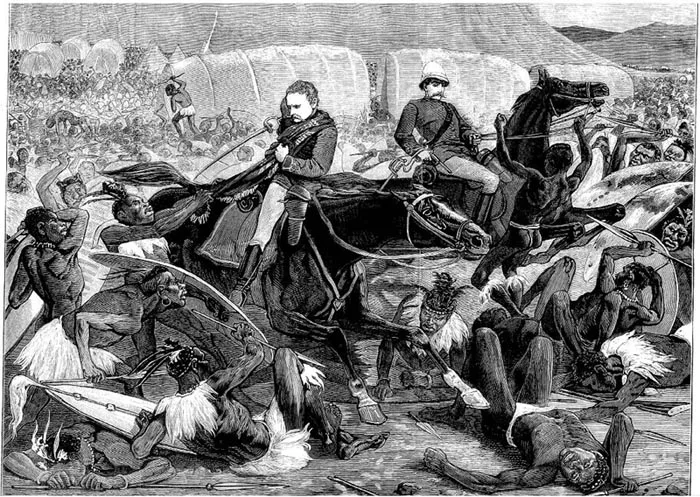
The Battle of Isandlwana (alternative spelling: Isandhlwana) on 22 January 1879 was the first major encounter in the Anglo-Zulu War between the British Empire and the Zulu Kingdom. Eleven days after the British invaded Zululand in Southern Africa, a Zulu force of some 20,000 warriors attacked a portion of the British main column consisting of about 1,800 British, colonial and native troops with approximately 350 civilians. The Zulus were equipped mainly with the traditional assegai iron spears and cow-hide shields, but also had a number of muskets and antiquated rifles.
The British and colonial troops were armed with the modern Martini–Henry breechloading rifle and two 7-pounder mountain guns deployed as field guns, as well as a Hale rocket battery. The Zulus had a vast disadvantage in weapons technology, but they greatly outnumbered the British and ultimately overwhelmed them, killing over 1,300 troops, including all those out on the forward firing line. The Zulu army suffered anywhere from 1,000 to 3,000 killed.
The battle was a decisive victory for the Zulus and caused the defeat of the first British invasion of Zululand. The British Army had suffered its worst defeat against an indigenous foe equipped with vastly inferior military technology. Isandlwana resulted in the British taking a much more aggressive approach in the Anglo–Zulu War, leading to a heavily reinforced second invasion, and the destruction of King Cetshwayo's hopes of a negotiated peace.
Background
Following the scheme by which Lord Carnarvon had brought about the Confederation of Canada through the 1867 British North America Act, it was thought that a similar plan might succeed in South Africa and in 1877 Sir Henry Bartle Frere was appointed as High Commissioner for Southern Africa to instigate the scheme. Some of the obstacles to such a plan were the presence of the independent states of the South African Republic and the Kingdom of Zululand, both of which the British Empire would attempt to overcome by force of arms.
From Wikipedia (CC BY-SA 4.0).