Overview
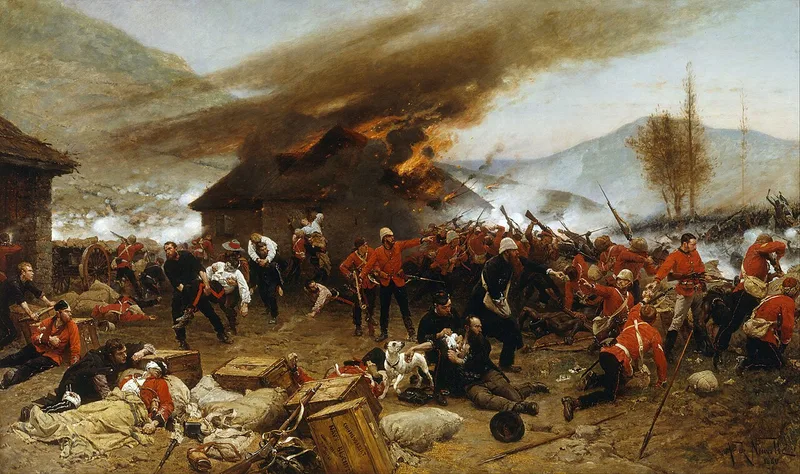
The Battle of Rorke's Drift, also known as the Defence of Rorke's Drift, was an engagement in the Anglo-Zulu War. The successful British defence of the mission station of Rorke's Drift, under the command of Lieutenants John Chard of the Royal Engineers and Gonville Bromhead, of the 24th Regiment of Foot began when a large contingent of Zulu warriors broke off from the main force during the final hour of the British defeat at the day-long Battle of Isandlwana on 22 January 1879, diverting to attack Rorke's Drift later that day and continuing into the following day.
Just over 150 British and colonial troops defended the station against attacks by 3,000 to 4,000 Zulu warriors. The massive but piecemeal attacks by the Zulu on Rorke's Drift came very close to overwhelming the much smaller garrison, but were consistently repelled. Eleven Victoria Crosses were awarded to individual defenders, along with a number of other decorations and honours.
Prelude
Rorke's Drift, known as kwaJimu ("Jim's Land") in the Zulu language, was a mission station of the Church of Sweden, and the former trading post of James Rorke, a merchant from the eastern Cape of Irish descent. It was located near a drift, or ford, on the Buffalo (Mzinyathi) River, which at the time formed the border between the British colony of Natal and the Zulu Kingdom. On 9 January 1879, the British No. 3 (Centre) Column, under Lord Chelmsford, arrived and encamped at the drift.
On 11 January, the day after the British ultimatum to the Zulus expired, the column crossed the river and encamped on the Zulu bank. A small force consisting of B Company, 2nd Battalion, 24th (2nd Warwickshire) Regiment of Foot (2nd/24th) under Lieutenant Gonville Bromhead was detailed to garrison the post, which had been turned into a supply depot and hospital under the overall command of Brevet Major Henry Spalding, 104th Foot, a member of Chelmsford's staff.
From Wikipedia (CC BY-SA 4.0).