Overview
{{Infobox military conflict
| conflict = Battle of the Little Bighorn
| partof = the Great Sioux War of 1876
| image =
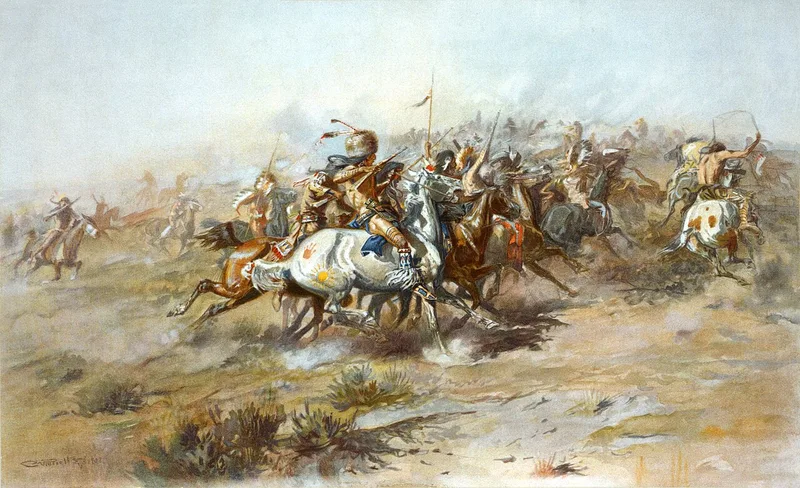
| caption = The Battle of Little Bighorn by Charles Marion Russell
| date = June 25–26, 1876
| place = Near Little Bighorn River, Crow Indian Reservation, Big Horn County, Montana, U.S.
| coordinates =
| map_type = Montana
| map_relief =
| map_size =
| map_marksize =
| map_caption = Location within Montana
| map_label = Little Big Horn Battlefield
| territory =
| result = Lakota, Northern Cheyenne, and Arapaho victory
| combatants_header = Native Peoples
| combatant1 =
| combatant2 =
| commander1 =
| commander2 =
| units1 = Nations of the plains
| units2 = 7th Cavalry Regiment
| strength1 = 1,100–2,500 warriors
| strength2 = c. 700 cavalrymen and scouts
| casualties1 =
| casualties2 =
| campaignbox =
}}
The Battle of the Little Bighorn, known to the Lakota and other Plains Indians as the Battle of the Greasy Grass, and commonly referred to as Custer's Last Stand, was an armed engagement between combined forces of the Lakota Sioux, Northern Cheyenne, and Arapaho tribes and the 7th Cavalry Regiment of the United States Army. The battle, which resulted in the defeat of U.S. forces, was the most significant action of the Great Sioux War of 1876. It took place on June 25–26, 1876, along the Little Bighorn River in the Crow Indian Reservation in southeastern Montana Territory.
Most battles in the Great Sioux War, including the Battle of the Little Bighorn, were on lands those Indians had taken from other tribes since 1851.Stands In Timber, John and Margot Liberty (1972): Cheyenne Memories. Lincoln and London. p. 170, note 13.White, Richard: "The Winning of the West: The Expansion of the Western Sioux in the Eighteenth and Nineteenth Centuries", The Journal of American History, Vo. 65, No. 2 (Sep. 1987), pp. 319–343 [342]. The Lakotas were there without consent from the local Crow tribe, which had a treaty on the area. Already in 1873, Crow chief Blackfoot had called for U.S. military actions against the Indian intruders.Annual Report of the Commissioner of Indian Affairs, 1873. Washington 1874, p. 124. The steady Lakota invasion (a reaction to white encroachment into the Black Hills) into treaty areas belonging to the smaller tribes ensured the United States a firm Indian alliance with the Arikaras and the Crows during the Lakota Wars.Dunlay, Thomas W. (1982). Wolves for the Blue Soldiers.
From Wikipedia (CC BY-SA 4.0).