Overview
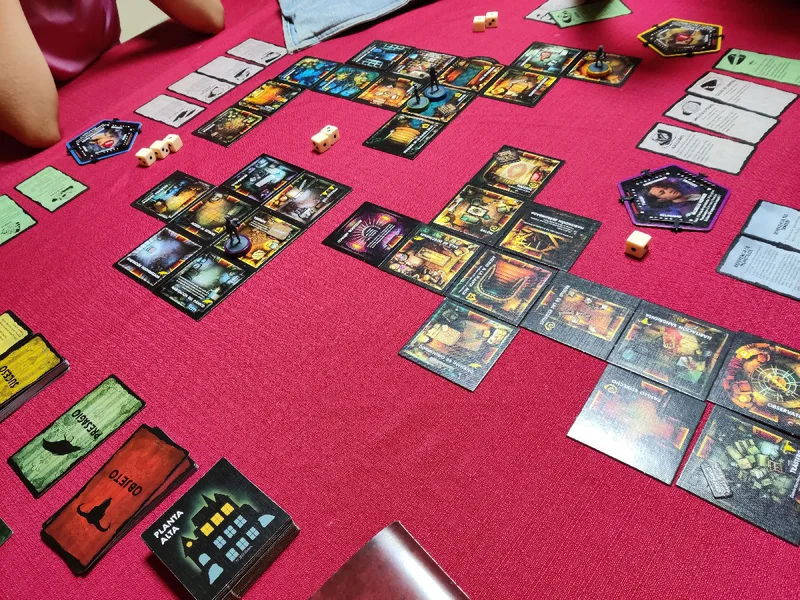
Betrayal at House on the Hill is a board game published by Avalon Hill in 2004, designed by Bruce Glassco and developed by Rob Daviau, Bill McQuillan, Mike Selinker, and Teeuwynn Woodruff. Players all begin as allies exploring a haunted house filled with dangers, traps, items, and omens. As players journey to new parts of the mansion, room tiles are chosen at random and placed on the game board; this means that the game is different each session. Eventually the "haunt" begins, with the nature and plot of this session's ghost story revealed; one player usually "betrays" the others and takes the side of the ghosts, monsters, or other enemies, while the remaining players collaborate to defeat them.
Gameplay
Betrayal consists of two phases, the initial Exploration phase and the Haunt phase. At the start of the game, each player selects a character and sets the meters at the starting values. The "house" starts with a ground, upper, and basement floors; the ground and upper floors are immediately connected by a staircase, whereas the basement remains unconnected until certain room tiles, event cards or other actions allow a connection. On each turn, the player can move through a number of rooms equivalent to their current Speed. If the player moves through a door where no room has been placed, they add a new room to the house. If that room has an Event, Item, or Omen icon, the player draws the respective card and follows its instructions. Event cards often require the player to make a roll against one of their skills to avoid damage or gain benefits.
After drawing an Omen card, the rolls a six sided die, and if this roll is lower than the number of Omen cards that have been drawn, the Haunt phase starts. Tables in the game's rulebooks are used to determine which Haunt is used based on what room and Omen triggered the Haunt, and who the "traitor" is; though often the traitor is the one who triggered the Haunt, it may be another player. At this point, the player who is the traitor leaves the room; they read through their specific Haunt goals and rules from one book, while the other players read their victory rules and conditions from a second book and discuss plans to deal with the traitor. Haunts are based on numerous horror tropes, such as zombies, cannibals, dragons, vampires, ghosts, etc.
From Wikipedia (CC BY-SA 4.0).