
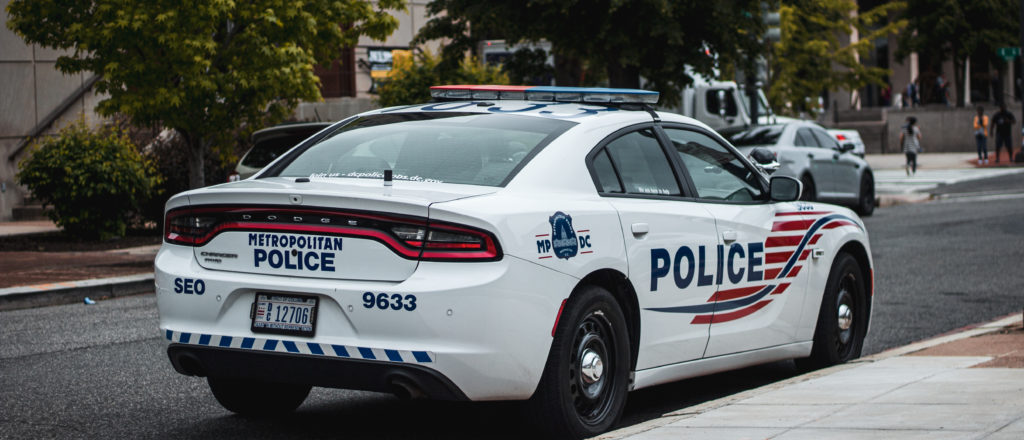
The Boston Police Department (BPD) is the primary law enforcement agency of Boston, Massachusetts, United States. Founded in 1854, the BPD is the oldest municipal police department in the United States. It is also the 20th largest law enforcement agency in the country, with 2,713 sworn and unsworn personnel.
Contents
History
Pre-incorporation (1635–1828)
Before the existence of a formal police department, the first night watch was established in Boston in 1635. In 1703, pay in the sum of 35 shillings a month was set for members of the night watch. In 1796, the watch was reorganized, and the watchmen carried a badge of office, a rattle, and a six-foot pole, which was painted blue and white with a hook on one end and a bill on the other. The hook was used to grab fleeing criminals, and the rounded "bill" was used as a weapon. The rattle was a noise-making device used for calling for assistance.
The Day Police, which had no connection to the night watch, was organized in 1838. The Day Police operated under the city marshal and had six appointed officers. This organization would eventually lead to the establishment of the modern-day Boston Police Department.
Nineteenth century
In 1838, a bill passed in the General Court that allowed the city to appoint police officers, paving the way for the creation of a formal police department. The Boston Police Department was formally founded in May 1854, at which point both the night watch and Day Police were disbanded. A 14-inch club replaced the old hook and bill, which had been in use for 154 years. At the time of its founding, the Boston Police constituted one of the first paid, professional police services in the United States. The department was closely organized and modeled after Sir Robert Peel's (London) Metropolitan Police Service.
On November 3, 1851, the first Irish-born Boston Police officer, Bernard "Barney" McGinniskin, was appointed. His presence generated considerable controversy. The Boston Pilot wrote, "He is the first Irishman that ever carried the stick of a policeman anywhere in this country, and meetings, even Faneuil Hall meetings, have been held to protect against the appointment." At the time, the police salary of $2.00 a day for the morning and afternoon beat and $1.20 for the night watch was nearly twice as high as the wages of laborers. City Marshal Francis Tukey resisted mayor John Prescott Bigelow's appointment of McGinniskin, expressing the predominant anti-Irish sentiments in the city by arguing it was done at "the expense of an American." On January 5, 1852, shortly before the newly elected mayor Benjamin Seaver (who had been supported by Tukey) took office, Tukey fired McGinniskin without giving a reason. After criticism in the press, Seaver reinstated McGinniskin, who remained in the police until the 1854 anti-Irish groundswell of the Know Nothing/American Party movement, when in the words of the Boston Pilot, "Mr. McGinniskin was discharged from the Boston Police for no other reason than he was a Catholic and born in Ireland." McGinniskin became a United States inspector at the customhouse and died of rheumatism on March 2, 1868. McGinniskin is buried in the St. Augustine Cemetery in South Boston.
On October 18, 1857, at about 5:15 a.m., Boston Police Officer Ezekiel W. Hodsdon was patrolling the corner of Havre and Maverick Street in East Boston. Hodsdon attempted to arrest two suspects for a burglary. A struggle ensued, and one of the suspects was able to get behind Hodsdon and shoot him in the head. Hodsdon died about 10:00 A.M., becoming the first Boston police officer killed in the line of duty. He was 25 years old. The murderers fled. Thousands of people visited the station house to view the body. Hodsdon left behind his wife Lydia and infant son Ezekiel, who was born just 13 days prior to his death. He was buried in Woodlawn Cemetery in Everett, according to Boston Globe newspaper reports on October 19, 1857. On October 18, 2007, a memorial was held in honor of Hodsdon on the corner of Havre and Maverick Streets in East Boston. On July 14, 1863, Boston Mayor Frederic W. Lincoln Jr. (1858–1861 & 1863–1867) ordered all 330 officers in the Department to quell a draft riot among Irish Catholics attempting to raid Union armories in the North End.
20th century
On September 9, 1919, when Police Commissioner Edwin Upton Curtis refused to allow the creation of a police union, 1,117 BPD officers went on strike. This signaled a dramatic shift in traditional labor relations and views on the part of the police, who were unhappy with stagnant wages and poor working conditions. The city soon fell into riots and public chaos as over three-fourths of the department was no longer enforcing public peace. Governor Calvin Coolidge intervened to quash further chaos. Coolidge announced that the police did not have the right to strike against the public safety and brought in the state national guard to restore order to Boston. The strike was broken, permanently, when Coolidge hired replacement police officers, many of whom were returning servicemen from World War I, and the former officers were refused re-entry into the department. Ironically, the new officers hired in the wake of the strike received higher salaries, more vacation days and city-provided uniforms, the very demands the original strikers were requesting. The BPD strike set a precedent for further movements to stymie police unionization around the country.
Coolidge's intervention in the strike brought him national fame, which, in turn, led to his nomination as Harding's running mate for vice-president in the 1920 presidential election.
In 1921, Irene McAuliffe, daughter of the late Weston police chief and horse breeder Patrick McAuliffe, was among the first six female members of the Boston Police Department. An accomplished horsewoman, she was sworn in as a mounted officer of the Weston Police Department in 1913 during the town's bicentennial celebration. She joined the District of Columbia Police Department in 1920, and in 1921 she became a member of the Boston Police Department's Vice Squad.
On May 29, 1930, Oliver Garrett was charged with 152 counts of conspiracy, extortion, and receiving gratuities for crimes allegedly committed as leader of BPD's liquor raiding unit during Prohibition. Commissioner Herbert A. Wilson, who had conducted a secret investigation into Garrett two years earlier and had overrode his subordinates to grant Garrett a questionable disability pension, was removed from office by the Governor Frank G. Allen and the Massachusetts Governor's Council. On May 7, 1931, Garrett pleaded to guilty and was sentenced to two years in the Deer Island House of Correction and fined $100.
In 1965, the largest police union representing Boston police employees, the Boston Police Patrolmen's Association, was formed.
21st century
On December 31, 2006, 31 Boston Municipal Police Officers were allowed to transfer to the Boston Police. On January 1, 2007, the rest of the Munis were either laid off or transferred to the city's Municipal Protective Services, which provides security to the city's Property Management Department. There was no merger with the Boston Municipal Police.
The transfer of Munis was planned in mid-2006 by Mayor Thomas M. Menino. This plan was met with heavy protest from the Boston Police Patrolmen's Association (BPPA). The BPPA's argument was that the Municipal officers were not qualified to be Boston police officers due to lack of training, political patronage, nepotism, and the fact that the Munis were not civil service tested.
On January 31, 2007, 911 callers mistakenly identified small electronic promotions found throughout Boston and the surrounding cities of Cambridge and Somerville as possible explosives. Upon investigation by Boston Police and other agencies, the suspicious devices turned out to be battery-powered LED placards with an image of a cartoon character called a "mooninite" used in a guerrilla marketing campaign for Aqua Teen Hunger Force Colon Movie Film For Theaters, a film based on the animated television series Aqua Teen Hunger Force on Cartoon Network's late-night programming block Adult Swim.
The BPD's handling of this incident has been criticized by some Boston residents and justified by others: One resident said that the police response was "silly and insane," and that "We're the laughing stock." Another resident said that the device "looked like a bomb. I picked it up, pulled the tape off it, and there were batteries, two on the top and three on the bottom." The same devices had been distributed in nine other cities across the USA without provoking a similar reaction. The United States Department of Homeland Security praised Boston authorities "for sharing their knowledge quickly with Washington officials and the public."
Beginning in September–October 2011, protesters assembled in Dewey Square as a show of solidarity with the Occupy Wall Street protest in New York. In the early hours of October 11, 2011, Boston Police and Transit Police moved into the protesters' secondary camp, arresting approximately 100 protesters. Protesters reported numerous incidents of police brutality. Mayor Menino denied the reports and claimed that the protesters endangered public safety.
Departmental organization
The Boston Police Department has approximately 2,015 officers and 808 civilian personnel, with patrol services covering an area of 89.6 mi2 (232.1 km2) and a population of 675,000. Like all City of Boston departments, the BPD requires all employed officers hired since 1995 to live within Boston city-limits. The BPD is divided into three zones and 11 neighborhood districts spread across the city, with each zone supervised by a Deputy Superintendent and every district headed by a Captain.
Ranks
The Boston Police rank structure is as follows:
Leadership
Dennis White was appointed as commissioner on February 1, 2021; he was placed on leave on February 3, 2021. Gregory P. Long has been the superintendent-in-chief since August 2018; he was named acting commissioner upon White being placed on leave.
Kathleen O'Toole was the first woman to serve as commissioner, from February 2004 through May 2006 when she left to take a new position as Chief Inspector of the Inspectorate of the Irish national police force, the Garda Síochána.
A three-person police commission (also called the police board) consisted of members nominated by the Governor of Massachusetts and approved by the Massachusetts Governor's Council. The commission was established in 1878 and abolished in 1906.
Boston's police commissioner was appointed by the Governor until 1962. Edmund L. McNamara was the first commissioner to be appointed by the mayor of Boston, taking office in April 1962 via appointment by mayor John F. Collins. Once appointed, a commissioner can only be removed from the position for cause until their term expires. A commissioner may be appointed to a five-year term, or to serve the remainder of a predecessor's five-year term.
Names in italics indicate a person served as acting (interim) commissioner only. Since 1985, several acting commissioners have been sworn as permanent. Numbering is per cited contemporary news reports and may include inconsistencies.
The Boston Police Special Operations Unit is a specialized unit within the Boston Police Department responsible for combined duties involving Highway Patrol and traffic enforcement, crowd control, and special weapons and tactics (SWAT) services within the city.
One unique feature of the unit is that the Special Operations Unit primarily relies on the use of Ford Crown Victoria Police Interceptors and Harley-Davidsons in their daily patrols. The use of motorcycles allows the unit to perform routine traffic enforcement; accompany parades, crowds, and visiting dignitaries; and to quickly travel to situations wherein the unit's SWAT skills are requested. Specialized trucks and support vehicles are also used to transport equipment and officers when needed.
Equipment
Transportation
The Boston Police uses the following vehicles.
Ford Police Interceptor Utility – Current issue patrol car. they own 10 of new 2025 patrol cars)
Chevrolet Caprice Current issue patrol car.
Chevrolet Impala Current issue patrol car.
Chevrolet Tahoe PPV – Current issue patrol car.
Ford Crown Victoria Police Interceptor – Mostly phased out as of July 2019. Occasionally seen on a detail, etc.
Ford F-250 - Prisoner transport vehicle
Ford Expedition
Harley-Davidson
HMMWV
Weapons
Boston police officers may carry "only weapons, magazines and ammunition authorized and issued by the Department", which "include, but are not limited to":
Benelli M3 SBS (12 gauge)
Bushmaster XM-15 (.223 Remington)
Glock Model 22 (.40 S&W)
Glock Model 23 (.40 S&W)
Glock Model 27 (.40 S&W)
SIG Sauer GSR in .45 ACP
SIG Sauer P320 9×19mm: used by Boston Police Department Special Operations Unit only.
Demographics
By gender
Male: 84%
Female: 16%
By race
White: 65.5%
African-American: 23.9%
Hispanic: 8.3%
Asian: 2.4%
Fictional portrayals
The Boston Police Department has been portrayed in several prominent motion pictures including The Equalizer, Patriots Day, The Thomas Crown Affair, Gone Baby Gone, Mystic River, The Departed, Edge of Darkness, Blown Away, The Brink's Job, That's My Boy, R.I.P.D., The Heat, X2, What's The Worst That Could Happen?, The Boondock Saints, Spenser Confidential, Surrogates, and The Town. BPD is also featured in the television series City on a Hill, Spenser: For Hire, Rizzoli & Isles, Leverage, Crossing Jordan, Fringe, Boston Blue, and the failed Katee Sackhoff/Goran Visnjic police show pilot Boston's Finest.