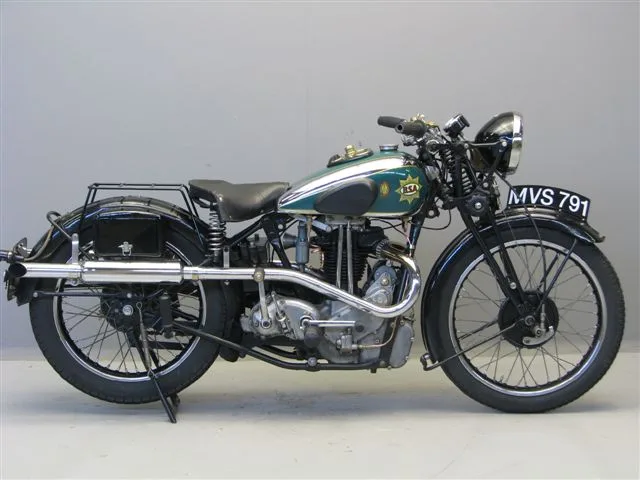
Overview
The BSA Gold Star is a motorcycle made by BSA from 1938 to 1963. They were 350 cc and 500 cc single-cylinder four-stroke production motorcycles known for being among the fastest bikes of the 1950s. Being hand built and with many optional performance modifications available, each motorcycle came from the factory with documented dynamometer test results, allowing the new owner to see the horsepower (bhp) produced.
The Gold Star was almost continuously developed over its lifetime by BSA's engineers and riders, who improved its capabilities and increased output from its essentially simple push-rod petrol engine than had been thought possible. It was highly successful across almost all areas of motorcycle sport for well over a decade and is still regarded as a design icon of its era.
Origin
In 1937, Wal Handley lapped the Brooklands circuit at over on a BSA Empire Star, and was awarded one of the traditional Gold Star badges. That inspired BSA to produce the BSA Gold Star.
The first Gold Star was an M24 model. It had an all alloy bore and stroke, displacement, with a separate rocker box bolted to the aluminium head, pushrod valve actuation, an Elektron (magnesium alloy) gearbox with close ratio option, and a rigid frame made of light tubes devoid of sidecar attachment lugs. This model continued up to the start of World War II.
There were two variants of the M24; 1938, JM24 and 1939, KM24. Several modifications were made to the design during its lifespan. The 1939 KM model used a redesigned crank and crankcase with timing gears on fixed shafts, supported by a strong steel "outrigger" plate (a feature carried on throughout the Gold Star's entire production period.) The earlier JM model had cams that ran directly in the timing cover, with the potential for premature wear, hence the re-design. Power outputs were around 30bhp. The cast Elektron gearbox was dropped in 1939 to use the side-valve M20's cast aluminium shell but with close gear ratios as an option. Some KM's were used by the military at the start of WW2. Very few of either model were produced, with numbers in the low hundreds for each.
From Wikipedia (CC BY-SA 4.0).