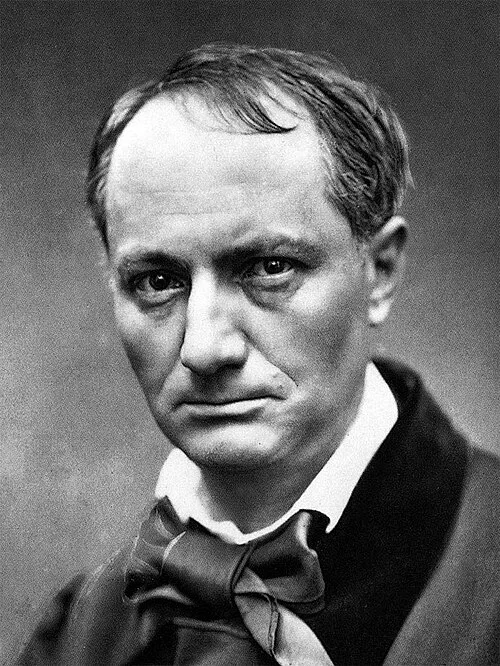
Overview
Charles Pierre Baudelaire (, ; ; 9 April 1821 – 31 August 1867) was a French poet who also worked as an essayist, art critic and translator. His poems are described as exhibiting mastery of rhyme and rhythm, containing an exoticism inherited from Romantics, and are based on observations of real life.
His most famous work, a book of lyric poetry titled Les Fleurs du mal (The Flowers of Evil), expresses the changing beauty of nature in the rapidly industrialising Paris caused by Haussmann's renovation of Paris during the mid-19th century. Baudelaire's original style of prose-poetry influenced a generation of poets including Paul Verlaine, Arthur Rimbaud and Stéphane Mallarmé. He coined the term modernity (modernité) to designate the fleeting experience of life in an urban metropolis, and the responsibility of artistic expression to capture that experience. Marshall Berman has credited Baudelaire as being the first Modernist.
Early life
Baudelaire was born in Paris, France, on 9 April 1821, and baptized two months later at Saint-Sulpice Roman Catholic Church. His father, Joseph-François Baudelaire (1759–1827), a senior civil servant and amateur artist, who at 60, was 34 years older than Baudelaire's 26-year-old mother, Caroline (née Dufaÿs) (1794–1871); she was his second wife.
Joseph-François died during Baudelaire's childhood, at rue Hautefeuille, Paris, on 10 February 1827. The following year, Caroline married Lieutenant Colonel , who later became a French ambassador to various noble courts.
From Wikipedia (CC BY-SA 4.0).