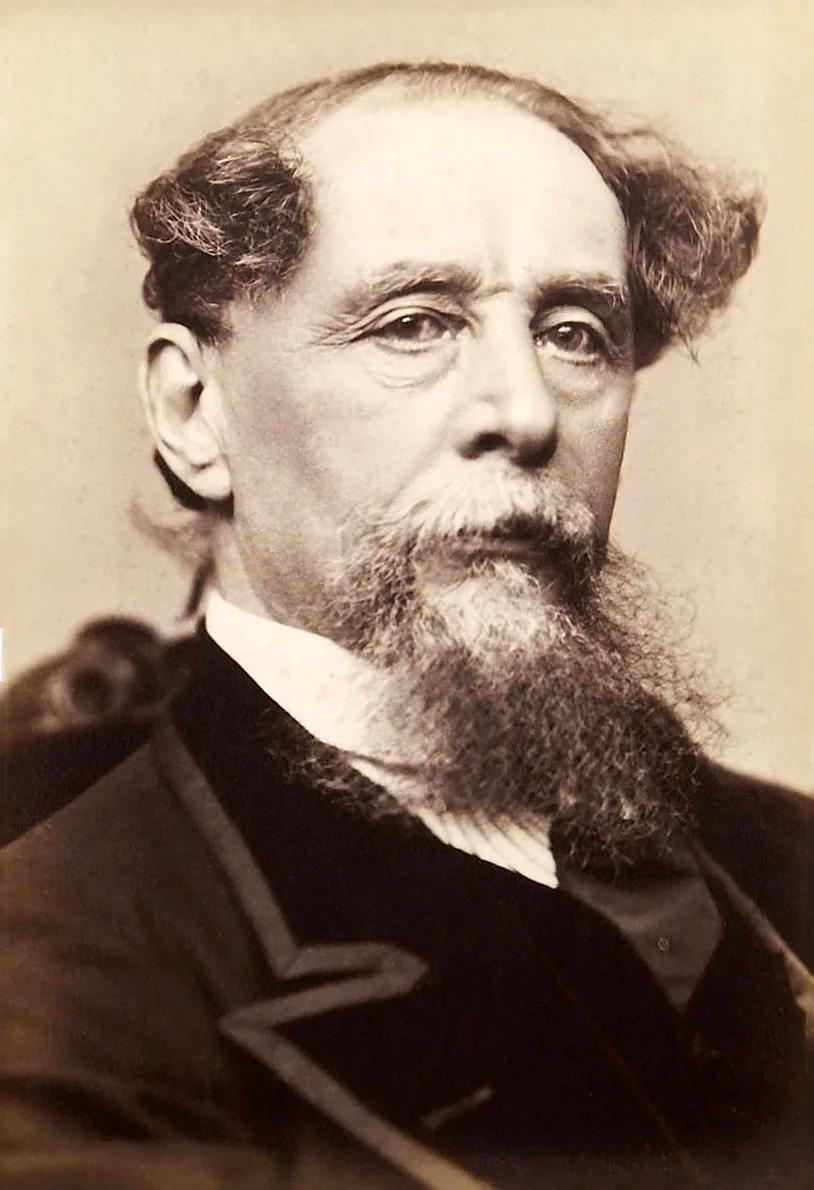
Charles John Huffam Dickens ( ; 7 February 1812 – 9 June 1870) was an English writer and journalist. He created some of literature's best-known fictional characters, and is regarded by many as the greatest novelist of the Victorian era. His works enjoyed unprecedented popularity during his lifetime and, by the 20th century, critics and scholars had recognised him as a literary genius. His novels and short stories are widely read today.
Born in Portsmouth, Dickens left school at age 12 to work in a boot-blacking factory when his father John was incarcerated in a debtors' prison. After three years, he returned to school before beginning his literary career as a journalist. Dickens edited a weekly journal for 20 years; wrote 15 novels, 5 novellas, hundreds of short stories and nonfiction articles; lectured and performed readings extensively; was a tireless letter writer; and campaigned vigorously for children's rights, education and other social reforms.
Dickens's literary success began with the 1836 serial publication of The Pickwick Papers, a publishing phenomenon—thanks largely to the introduction of the character Sam Weller in the fourth episode—that sparked Pickwick merchandise and spin-offs. Within a few years, Dickens had become an international literary celebrity, famous for his humour, satire and keen observation of character and society. His novels, most of them published in monthly or weekly instalments, pioneered the serial publication of narrative fiction, which became the dominant Victorian mode for novel publication. Cliffhanger endings in his serial publications kept readers in suspense. The installment format allowed Dickens to evaluate his audience's reaction, and he often modified his plot and character development based on such feedback. For example, when his wife's podiatrist expressed distress at the way Miss Mowcher in David Copperfield seemed to reflect her own disabilities, Dickens improved the character with positive features. His plots were carefully constructed and he often wove elements from topical events into his narratives. Masses of the illiterate poor would individually pay a halfpenny to have each new monthly episode read to them, opening up and inspiring a new class of readers.
His 1843 novella A Christmas Carol remains especially popular and continues to inspire adaptations in every creative medium. Oliver Twist and Great Expectations are also frequently adapted and, like many of his novels, evoke images of early Victorian London. His 1853 novel Bleak House, a satire on the judicial system, helped support a reformist movement that culminated in the 1870s legal reform in England. A Tale of Two Cities (1859; set in London and Paris) is regarded as his best-known work of historical fiction. The most famous celebrity of his era, he undertook, in response to public demand, a series of public reading tours in the later part of his career. The term Dickensian is used to describe something that is reminiscent of Dickens and his writings, such as poor social or working conditions, or comically repulsive characters.
Contents
Early life
Charles John Huffam Dickens was born on 7 February 1812 at 1 Mile End Terrace (now 393 Commercial Road), Landport in Portsea Island (Portsmouth), Hampshire, the second of eight children of Elizabeth Dickens (née Barrow; 1789–1863) and John Dickens (1785–1851). His father was a clerk in the Royal Navy Pay Office and was temporarily stationed in the district. He asked Christopher Huffam, rigger in the Royal Navy and head of an established firm, to act as godfather to Charles. Huffam is thought to be the inspiration for Paul Dombey, the owner of a shipping company in Dickens's novel Dombey and Son (1848).
In January 1815 John Dickens was called back to London, and the family moved to Norfolk Street, Fitzrovia. When Charles was four they relocated to Sheerness and thence to Chatham, Kent, where he spent his formative years until the age of 11. His early life seems to have been idyllic, though he thought himself a "very small and not-over-particularly-taken-care-of boy".
Charles spent time outdoors, but also read voraciously, including the picaresque novels of Tobias Smollett and Henry Fielding, as well as Robinson Crusoe and Gil Blas. He read and re-read The Arabian Nights and the Collected Farces of Elizabeth Inchbald. Aged seven, he first saw Joseph Grimaldi—the father of modern clowning—perform at the Star Theatre in Rochester, Kent. He later imitated Grimaldi's clowning on several occasions, and would also edit the Memoirs of Joseph Grimaldi. He retained poignant memories of childhood, helped by an excellent memory of people and events, which he used in his writing. His father's brief work as a clerk in the Navy Pay Office afforded him a few years of private education, first at a dame school and then at a school run by William Giles, a dissenter, in Chatham.
This period came to an end in June 1822, when John Dickens was recalled to Navy Pay Office headquarters at Somerset House and the family (except for Charles, who stayed behind to finish his final term at school) moved to Camden Town in London. The family had left Kent amidst rapidly mounting debts and, living beyond his means, John Dickens was forced by his creditors into the Marshalsea debtors' prison in Southwark, London, in 1824. His wife and youngest children joined him there, as was the practice at the time. Charles, then 12 years old, boarded with Elizabeth Roylance, a family friend, at 112 College Place, Camden Town. Mrs Roylance was "a reduced impoverished old lady, long known to our family", whom Dickens later immortalised, "with a few alterations and embellishments", as "Mrs Pipchin" in Dombey and Son. Later, he lived in a back-attic in the house of an agent for the Insolvent Court, Archibald Russell, "a fat, good-natured, kind old gentleman ... with a quiet old wife" and lame son, in Lant Street in Southwark. They provided the inspiration for the Garlands in The Old Curiosity Shop.
Career
Journalism and writing
In 1832, at the age of 20, Dickens was energetic and increasingly self-confident. He enjoyed mimicry and popular entertainment, lacked a sense of what he wanted to become, and yet knew he wanted fame. Drawn to the theatre—he became an early member of the Garrick Club—he landed an acting audition at Covent Garden, where the manager George Bartley and the actor Charles Kemble were to see him. Dickens prepared meticulously and decided to imitate the comedian Charles Mathews, but ultimately he missed the audition because of a cold. Before another opportunity arose, he had set out on his career as a writer.
In 1833 Dickens submitted his first story, "A Dinner at Poplar Walk", to the London periodical Monthly Magazine. His uncle William Barrow offered him a job on The Mirror of Parliament and he worked in the House of Commons for the first time early in 1832. He rented rooms at 15 Buckingham Street and later at Furnival's Inn and worked as a political journalist, reporting on Parliamentary debates, and he travelled across Britain to cover election campaigns for the Morning Chronicle.
His journalism, in the form of sketches in periodicals, formed his first collection of pieces, published in 1836: Sketches by Boz—Boz being a family nickname he employed as a pseudonym for some years. Dickens apparently adopted it from the nickname 'Moses', which he had given to his youngest brother Augustus Dickens, after a character in Oliver Goldsmith's The Vicar of Wakefield. When pronounced by anyone with a head cold, "Moses" became "Boses"—later shortened to Boz.
Dickens's name was considered "queer" by a contemporary critic, who wrote in 1849: "Mr Dickens, as if in revenge for his own queer name, does bestow still queerer ones upon his fictitious creations". Dickens contributed to and edited journals throughout his literary career. In January 1835, the Morning Chronicle launched an evening edition, under the editorship of the Chronicle's music critic, George Hogarth. Hogarth invited him to contribute Street Sketches and Dickens became a regular visitor to his Fulham house—excited by Hogarth's friendship with Walter Scott (whom Dickens greatly admired) and enjoying the company of Hogarth's three daughters, Georgina, Mary and 19-year-old Catherine.
Dickens made rapid progress professionally and socially. He began a friendship with William Harrison Ainsworth, the author of the highwayman novel Rookwood (1834), whose bachelor salon in Harrow Road had become the meeting place for a set that included Daniel Maclise, Benjamin Disraeli, Edward Bulwer-Lytton and George Cruikshank. All these became his friends and collaborators, with the exception of Disraeli, and he met his first publisher, John Macrone, at the house.
First visit to the United States
On 22 January 1842, Dickens and his wife arrived in Boston, Massachusetts, aboard the RMS Britannia during their first trip to the United States and Canada. At this time Georgina Hogarth, another sister of Catherine, joined the Dickens household, now living at Devonshire Terrace, Marylebone, to care for the young family they had left behind. She remained with them as housekeeper, organiser, adviser and friend until Dickens's death in 1870. Dickens modelled the character of Agnes Wickfield after Georgina and Mary.
He described his impressions in a travelogue, American Notes for General Circulation. In it Dickens includes a powerful condemnation of slavery which he had attacked as early as The Pickwick Papers, correlating the emancipation of the poor in England with the abolition of slavery abroad citing newspaper accounts of runaway slaves disfigured by their masters. In spite of the abolitionist sentiments gleaned from his trip to America, some modern commentators have pointed out inconsistencies in Dickens's views on racial inequality. For instance, he has been criticised for his subsequent acquiescence in Governor Edward John Eyre's harsh crackdown during the 1860s Morant Bay rebellion in Jamaica and his failure to join other British progressives in condemning it. From Richmond, Virginia, Dickens returned to Washington, D.C., and started a trek westwards, with brief pauses in Cincinnati and Louisville, Kentucky, to St. Louis. While there he expressed a desire to see an American prairie before returning east. A group of 13 men then set out with Dickens to visit Looking Glass Prairie, a trip 30 miles into Illinois.
During his American visit, Dickens spent a month in New York City, giving lectures, raising the question of international copyright laws and the pirating of his work in America. He persuaded a group of 25 writers, headed by Washington Irving, to sign a petition for him to take to the US Congress, but the press were generally hostile to this, saying that he should be grateful for his popularity and that it was mercenary to complain about his work being pirated.
The popularity he gained caused a shift in his self-perception according to the critic Kate Flint, who writes that he "found himself a cultural commodity, and its circulation had passed out his control", causing him to become interested in and delve into themes of public and personal personas in the next novels. She writes that he assumed a role of "influential commentator", publicly and in his fiction, evident in his next few books. His trip to the US ended with a trip to Canada—Niagara Falls, Toronto, Kingston, Ontario, and Montreal—where he appeared on stage in light comedies.
Return to England
Soon after his return to England, Dickens began work on the first of his Christmas stories, A Christmas Carol, written in 1843, which was followed by The Chimes in 1844 and The Cricket on the Hearth in 1845. Of these, A Christmas Carol was most popular and, tapping into an old tradition, did much to promote a renewed enthusiasm for the joys of Christmas in Britain and America. The seeds for the story became planted in Dickens's mind during a trip to Manchester to witness the conditions of the manufacturing workers there. This, along with scenes he had recently witnessed at the Field Lane Ragged School, caused Dickens to resolve to "strike a sledge hammer blow" for the poor. As the idea for the story took shape and the writing began in earnest, Dickens became engrossed in the book. He later wrote that as the tale unfolded he "wept and laughed, and wept again" as he "walked about the black streets of London fifteen or twenty miles many a night when all sober folks had gone to bed".
Between 1843 and 1844 Martin Chuzzlewit, the last of his picaresque novels, was serialised. It includes the character of Sarah Gamp, a nurse who is dissolute, sloppy and generally drunk, and also features one of the first literary private detective characters, Mr Nadgett. After living briefly in Italy (1844), Dickens travelled to Switzerland (1846), where he began work on Dombey and Son (1846–48).
At about this time, he was made aware of a large embezzlement at the firm where his brother, Augustus, worked (John Chapman & Co). It had been carried out by Thomas Powell, a clerk, who was on friendly terms with Dickens and who had acted as mentor to Augustus when he started work. Powell was also an author and poet and knew many of the famous writers of the day. After further fraudulent activities, Powell fled to New York and published a book called The Living Authors of England with a chapter on Charles Dickens, who was not amused by what Powell had written. One item that seemed to have annoyed him was the assertion that he had based the character of Paul Dombey (Dombey and Son) on Thomas Chapman, one of the principal partners at John Chapman & Co. Dickens immediately sent a letter to Lewis Gaylord Clark, editor of the New York literary magazine The Knickerbocker, saying that Powell was a forger and thief. Clark published the letter in the New-York Tribune and several other papers picked up on the story. Powell began proceedings to sue these publications and Clark was arrested. Dickens, realising that he had acted in haste, contacted John Chapman & Co to seek written confirmation of Powell's guilt. Dickens did receive a reply confirming Powell's embezzlement, but once the directors realised this information might have to be produced in court, they refused to make further disclosures. Owing to the difficulties of providing evidence in America to support his accusations, Dickens eventually made a private settlement with Powell out of court.
Middle years
In December 1845 Dickens took up the editorship of the London-based Daily News, a liberal paper through which Dickens hoped to advocate, in his own words, "the Principles of Progress and Improvement, of Education and Civil and Religious Liberty and Equal Legislation." Among the other contributors Dickens chose to write for the paper were the radical economist Thomas Hodgskin and the social reformer Douglas William Jerrold, who frequently attacked the Corn Laws. Dickens lasted only ten weeks on the job before resigning due to a combination of exhaustion and frustration with one of the paper's co-owners.
A Francophile, Dickens often holidayed in France and, in a speech delivered in Paris in 1846 in French, called the French "the first people in the universe". During his visit to Paris, Dickens met the French literati Alexandre Dumas, Victor Hugo, Eugène Scribe, Théophile Gautier, François-René de Chateaubriand and Eugène Sue. In early 1849 Dickens started to write David Copperfield. It was published between 1849 and 1850. In Dickens's biography, Life of Charles Dickens (1872), John Forster wrote of David Copperfield, "underneath the fiction lay something of the author's life". It was Dickens's personal favourite among his novels, as he wrote in the preface to the 1867 edition. His collection of letters, of which more than 14,000 are known, covered a wide range of subject-matter. Letters during this period included a correspondence with Mary Tyler, dated 6 November 1849, on the comedic merits of Punch and Judy, a puppet show dominated by the anarchic clowning of Mr. Punch, and his review of the Great Exhibition, the first in a series of world's fairs, which he attended at Hyde Park, London, in 1851. After the First Opium War Dickens viewed China through a lens of both mockery and fear, alluding to the Western "yellow peril" stereotype. During his visit to the Great Exhibition, he scorned Chinese exhibits as symbols of stagnation, labelling them a "glory of yellow jaundice", writing progress was hindered by the isolationist approach of the Qing dynasty with "China, shutting itself up, as far as possible, within itself."
In late 1851, Dickens moved into Tavistock House where he wrote Bleak House (1852–53), Hard Times (1854) and Little Dorrit (1855–57). A work incorporating Gothic elements such as the depiction of London as a murky city swathed in fog, Bleak House is credited with introducing urban fog to the novel, which would become a frequent characteristic of urban Gothic literature and film. Reflecting the public enthusiasm for dinosaurs that first developed in Victorian England, the opening of Bleak House contains an early mention of dinosaurs in literature: "it would not be wonderful to meet a Megalosaurus, forty feet long or so, waddling like an elephantine lizard up Holborn Hill".
Later life
On 9 June 1865, while returning from Paris with Ellen Ternan, Dickens was involved in the Staplehurst rail crash in Kent. The train's first seven carriages plunged off a cast iron bridge that was under repair and ten passengers were killed. The only first-class carriage to remain on the track—which was left hanging precariously off the bridge—was the one in which Dickens was travelling. For three hours before rescuers arrived, Dickens tended and comforted the wounded and the dying with a flask of brandy and a hat refreshed with water. Before leaving, he remembered the unfinished manuscript for Our Mutual Friend, and he returned to his carriage to retrieve it.
Dickens later used the experience of the crash as material for his short ghost story, "The Signal-Man", in which the central character has a premonition of his own death in a rail crash. He also based the story on several previous rail accidents, such as the Clayton Tunnel rail crash in Sussex of 1861. Dickens managed to avoid an appearance at the inquest to avoid disclosing that he had been travelling with Ternan and her mother, which would have caused a scandal. After the crash, Dickens was nervous when travelling by train and would use alternative means when available. In 1868 he wrote, "I have sudden vague rushes of terror, even when riding in a hansom cab, which are perfectly unreasonable but quite insurmountable." Dickens's son, Henry, recalled, "I have seen him sometimes in a railway carriage when there was a slight jolt. When this happened he was almost in a state of panic and gripped the seat with both hands."
Second visit to the United States
While he contemplated a second visit to the United States, the outbreak of the Civil War in America in 1861 delayed his plans. On 9 November 1867, over two years after the war, Dickens set sail from Liverpool for his second American reading tour. Landing in Boston, he devoted the rest of the month to a round of dinners with such notables as Ralph Waldo Emerson, Henry Wadsworth Longfellow and his American publisher, James T. Fields. In early December, the readings began. He performed 76 readings, netting £19,000, from December 1867 to April 1868. Dickens shuttled between Boston and New York, where he gave 22 readings at Steinway Hall. Although he had started to suffer from what he called the "true American catarrh", he kept to a packed schedule, even managing to squeeze in some sleighing in Central Park.
During his travels, he saw a change in the people and the circumstances of America. His final appearance was at a banquet the American Press held in his honour at Delmonico's on 18 April, when he promised never to denounce America again. By the end of the tour Dickens could hardly manage solid food, subsisting on champagne and eggs beaten in sherry. On 23 April he boarded the Cunard liner Russia to return to Britain, barely escaping a federal tax lien against the proceeds of his lecture tour.
Farewell readings
In 1868–69 Dickens gave a series of "farewell readings" in England, Scotland and Ireland, beginning on 6 October. He managed, of a contracted 100 readings, to give 75 in the provinces, with a further 12 in London. As he pressed on he was affected by giddiness and fits of paralysis. He had a stroke on 18 April 1869 in Chester. He collapsed on 22 April 1869, in Preston, Lancashire; on doctor's advice, the tour was cancelled. After further provincial readings were cancelled, he began work on his final novel, The Mystery of Edwin Drood. Described as a "dark and gothic" tale, his unfinished novel focuses on Drood's uncle, John Jasper, a drug-addicted choirmaster. It was fashionable in the 1860s to 'do the slums' and, in company, Dickens visited opium dens in Shadwell in the East End of London, where he witnessed an elderly addict called "Laskar Sal", who formed the model for "Opium Sal" in Edwin Drood.
After Dickens regained enough strength, he arranged, with medical approval, for a final series of readings to partly make up to his sponsors what they had lost due to his illness. There were 12 performances, on 11 January to 15 March 1870; the last at 8:00pm at St James's Hall, London. Though in grave health by then, he read A Christmas Carol and The Trial from Pickwick. On 2 May, he made his last public appearance at a Royal Academy banquet in the presence of the Prince and Princess of Wales, paying a special tribute on the death of his friend the illustrator Daniel Maclise.
Death
On 8 June 1870 Dickens had another stroke at his home after a full day's work on Edwin Drood. He never regained consciousness. The next day, he died at Gads Hill Place, aged 58. His biographer Claire Tomalin has suggested Dickens was actually in Peckham when he had had the stroke and his mistress Ellen Ternan and her maids had him taken back to Gads Hill so that the public would not know the truth about their relationship. Contrary to his wish to be buried at Rochester Cathedral "in an inexpensive, unostentatious, and strictly private manner", he was laid to rest in Poets' Corner in Westminster Abbey. A printed epitaph circulated at the time of the funeral reads:
To the Memory of Charles Dickens (England's most popular author) who died at his residence, Higham, near Rochester, Kent, 9 June 1870, aged 58 years. He was a sympathiser with the poor, the suffering, and the oppressed; and by his death, one of England's greatest writers is lost to the world.
A letter from Dickens to the Clerk of the Privy Council in March indicates he had been offered and accepted a baronetcy, which was not gazetted before his death. His last words were "On the ground" in response to his sister-in-law Georgina's request that he lie down. On Sunday, 19 June 1870, five days after Dickens was buried in the Abbey, Dean Arthur Penrhyn Stanley delivered a memorial elegy, lauding "the genial and loving humorist whom we now mourn", for showing by his own example "that even in dealing with the darkest scenes and the most degraded characters, genius could still be clean, and mirth could be innocent". Pointing to the fresh flowers that adorned the novelist's grave, Stanley assured those present that "the spot would thenceforth be a sacred one with both the New World and the Old, as that of the representative of literature, not of this island only, but of all who speak our English tongue."
In his will, drafted more than a year before his death, Dickens left the care of his £80,000 estate (£8,000,000 in 2025) to his long-time colleague John Forster and his "best and truest friend" Georgina Hogarth who, along with Dickens's two sons, also received a tax-free sum of £8,000 (equivalent to £800,000 in 2025). He confirmed his wife Catherine's annual allowance
of £600 (£60,000 in 2025). He bequeathed £19 19s (£2,000 in 2025) to each servant in his employment at the time of his death.
Literary style
Dickens's approach to the novel is influenced by various things, including the picaresque novel tradition, melodrama and the novel of sensibility. According to Ackroyd, other than these, perhaps the most important literary influence on him was derived from the fables of The Arabian Nights. Satire and irony are central to the picaresque novel. Comedy is also an aspect of the British picaresque novel tradition of Laurence Sterne, Henry Fielding and Tobias Smollett. Fielding's Tom Jones was a major influence on the 19th-century novelist including Dickens, who read it in his youth and named a son Henry Fielding Dickens after him. Influenced by Gothic fiction—a literary genre that began with The Castle of Otranto (1764) by Horace Walpole—Dickens incorporated Gothic imagery, settings and plot devices in his works. Victorian gothic moved from castles and abbeys into contemporary urban environments: in particular London, such as Dickens's Oliver Twist and Bleak House. The jilted bride Miss Havisham from Great Expectations is one of Dickens's best-known gothic creations; living in a ruined mansion, her bridal gown effectively doubles as her funeral shroud.
No other writer had such a profound influence on Dickens as William Shakespeare. On Dickens's veneration of Shakespeare, Alfred Harbage wrote in A Kind of Power: The Shakespeare-Dickens Analogy (1975) that "No one is better qualified to recognise literary genius than a literary genius". Regarding Shakespeare as "the great master" whose plays "were an unspeakable source of delight", Dickens's lifelong affinity with the playwright included seeing theatrical productions of his plays in London and putting on amateur dramatics with friends in his early years. In 1838, Dickens travelled to Stratford-upon-Avon and visited the house in which Shakespeare was born, leaving his autograph in the visitors' book. Dickens would draw on this experience in his next work, Nicholas Nickleby (1838–39), expressing the strength of feeling experienced by visitors to Shakespeare's birthplace: the character Mrs Wititterly states, "I don't know how it is, but after you've seen the place and written your name in the little book, somehow or other you seem to be inspired; it kindles up quite a fire within one."
Dickens's writing style is marked by a profuse linguistic creativity. Satire, flourishing in his gift for caricature, is his forte. An early reviewer compared him to the artist and social critic Hogarth for his keen practical sense of the ludicrous side of life, though his acclaimed mastery of varieties of class idiom may in fact mirror the conventions of contemporary popular theatre. Dickens worked intensively on developing arresting names for his characters that would reverberate with associations for his readers and assist the development of motifs in the storyline, giving what one critic calls an "allegorical impetus" to the novels' meanings. To cite one of numerous examples, the name Mr Murdstone in David Copperfield conjures up twin allusions to murder and stony coldness. His literary style is also a mixture of fantasy and realism. His satires of British aristocratic snobbery—he calls one character the "Noble Refrigerator"—are often popular. Comparing orphans to stocks and shares, people to tug boats or dinner-party guests to furniture are just some of Dickens's acclaimed flights of fancy. On his ability to elicit a response from his works, the English screenwriter Sarah Phelps writes, "He knew how to work an audience and how to get them laughing their heads off one minute or on the edge of their seats and holding their breath the next. The other thing about Dickens is that he loved telling stories and he loved his characters, even those horrible, mean-spirited ones."
Characters
Dickens's biographer Claire Tomalin regards him as the greatest creator of characters in English fiction after Shakespeare. Dickensian characters are amongst the most memorable in English literature, especially so because of their typically whimsical names. The likes of Ebenezer Scrooge, Tiny Tim, Jacob Marley and Bob Cratchit (A Christmas Carol); Oliver Twist, The Artful Dodger, Fagin and Bill Sikes (Oliver Twist); Pip, Miss Havisham, Estella and Abel Magwitch (Great Expectations); Sydney Carton, Charles Darnay and Madame Defarge (A Tale of Two Cities); David Copperfield, Uriah Heep and Mr Micawber (David Copperfield); Daniel Quilp and Nell Trent (The Old Curiosity Shop), Samuel Pickwick and Sam Weller (The Pickwick Papers); and Wackford Squeers (Nicholas Nickleby) are so well known as to be part and parcel of popular culture, and in some cases have passed into ordinary language: a scrooge, for example, is a miser or someone who dislikes Christmas festivity.
His characters were often so memorable that they took on a life of their own outside his books. "Gamp" became a slang expression for an unwieldy umbrella from the character Mrs Gamp because she always carries one, and "Pickwickian", "Pecksniffian" and "Gradgrind" all entered dictionaries due to Dickens's original portraits of such characters who were, respectively, quixotic, hypocritical and vapidly factual. Sam Weller, the character that made Dickens famous, became known for his Wellerisms—one-liners that turn proverbs on their heads.
Many characters were drawn from real life: Mrs Nickleby is based on his mother, although she did not recognise herself in the portrait, just as Mr Micawber is constructed from aspects of his father's 'rhetorical exuberance'; Harold Skimpole in Bleak House is based on James Henry Leigh Hunt; his wife's dwarfish chiropodist recognised herself in Miss Mowcher in David Copperfield. Perhaps Dickens's impressions on his meeting with Hans Christian Andersen informed the delineation of Uriah Heep (a term synonymous with sycophant).
Virginia Woolf maintained that "we remodel our psychological geography when we read Dickens" as he produces "characters who exist not in detail, not accurately or exactly, but abundantly in a cluster of wild yet extraordinarily revealing remarks". T. S. Eliot wrote that Dickens "excelled in character; in the creation of characters of greater intensity than human beings". One "character" vividly drawn throughout his novels is London itself. Dickens described London as a magic lantern, inspiring the places and people in many of his novels. From the coaching inns on the outskirts of the city to the lower reaches of the Thames, all aspects of the capital—Dickens's London—are described over the course of his body of work. Walking the streets (particularly around London) formed an integral part of his writing life, stoking his creativity. Dickens was known to regularly walk at least a dozen miles (19 km) per day, and once wrote, "If I couldn't walk fast and far, I should just explode and perish."
Autobiographical elements
Authors frequently draw their portraits of characters from people they have known in real life. David Copperfield is regarded by many as a veiled autobiography of Dickens. The scenes of interminable court cases and legal arguments in Bleak House reflect Dickens's experiences as a law clerk and court reporter, and in particular his direct experience of the law's procedural delay during 1844 when he sued publishers in Chancery for breach of copyright. Dickens's father was sent to prison for debt, and this became a common theme in many of his books, with the detailed depiction of life in the Marshalsea prison in Little Dorrit resulting from Dickens's own experiences of the institution. Lucy Stroughill, a childhood sweetheart, may have affected several of Dickens's portraits of girls such as Little Em'ly in David Copperfield and Lucie Manette in A Tale of Two Cities.
Dickens may have drawn on his childhood experiences, but he was also ashamed of them and would not reveal that this was where he gathered his realistic accounts of squalor. Very few knew the details of his early life until six years after his death, when John Forster published a biography on which Dickens had collaborated. Though Skimpole brutally sends up Leigh Hunt, some critics have detected in his portrait features of Dickens's own character, which he sought to exorcise by self-parody.
Episodic writing
A pioneer of the serial publication of narrative fiction, Dickens wrote most of his major novels in monthly or weekly instalments in journals such as Master Humphrey's Clock and Household Words, later reprinted in book form. These instalments made the stories affordable and accessible, with the audience more evenly distributed across income levels than before. His instalment format inspired a narrative that he would explore and develop throughout his career, and the regular cliffhangers made each new episode widely anticipated. When The Old Curiosity Shop was being serialised, American fans waited at the docks in New York harbour, shouting out to the crew of an incoming British ship, "Is little Nell dead?" Dickens was able to incorporate this episodic writing style but still end up with a coherent novel at the end. He wrote, "The thing has to be planned for presentation in these fragments, and yet for afterwards fusing together as an uninterrupted whole."
Another important impact of Dickens's episodic writing style resulted from his exposure to the opinions of his readers and friends. His friend Forster had a significant hand in reviewing his drafts, an influence that went beyond matters of punctuation; he toned down melodramatic and sensationalist exaggerations, cut long passages (such as the episode of Quilp's drowning in The Old Curiosity Shop), and made suggestions about plot and character. It was he who suggested that Charley Bates should be redeemed in Oliver Twist. Dickens had not thought of killing Little Nell and it was Forster who advised him to entertain this possibility as necessary to his conception of the heroine. When in 1863 the Jewish English reader Eliza Davis wrote to rebuke him for having "encouraged a vile prejudice against the despised Hebrew" with the character of Fagin in Oliver Twist, Dickens halted the second printing of the novel and made some changes to the original 1837 text. He also created a group of sympathetic Jewish characters in his next novel, Our Mutual Friend, published 1864–1865.
At the helm in popularising cliffhangers and serial publications in Victorian literature, Dickens's influence can also be seen in television soap operas and film series, with The Guardian stating that "the DNA of Dickens's busy, episodic storytelling, delivered in instalments and rife with cliffhangers and diversions, is traceable in everything." His serialisation of his novels also drew comments from other writers. In the Scottish author Robert Louis Stevenson's novel The Wrecker, Captain Nares, investigating an abandoned ship, remarked: "See! They were writing up the log," said Nares, pointing to the ink-bottle. "Caught napping, as usual. I wonder if there ever was a captain yet that lost a ship with his log-book up to date? He generally has about a month to fill up on a clean break, like Charles Dickens and his serial novels."
Social commentary
Dickens's novels were, among other things, works of social commentary. Simon Callow states, "From the moment he started to write, he spoke for the people, and the people loved him for it." He was a fierce critic of the poverty and social stratification of Victorian society. In a New York address, he expressed his belief that "Virtue shows quite as well in rags and patches as she does in purple and fine linen". Dickens's second novel, Oliver Twist (1839), shocked readers with its images of poverty and crime: it challenged middle class polemics about criminals, making impossible any pretence to ignorance about what poverty entailed. Today, Dickensian is a term applied to insanitary social conditions or grim institutions akin to those denounced by Dickens in his work, with the Oxford professor Peter Conrad writing, "Dickens, like Banksy, writes blackly prophetic graffiti on the wall."
At a time when Britain was the major economic and political power of the world, Dickens highlighted the life of the forgotten poor and disadvantaged within society. Through his journalism he campaigned on specific issues—such as sanitation and the workhouse—but his fiction probably demonstrated its greatest prowess in changing public opinion in regard to class inequalities. He often depicted the exploitation and oppression of the poor and condemned the public officials and institutions that not only allowed such abuses to exist, but flourished as a result. His most strident indictment of this condition is in Hard Times (1854), Dickens's only novel-length treatment of the industrial working class. In this work, he uses vitriol and satire to illustrate how this marginalised social stratum was termed "Hands" by the factory owners; that is, not really "people" but rather only appendages of the machines they operated. His writings inspired others, in particular journalists and political figures, to address such problems of class oppression. For example, the prison scenes in The Pickwick Papers are claimed to have been influential in having the Fleet Prison shut down. Karl Marx asserted that Dickens "issued to the world more political and social truths than have been uttered by all the professional politicians, publicists and moralists put together". George Bernard Shaw even remarked that Great Expectations was more seditious than Marx's Das Kapital. The exceptional popularity of Dickens's novels, even those with socially oppositional themes (Bleak House, 1853; Little Dorrit, 1857; Our Mutual Friend, 1865), not only underscored his ability to create compelling storylines and unforgettable characters, but also ensured that the Victorian public confronted issues of social justice that had commonly been ignored. Bleak House, a satire of protracted legal cases with Jarndyce and Jarndyce—a fictional long-running Chancery case which has been cited by courts as a symbol of a legal case that interminably drags on—the central plot of the novel, helped support a judicial reform movement that culminated in the enactment of legal reform in England in the 1870s.
Literary techniques
Dickens is often described as using idealised characters and highly sentimental scenes to contrast with his caricatures and the ugly social truths he reveals. The story of Nell Trent in The Old Curiosity Shop (1841) was received as extremely moving by contemporary readers but viewed as ludicrously sentimental by Oscar Wilde. "One must have a heart of stone to read the death of little Nell", he said in a famous remark, "without dissolving into tears ... of laughter." G. K. Chesterton stated, "It is not the death of little Nell, but the life of little Nell, that I object to", arguing that the maudlin effect of his description of her life owed much to the gregarious nature of Dickens's grief, his "despotic" use of people's feelings to move them to tears in works like this.
The question as to whether Dickens belongs to the tradition of the sentimental novel is debatable. Valerie Purton, in her book Dickens and the Sentimental Tradition, sees him continuing aspects of this tradition, and argues that his "sentimental scenes and characters [are] as crucial to the overall power of the novels as his darker or comic figures and scenes", and that "Dombey and Son is [ ... ] Dickens's greatest triumph in the sentimentalist tradition". The Encyclopædia Britannica online comments that, despite "patches of emotional excess", such as the reported death of Tiny Tim in A Christmas Carol (1843), "Dickens cannot really be termed a sentimental novelist".
In Oliver Twist, Dickens provides readers with an idealised portrait of a boy so inherently and unrealistically good that his values are never subverted by either brutal orphanages or coerced involvement in a gang of young pickpockets. While later novels also centre on idealised characters (Esther Summerson in Bleak House and Amy Dorrit in Little Dorrit), this idealism serves only to highlight Dickens's goal of poignant social commentary. Dickens's fiction, reflecting what he believed to be true of his own life, makes frequent use of coincidence, either for comic effect or to emphasise the idea of providence. For example, Oliver Twist turns out to be the lost nephew of the upper-class family that rescues him from the dangers of the pickpocket group. Such coincidences are a staple of 18th-century picaresque novels, such as Henry Fielding's Tom Jones, which Dickens enjoyed reading as a youth.
Reputation
Dickens was the most popular novelist of his time, and remains one of the best-known and most-read of English authors. His works have never gone out of print, and have been adapted continually for the screen since the invention of cinema, with at least 200 motion pictures and television adaptations based on Dickens's works documented. Many of his works were adapted for the stage during his own lifetime—early productions included The Haunted Man which was performed in the West End's Adelphi Theatre in 1848—and, as early as 1901, the British silent film Scrooge, or, Marley's Ghost was made by Walter R. Booth. Contemporaries such as the publisher Edward Lloyd cashed in on Dickens's popularity with cheap imitations of his novels, resulting in his own popular 'penny dreadfuls'.
Dickens created some of the world's best-known fictional characters and is regarded by many as the greatest British novelist of the Victorian era. From the beginning of his career in the 1830s, his achievements in English literature were compared to those of Shakespeare. Dickens's literary reputation, however, began to decline with the publication of Bleak House in 1852–53. Philip Collins calls Bleak House "a crucial item in the history of Dickens's reputation". Reviewers and literary figures during the 1850s, 1860s and 1870s, saw a "drear decline" in Dickens, from a writer of "bright sunny comedy ... to dark and serious social commentary". The Spectator called Bleak House "a heavy book to read through at once ... dull and wearisome as a serial"; Richard Simpson, in The Rambler, characterised Hard Times as "this dreary framework"; Fraser's Magazine thought Little Dorrit "decidedly the worst of his novels". All the same, despite these "increasing reservations amongst reviewers and the chattering classes, 'the public never deserted its favourite'". Dickens's popular reputation remained unchanged, sales continued to rise, and Household Words and later All the Year Round were highly successful.
As his career progressed, Dickens's fame and the demand for his public readings were unparalleled. In 1868, The Times wrote, "Amid all the variety of 'readings', those of Mr Charles Dickens stand alone." A Dickens biographer, Edgar Johnson, wrote: "It was [always] more than a reading; it was an extraordinary exhibition of acting that seized upon its auditors with a mesmeric possession." The author David Lodge called him the "first writer to be an object of unrelenting public interest and adulation". Juliet John backed the claim for Dickens "to be called the first self-made global media star of the age of mass culture". The word "celebrity" first appeared in the Oxford English Dictionary in 1851, and the BBC states "Charles Dickens was one of the first figures to be called one". Comparing his reception at public readings to those of a contemporary pop star—the BBC compared his reception in the US to the Beatles—The Guardian states, "People sometimes fainted at his shows. His performances even saw the rise of that modern phenomenon, the 'speculator' or ticket tout (scalpers)—the ones in New York City escaped detection by borrowing respectable-looking hats from the waiters in nearby restaurants."
Legacy
Dickens is credited as one of the 528 original Founding Members of the London Library, alongside Thomas Carlyle, John Forster, and others. He was also a committee member of the Library in its early years, from 1846-1847.
Museums and festivals celebrating Dickens's life and works exist in many places with which Dickens was associated. These include the Charles Dickens Museum in London, the historic home where he wrote Oliver Twist, The Pickwick Papers and Nicholas Nickleby; and the Charles Dickens' Birthplace Museum in Portsmouth, the house in which he was born. The original manuscripts of many of his novels, as well as printers' proofs, first editions and illustrations from the collection of Dickens's friend John Forster are held at the Victoria and Albert Museum. Dickens's will stipulated that no memorial be erected in his honour—"I conjure to my friends on no account to make me the subject of any monument, memorial or testimonial whatsoever. I rest my claims to the remembrance of my country upon my published works". Nonetheless, a life-size bronze statue of Dickens entitled Dickens and Little Nell, cast in 1890 by Francis Edwin Elwell, stands in Clark Park in the Spruce Hill neighbourhood of Philadelphia, United States. Another life-size statue of Dickens is located at Centennial Park in Sydney, Australia. In 1960 a bas-relief sculpture of Dickens, notably featuring characters from his books, was commissioned from the sculptor Estcourt J Clack to adorn the office building built on the site of his former home at 1 Devonshire Terrace, London. In 2014, a life-size statue was unveiled near his birthplace in Portsmouth on the 202nd anniversary of his birth; this was supported by his great-great-grandsons, Ian and Gerald Dickens.
A Christmas Carol is most probably his best-known story, with frequent new adaptations. It is also the most-filmed of Dickens's stories, with many versions dating from the early years of cinema. According to the historian Ronald Hutton the current state of the observance of Christmas is largely the result of a mid-Victorian revival of the holiday spearheaded by A Christmas Carol. Dickens catalysed the emerging Christmas as a family-centred festival of generosity, in contrast to the dwindling community-based and church-centred observations, as new middle-class expectations arose. Its archetypal figures (Scrooge, Tiny Tim, the Christmas ghosts) entered into Western cultural consciousness. "Merry Christmas", a prominent phrase from the tale, was popularised following the appearance of the story. The term Scrooge became a synonym for miser, and his exclamation "Bah! Humbug!'", a dismissal of the festive spirit, likewise gained currency as an idiom. The Victorian-era novelist William Makepeace Thackeray called the book "a national benefit, and to every man and woman who reads it a personal kindness".
Works
Dickens published 15 major novels, several novellas, a large number of short stories (including a number of Christmas-themed stories), a handful of plays and several non-fiction books.
Novels and novellas
Most of Dickens's work was initially published in serial form, either weekly in magazines or monthly in free-standing instalments, then reprinted in standard book formats.
The Pickwick Papers (The Posthumous Papers of the Pickwick Club; monthly serial, April 1836 to November 1837). Novel.
Oliver Twist (The Adventures of Oliver Twist; monthly serial in Bentley's Miscellany, February 1837 to April 1839). Novel.
Nicholas Nickleby (The Life and Adventures of Nicholas Nickleby; monthly serial, April 1838 to October 1839). Novel.
The Old Curiosity Shop (weekly serial in Master Humphrey's Clock, April 1840 to November 1841). Novel.
Barnaby Rudge (Barnaby Rudge: A Tale of the Riots of Eighty; weekly serial in Master Humphrey's Clock, February to November 1841). Novel.
Martin Chuzzlewit (The Life and Adventures of Martin Chuzzlewit; monthly serial, January 1843 to July 1844). Novel.
A Christmas Carol (A Christmas Carol in Prose: Being a Ghost-story of Christmas; 1843). Novella.
The Chimes (The Chimes: A Goblin Story of Some Bells That Rang an Old Year Out and a New Year In; 1844). Novella.
The Cricket on the Hearth (The Cricket on the Hearth: A Fairy Tale of Home; 1845). Novella.
Dombey and Son (Dealings with the Firm of Dombey and Son: Wholesale, Retail and for Exportation; monthly serial, October 1846 to April 1848). Novel.