Plot summary
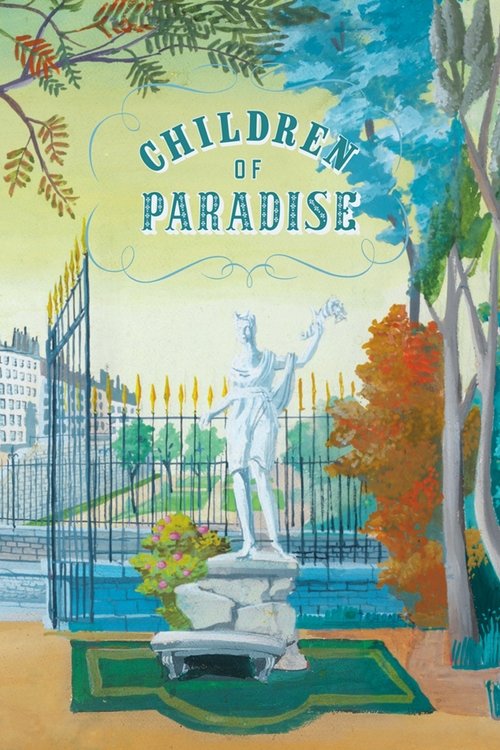
Children of Paradise is divided into two parts, Boulevard du Crime ("Boulevard of Crime") and L'Homme Blanc ("The Man in White"). The first begins around 1827, the second about seven years later. The action takes place mainly in the neighbourhood of the Boulevard du Temple in Paris, nicknamed "Boulevard of Crime" because of all the melodramas and bloody scenarios offered to the largely plebeian public each evening. There are two principal theatres: the Théâtre des Funambules ("Theatre of Tightrope Walkers") specializes in pantomime, since the authorities do not allow it to use spoken dialogue, which is reserved for the "official" venue, the Grand Theatre.
Part I: Boulevard of Crime
A young actor and womaniser, Frédérick Lemaître, dreams of becoming a star. He meets and flirts with Garance, a beautiful woman who earns her living by modestly exhibiting her physical charms in a carnival show. Garance staves off Frédérick's advances and goes to visit one of her acquaintances, Pierre-François Lacenaire, a rebel in revolt against society. Lacenaire is a proud, dangerous individual who works as a scrivener to cover his organized criminal enterprises. Shortly thereafter, Garance is accused of stealing a man's gold watch while she is watching a pantomime featuring Baptiste Deburau and a barker (Baptiste's father) in front of the Funambules Theatre. Lacenaire is in fact the guilty party. Baptiste, dressed up as the stock character Pierrot, saves her from the police by silently acting out the theft, which he has just witnessed. He reveals a great talent, a veritable vocation for pantomime, but falls immediately and irremediably in love with Garance, saving a flower she thanked him with. In the background, there is a price list for various seats, including Paradise, which is visible over the mime's shoulder.
Baptiste's father is one of the stars at the Funambules. The daughter of the theatre director, Nathalie, who is a mime also, is deeply in love with Baptiste. Before the performance that evening, a used-clothes peddler named Jéricho reads in her palm that she will marry the man she loves, as he knew her father was worried about her mood affecting her performances. When a fight breaks out that evening between two rival clans of actors, Baptiste and Frédérick manage to calm the crowd down by improvising a mime act, thus saving the day's receipts. The most enthusiastic of the spectators are those seated in "paradise" (paradis), a term denoting in French theatrical language the top floor of the balcony, where the cheapest seats are located.
Later that night, Baptiste catches sight of Garance with Lacenaire and his accomplices in a seedy restaurant/dancehall, "Le Rouge Gorge" (a pun: this means "The Robin" or "The Red Breast", but literally translates as "The Red Throat", a reference to the previous owner's throat having been slit). When he invites Garance to dance, he is thrown out of the restaurant by Avril, one of Lacenaire's thugs. He turns the situation around and leaves with Garance, for whom he finds a room at the same boarding house where he and Frédérick live. After declaring his love, Baptiste flees Garance's room when she says she doesn't feel the same way, despite her clear invitation to stay. When Frédérick hears Garance singing in her room, which is next to his, he quickly joins her.
Baptiste becomes the star of the Funambules; fuelled by his passion, he writes several very popular pantomimes, performing with Garance and Frédérick, who are now lovers. Baptiste is tormented by their affair, while Nathalie, who is convinced that she and Baptiste are "made for each other", suffers from his lack of love for her.
Garance is visited in her dressing room by the Count Édouard de Montray, a wealthy and cynical dandy who offers her his fortune if she will agree to be his mistress. Garance is repelled by him and mockingly rejects his proposition. The Count nonetheless offers her his protection if the need were to arise. She is later unjustly suspected of complicity in an abortive robbery and murder attempt by Lacenaire and Avril. To avoid arrest she is forced to appeal to Count Édouard for protection. The first part of the film comes to an end with this development.
Part II: The Man in White
Several years later, Frédérick is the star of the Grand Theatre. A man about town and a spendthrift, he is burdened with debts – which don't prevent him from devastating the mediocre play in which he currently has the main role by exposing it to ridicule in rehearsal and then playing it for laughs, rather than straight melodrama, on opening night. Despite achieving a smashing success, the play's three fussy authors are outraged and challenge him to a duel. He accepts and when he returns to his dressing room, Frédérick is confronted by Lacenaire, who apparently intends to rob and kill him. However, the criminal is an amateur playwright and strikes up a friendship with the actor instead. He and Avril serve as Frédérick's seconds the next morning, when the actor arrives at the duel dead drunk.
Baptiste is enjoying even greater success as a mime at the Funambules. When Frédérick goes to a performance the day after surviving the duel, he is surprised to find himself in the same box as Garance. His old flame has returned to Paris after having travelled throughout the world with the Count de Montray, who has kept her these several years. She has been attending the Funambules every night incognito to watch Baptiste perform. She knows she has always been genuinely in love with him. Frédérick suddenly finds himself jealous for the first time in his life. While the feeling is highly unpleasant, he remarks that his jealousy will help him as an actor. He will finally be able to play the role of Othello, having now experienced the emotions which motivate the character. Garance asks Frédérick to tell Baptiste of her presence, but Nathalie, now Baptiste's wife, is first informed by the spiteful rag-man Jéricho. She sends their small son to Garance's box to mortify her with their family's happiness. By the time Frédérick alerts Baptiste and he rushes to find her, the box is empty.
When Garance returns to the Count's luxurious mansion, she finds Lacenaire waiting for her. Lacenaire satisfies himself that Garance has no love for him and, on his way out, encounters the Count, who is irritated to see such an individual in his home. Lacenaire reacts to the Count's challenge with threats, revealing the knife at his belt. Later, Garance declares to the Count that she will never love him since she is already in love with another man, but declares she will continue to try to please him, and offers to spread the word on the streets that she is "mad" about him, if he would like.
Frédérick has finally achieved his dream of playing the role of Othello. The Count, who insists on attending the performance with Garance, is convinced that the actor is the man she loves. At a break in the play, the Count coolly mocks Frédérick, trying to provoke him into a duel. Elsewhere Baptiste, who is also in the audience, encounters Garance at last. When Lacenaire takes Frédérick's side in the verbal jousting, the Count attempts to humiliate him as well. Lacenaire takes revenge by calling him a cuckold and, dramatically pulling back a curtain, reveals Garance in Baptiste's embrace on the balcony. The two lovers slip away to spend the night together in Garance's former room at the Great Post House.
The next morning, at a hammam, Lacenaire assassinates the Count. He then calmly sits to wait for the police and meet his "destiny", which is to die on the scaffold. At the rooming house, Nathalie walks in on Baptiste and Garance. Garance is in a hurry to exit in order to prevent the duel between Frédérick and the Count, who she is unaware has been murdered, but Nathalie blocks her way, insisting that leaving is easy, while to stay and share someone's everyday life, as she has for the past six years with Baptiste, is much more difficult. Garance responds that she has lived with Baptiste for six years as well, that she felt him every day and night even though she was with another. Nathalie dismisses Garance's experience as unimportant and moves past her to Baptiste, allowing Garance to leave. Nathalie pleads with Baptiste for reassurance as he attempts to follow Garance. Baptiste pushes past her and is soon lost in the frantic Carnival crowd amid a sea of bobbing masks and unheeding, white Pierrots. The film ends as a desperate Baptiste is swept away with the crowd and Garance leaves in her carriage, her face impassive.