The Cincinnati Bengals are a professional American football team based in Cincinnati. The Bengals compete in the National Football League (NFL) as a member of the American Football Conference (AFC) North division. The team plays its home games at Paycor Stadium in downtown Cincinnati.
Former Cleveland Browns head coach Paul Brown began planning for the creation of the Bengals franchise in 1965, and Cincinnati's city council approved the construction of Riverfront Stadium in 1966. Finally, in 1967, the Bengals were founded when a group headed by Brown received franchise approval by the American Football League (AFL) on May 23, 1967, and they began play in the 1968 season. Brown was the Bengals' head coach from their inception to 1975.
After being dismissed as the Browns' head coach by Art Modell (who had purchased a majority interest in the team in 1961) in January 1963, Brown had shown interest in establishing another NFL franchise in Ohio and looked at both Cincinnati and Columbus. He ultimately chose the former when a deal between the city, Hamilton County, and Major League Baseball's Cincinnati Reds (who were seeking a replacement for the obsolete Crosley Field) was struck that resulted in an agreement to build a multipurpose stadium which could host both baseball and football games. Due to the impending merger of the AFL and the NFL, which was scheduled to take full effect in the 1970 season, Brown agreed to join the AFL as its 10th and final franchise. The Bengals, like the other former AFL teams, were assigned to the AFC following the merger. Cincinnati was also selected because, like the baseball team they shared a city with (the Cincinnati Reds), they could draw from several large neighboring cities (Louisville and Lexington, Kentucky; Columbus, Dayton, and Springfield, Ohio) that are all no more than 110 miles (180 km) away from downtown Cincinnati, along with Indianapolis, until the Baltimore Colts relocated there prior to the 1984 NFL season.
After Paul Brown's death in 1991, controlling interest in the team was inherited by his son, Mike Brown. In 2011, Brown purchased shares of the team owned by the estate of co-founder Austin Knowlton and is now the majority owner of the Bengals franchise.
The Bengals won the AFC championship in 1981, 1988, and in 2021. After each of the 1981 and 1988 conference championships, they went on to lose to the San Francisco 49ers, in Super Bowls XVI and XXIII. The team struggled greatly in the 1990s and the early 2000s, during which time they were sometimes referred to disparagingly as "The Bungles," a term coined by Steelers broadcaster Myron Cope. Following the 1990 season, the team went 14 years without making the NFL playoffs or posting a winning record. The Bengals went through several head coaches in that period, and many of their top draft picks did not pan out.
The team's fortunes improved in the mid-2000s and into the mid-2010s, which saw them become more consistent postseason contenders, but they continued to struggle in the playoffs. The turning point for the Bengals was during the 2021 season, when they won their first playoff game in 31 years and advanced to the first of two consecutive AFC Championship games. In 2021, they defeated the Kansas City Chiefs 27–24 in overtime and advanced to Super Bowl LVI, their first appearance in the Super Bowl in 33 years, where they lost to the Los Angeles Rams 23–20. They advanced to the AFC Championship game again in 2022 but lost to the eventual Super Bowl champion Chiefs by a score of 23–20.
The team does not have an official general manager. However, Duke Tobin is the Bengals' "de facto general manager" because he handles most personnel decisions. In a 2011 survey, Brown was rated as among the worst team owners in American professional sports.
In a Forbes article on the value of NFL teams as of August 2022, the Cincinnati Bengals were ranked last with a value of $3 billion.
Contents
History
Brown family era (1968–present)
In 1967, an ownership group led by Paul Brown was granted a franchise in the American Football League. Brown named the team the Bengals in order "to give it a link with past professional football in Cincinnati". Another Cincinnati Bengals team had existed in the city and played in three previous American Football Leagues from 1937 to 1942. The city's world-renowned zoo was also home to a rare white Bengal tiger.
In a possible insult to Art Modell – or possibly as a homage to the Massillon Tigers – Brown chose the exact shade of orange used by his former team. He added black as the secondary color. Brown chose a very simple logo: the word "BENGALS" in black lettering. One of the potential helmet designs Brown rejected was a striped motif that was similar to the helmets adopted by the team in 1981 still in use today; however, that design featured stripes which were more uniform in width. The Bengals began play in the 1968 season.
In 1966, the American Football League agreed to a merger with its older and more established rival, the National Football League. Among the terms of the merger was that the AFL was permitted to add one additional franchise; the NFL wanted an even number of clubs in the merged league, so a team needed to be added to bring the number of clubs in the merged league to 26 teams.
For the AFL, a key motive behind their agreement to accept a new team was that the guarantee of an eventual place in the NFL meant the league could charge a steep expansion fee of $10 million – 400 times the $25,000 the original eight owners paid when they founded the league in 1960. The cash from the new team provided the American Football League with the funds needed to pay the indemnities required to be paid by the AFL to the NFL, as stipulated by the merger agreement.
Prior to the merger's announcement, Brown had not seriously considered joining the American Football League and was not a supporter of what he openly regarded to be an inferior competition, once famously stating that "I didn't pay ten million dollars to be in the AFL." However, with the announcement of the merger, Brown realized that the AFL expansion franchise would likely be his only realistic path back into the NFL in the short to medium term, and ultimately acquiesced to joining the AFL after learning that the team was guaranteed to become an NFL franchise after the merger was completed in 1970.
Logos and uniforms
When the team debuted in 1968, the Bengals' uniforms were modeled after the Cleveland Browns. When Paul Brown was fired by Art Modell, Brown still owned the equipment used by Cleveland, so after the firing, Paul Brown packed up all his equipment, which he then used for his new team in Cincinnati. The Cleveland Browns' team colors were brown, orange, and white, and their helmets were solid orange with a white dorsal stripe over the crest.
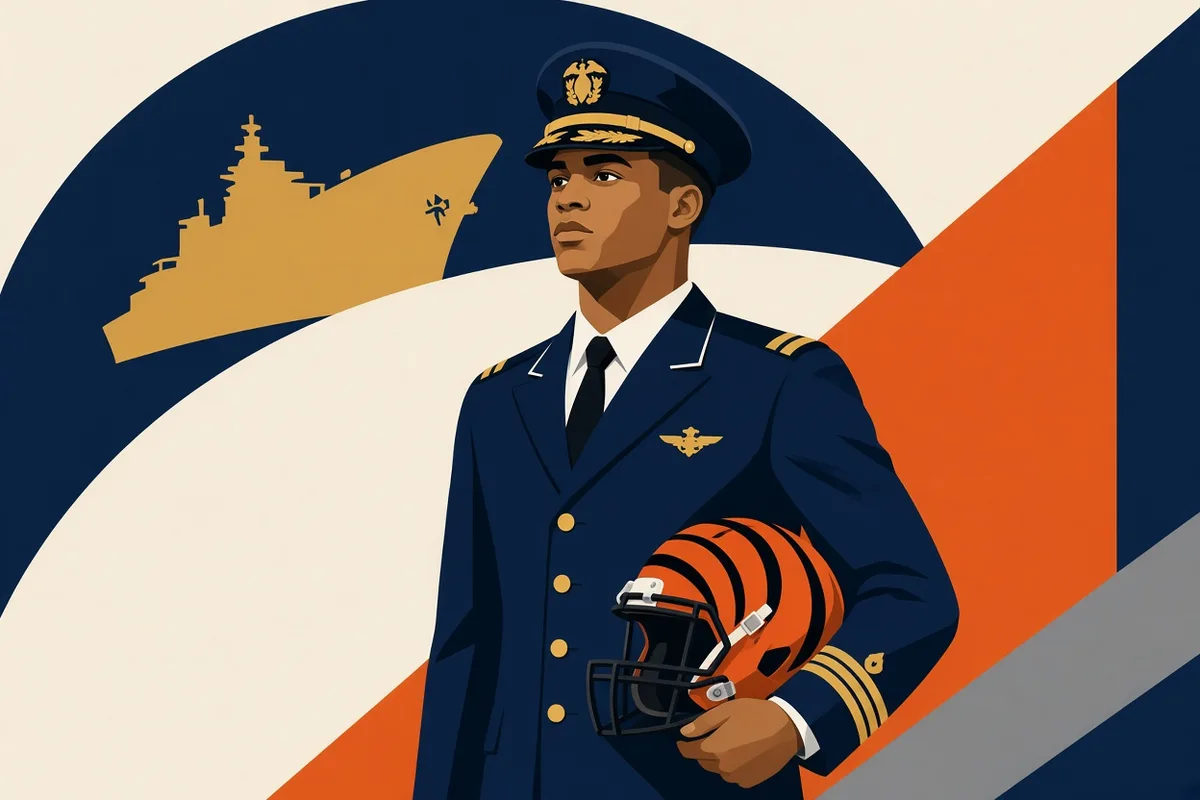
The Bengals' team colors were orange, black, and white, and their helmets were a similar shade of orange, with the only variations being the word "Bengals" in black block letters (with a white outline) on either side of the helmet and no stripe on the helmet. The Cincinnati Bengals were unique in the NFL, as they did not have secondary uniform numbers on the jerseys (called "TV numbers") until they appeared on the sleeves in the 1980 season; they were the only NFL team that didn't have them prior to that point. That same year, the team changed their helmet face mask color from gray to black. The team did not discard their Cleveland-like uniforms until 1981. During that year, a then-unique uniform design was introduced: Although the team kept black jerseys, white jerseys, and white pants, they were now trimmed with orange and black tiger stripes. The team also introduced the orange helmets with black tiger stripes that are still in use today. Sports Illustrated likened the Bengals' new helmets to "varicose pumpkins."
In 1997, the Bengals designed a logo consisting of a leaping tiger, and it was added to the uniform sleeves (with this, the TV numbers moved to the shoulder). Another alternate logo consisted of a Bengal's head facing to the left. However, the orange helmet with black tiger stripes continued to be the trademark. In 2004, a new tiger stripe pattern and more accents were added to the uniforms. The black jerseys now featured orange tiger-striped sleeves and white side panels, while the white jerseys began to use black tiger-striped sleeves and orange shoulders. A new logo consisting of an orange "B" covered with black tiger stripes was introduced. The team also started rotating black pants and debuted an alternate orange jersey, with white side panels and black tiger-striped sleeves. The Bengals have worn their black uniforms at home throughout their history, with some exceptions, such as the 1970 season, when the Bengals wore white at home for the entire season as well as most of the 1971 season (the Bengals were the first AFL team to wear white at home, as its rules required the home team to wear their dark jerseys, unlike the NFL, which allowed the home team choice of jersey color starting in 1964). Since 2005, the Bengals have worn white for September home games where the heat could become a factor.
Mascots
The team's official mascot is a Bengal tiger named Who Dey. Its jersey number is 1. Aside from Who Dey, the team also has the Ben-Gals, the team's cheerleading squad, which included Laura Vikmanis, the oldest cheerleader in league history.
Carol Motsinger in 2015 said, "In 2012, Cincinnati welcomed another tiger named Who Dey. This time, one that walks on four legs. More than 1,000 Bengals season ticket holders named a Malayan tiger Who Dey at Cincinnati Zoo & Botanical Garden. He was recently traded to a zoo in Kansas."
The Ohio History Central notes: "In 1940, a third American Football League formed, and the Cincinnati Bengals joined it. Unfortunately, World War II began the following year, causing manpower shortages as men joined the armed forces. This prompted this newer AFL to cease playing after the 1941 season. Paul Brown, former coach of the Cleveland Browns, received authorization from a modern American Football League to create a team in Cincinnati. Brown chose the name Bengals to memorialize the teams of the same name that had represented Cincinnati in the past."
Rivalries
Divisional
The Bengals' historic rivalry with the Cleveland Browns is often referred to as the "Battle of Ohio", started as the result of former Browns head coach and team founder Paul Brown starting the Bengals franchise after leaving the Browns. The colors of each team are similar since Paul Brown chose the exact shade of orange used by the Browns for the Bengals, and the Bengals' original uniforms were identical to the Browns' uniforms, excluding the word "Bengals" on the helmet. The rivalry reached its peak during the 1980s when both teams were vying viciously for a spot in the playoffs. During the 1990s the rivalry also butted heads when Brown's sons were in charge of the day-to-day operations of the Bengals. The Bengals lead the series 55–48 as of the end of the 2024 season.
The Bengals and Pittsburgh Steelers have played each other twice a year since becoming division rivals in 1970. This rivalry has gained intensity since the 2000s, as the teams have met twice in the playoffs, with both games being marked by hard hits and injuries with the most infamous example occurring in the 2005 playoffs. The Steelers lead the overall series 71–40 and the postseason series 2–0. However, the Steelers have been more dominant recently, posting a record of 28–7 since 2004, when they drafted Roethlisberger. There were two times that the rivalry has met during the playoffs: the Wild Card rounds of 2005 and 2015, with the Steelers winning both meetings at Cincinnati. The 2005 game is marked as a special time in the rivalry because this is when Steelers defensive tackle Kimo Von Oelhoffen injured Bengals quarterback Carson Palmer, while the 2015 game is also special because Bengals running back Jeremy Hill fumbled the ball in the waning minutes when the Bengals had a 16–15 lead over the Steelers to give the latter one last chance. They used that chance wisely as they drove down the field (with the help of two costly personal fouls by the Bengals) and kicked a game-winning field goal.
The Bengals' rivalry with the Baltimore Ravens began when the original Browns franchise relocated to Baltimore to become the Ravens. Since then, the rivalry heated up when longtime Ravens defensive coordinator Marvin Lewis was hired as the head coach of the Bengals. The Ravens lead the all-time series 33-28 as of the 2025 season. The Bengals won the only playoff meeting in the 2022 AFC Wild Card round.
Contributions to NFL culture
No-huddle offense
A no-huddle offense was commonly used by all teams when time in the game was running low. However, Sam Wyche, the head coach of the Bengals in 1988, along with offensive coordinator Bruce Coslet, made the high-paced offense the standard modality for the ball club regardless of time remaining. By quickly substituting and setting up for the next play—often within 5–10 seconds after the last play despite being afforded 45 seconds—the Bengals hindered the other team's defense from substituting situational players, regrouping for tactics, and resting. In response, the NFL instituted rules allowing the defense ample time for substitutions when offensive substitutions were made.
The hurry-up tactic was used by the franchise during the late 1980s while Sam Wyche was the coach. A rival for AFC supremacy during this time was the Buffalo Bills, coached by Marv Levy, who also used a version of the no-huddle offense starting with the 1989 season. The Bengals had beaten the Bills three times in 1988 (pre-season, regular season, and the AFC Championship Game). Marv Levy threatened to fake injuries if the Bengals used the "no-huddle" in the AFC Championship. Wyche was notified that the commissioner had ordered the "no-huddle" illegal for the game. The official notified Wyche and the Bengals' team just two hours before the game kickoff. Wyche asked to talk directly to the commissioner and word immediately came back that the "no-huddle" would not be penalized. Levy did not have his players' fake injuries in the game but installed his version the next year, 1989. The Bengals first used the "no-huddle" in 1984. Most of the high-profile games (the various games for AFC titles and regular-season games) between the two led to these changes in NFL rules. Wyche also first used the timeout periods as an opportunity to bring his entire team to the sideline to talk to all eleven players, plus substitutes, at one time. This allowed trainers time to treat a cut or bruise and equipment managers time to repair an equipment defect.
West Coast offense
The West Coast offense is the popular name for the high-percentage passing scheme designed by former Bengals assistant Bill Walsh. Walsh formulated what has become popularly known as the West Coast offense during his tenure as assistant coach for the Cincinnati Bengals from 1968 to 1975, while working under the tutelage of Brown (and before embarking on his legendary coaching tenure with the San Francisco 49ers in the 1980s). Bengals quarterback Virgil Carter was the first player to successfully implement Walsh's system, leading the NFL in pass completion percentage in 1971. Ken Anderson replaced Carter as Cincinnati's starting quarterback in 1972 and was even more successful. In 1975 he would bring widespread recognition to the West Coast offense as well as to the Cincinnati team and its quarterback in a nationally televised Monday night contest between the Bengals and a Buffalo Bills team built around the running game of star player O. J. Simpson. Anderson's 447 passing yards were enough to overcome Simpson's 197 yards on the ground in a game that proved a milestone, providing a striking contrast between the "old" game of defense-minded football and the new game of higher scores and more action through a sophisticated aerial attack. The game, in effect, offered its viewers a glimpse of the future of professional football. Anderson, who was drafted by Paul Brown in 1971 and installed as starting quarterback in 1972, made four trips to the Pro Bowl, won four passing titles, was named NFL MVP in 1981, and set the record for completion percentage in a single season in 1982 with 70.66%. Defeated frequently during the 1970s by the Pittsburgh Steelers, a team that won four Super Bowls with 9 future Hall of Fame players, the Bengals under Anderson and head coach Forrest Gregg would finally break through the Steel Curtain, defeating the Steelers during both of their meetings in 1980 and again in 1981. Anderson, who had been named the "team franchise" by Bengal tight end Bob Trumpy, would ultimately prove his worth with a career record of 91 wins and 81 losses.
Zone blitz
The defense created to combat the West Coast offense also came from Cincinnati. Then-Bengals defensive coordinator Dick LeBeau (who later served as the team's head coach from 2000 to 2002) created the zone blitz in the 1980s in response to the West Coast offense.
Players
Retired numbers
In addition, despite not being formally retired, the Bengals have certain numbers that are in limited circulation:
13 Has only been worn once (in 2000, by Daniel Pope) since the retirement of Ken Riley.
14 Has not been worn since Andy Dalton after he was released in 2019. 14 was also worn by Ken Anderson from 1971 to 1986, arguably the best Bengals quarterback of all time.
78 Has not been worn by anyone since Anthony Muñoz retired.
Pro Football Hall of Fame members
There are four members of the Hall of Fame that have spent some portion of their career with the Bengals, but only Anthony Muñoz and Ken Riley spent their entire playing careers with the Bengals. Listed below are only Hall of Famers whose induction includes their tenure with the Bengals. Bengals founder and first coach Paul Brown is in the Hall of Fame, but was inducted before founding the team and is not credited as a Bengals Hall of Famer. Additionally, the Bengals have had two head coaches, Forrest Gregg and Dick LeBeau inducted for their playing career.
40th Anniversary Team
In 2007, in celebration of their 40th anniversary the Bengals named an all-time team voted on by the fans.
50th Anniversary Team
In 2017, in celebration of their 50th anniversary, a team was created based on "career statistics, team records and votes from the Bengals First 50."
Source:
Ring of Honor
The Bengals announced they would begin a Ring of Honor in 2021. The inaugural class included Pro Football Hall of Fame left tackle Anthony Muñoz and Paul Brown, who was the franchise's founder and first coach, with Ken Anderson and Ken Riley added after a season ticket holder vote.
*Posthumous induction
Coaching staff
Radio and television
The Bengals contract with iHeartMedia as their radio partner, with their flagship radio stations being WCKY (1530) and WEBN (102.7 FM), along with WLW (700) if not in conflict with the Reds. Most preseason and regular season games with them hosting an NFC opponent, are telecast on WXIX-TV, channel 19, the Fox affiliate. They also air games streaming on Amazon Prime Video and YouTube. Mike Watts and Anthony Muñoz are the TV announcers for preseason games, with Mike Valpredo as the sideline reporter. Most regular season games are televised on WKRC-TV, channel 12, the local CBS affiliate. They also air games streaming on Netflix alongside CBS games. NBC affiliate WLWT-TV airs games when the Bengals are featured on Sunday Night Football and Monday Night Football broadcasts not on ABC. ABC affiliate WCPO-TV airs it otherwise.
The radio broadcasting crew consists of Dan Hoard (play-by-play), and Dave Lapham (analyst).
Culture
Fight song
"The Bengal Growl" is the Bengals fight song. It was written by Bengals entertainment director George "Red" Bird upon the team's founding in 1968. Bird had been friends with Paul Brown for over 30 years. The two had met at Massillon Washington High School when Brown was head football coach and Bird was director of the famed Massillon Tiger Swing Band. Bird had served as the Browns' music and entertainment director in 1946, and kept that role until Brown convinced him to come to Cincinnati in 1968. His first task was to pen a fight song along the lines of the Browns' fight song, "Hi! O-Hi-O for Cleveland!" The song remains very popular among Bengals fans, who are known to belt out the song at "Bengals backer" bars all over the country. In 2021, Elizabeth Blackburn, now the team's head of strategy and fan engagement, told The Athletic recalled stopping at one such bar in San Francisco during the 2015 playoffs, and was surprised to hear the viewers break out into the song. As a measure of how popular the song remains among the Bengals fan base, when Blackburn wrote an editorial on her efforts to overhaul the team's image for the Bengals Web site, Blackburn specifically mentioned that the song was not going anywhere. "Welcome to the Jungle" is also a fight song for the Bengals. The song is mainly played before kickoffs to intimidate visiting teams.
Who Dey chant
"Who Dey?!" is the name of a chant of support by fans of the Cincinnati Bengals, in use since the 1980s. The entire chant is: "Who dey, who dey, who dey think gonna beat dem Bengals?" The answer screamed in unison, "Nobody." Sometimes fans will instead shout "Who Dey?" to represent the entire cheer. "Who Dey" is also the name of the team's mascot, a Bengal tiger.
Saying "Who Dey" at Bengals games is steeped in local beer lore. Hudy, a leading product of Hudepohl Brewing Company 1978 through the late 1980s, bears a phonetic similarity to the "Who Dey" chant. Beer vendors who carried full cases of bottled local beer up and down the steep upper stairs of what was then Riverfront Stadium would call out "If Hudy", "Burger" and other local beer names. Raucous fans would often chant back and forth with them as the vendors called out. During the 1980 season, the banter with the Hudepohl vendors grew organically into the now famous (Hu-Dey) -Who They?- chant.
The full Who Dey chant was first known to be used by fans of the 1980 Cincinnati Bengals. While the origin of the chant is disputed, one possible source for the chant is a 1980 commercial for (the now-defunct) Red Frazier Ford of Cincinnati, which used this tagline: "Who's going to give you a better deal than Red Frazier?...Nobody!" Cincinnati fans who had seen the commercial many times may have just copied it when cheering.
The chant bears some similarities to the phrase "Who Dat?", which was officially adopted by the New Orleans Saints in 1983 but had been used by Louisiana's high school team fans for some time. The saying "Who Dat?" originated in minstrel shows and vaudeville acts in the late 19th and early 20th centuries, then it was taken up by New Orleans Jazz and various Big band folks in the 1920s and 1930s. In the late 1960s, local Louisiana High Schools, St. Augustine High School and Patterson High School reportedly have been using the cheer and Gulf Coast fans of Alcorn State University and Louisiana State University picked up the cheer in the 1970s. Southern University in Baton Rouge, Louisiana claims to have originated the cheer in the late 1960s in their version: "Who dat talking 'bout beating dem Jags?"