




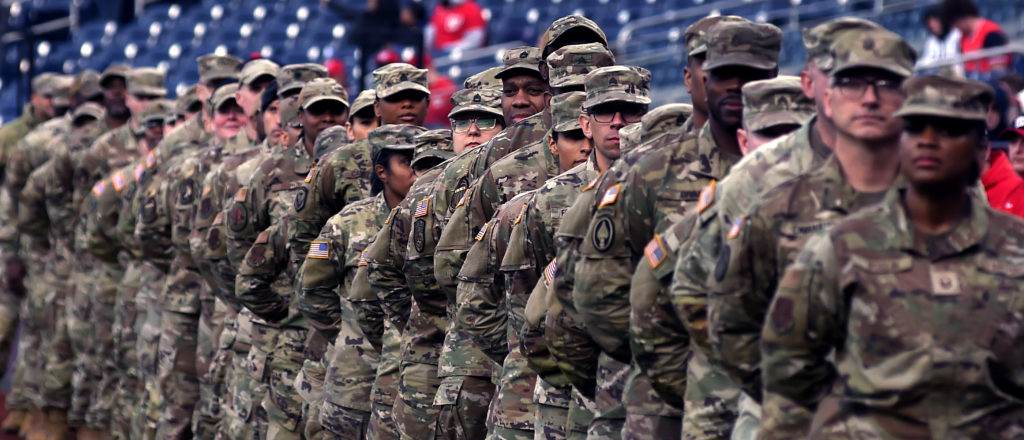
In the United States, military conscription, commonly known as "the draft", has been employed by the U.S. federal government in six conflicts: the American Revolutionary War, the American Civil War, World War I, World War II, the Korean War, and the Vietnam War. The fourth incarnation of the draft came into being in 1940, through the Selective Training and Service Act; this was the country's first peacetime draft.
From 1940 until 1973, during both peacetime and periods of conflict, men were drafted to fill vacancies in the U.S. Armed Forces that could not be filled through voluntary means. Active conscription in the United States ended in January 1973, and the U.S. Armed Forces moved to an all-volunteer military except for draftees called up through the end of 1972. Conscription remains in place on a contingency basis, however, in that all male U.S. citizens, even those residing abroad, and all male immigrants, whether documented or undocumented but residing within the United States, are required to register with the Selective Service System (SSS) between the ages of 18 and 25. Failure to register for the SSS, when otherwise required, can mean denial of federal employment, federal job training programs, and citizenship if an immigrant.
Beginning on December 18, 2026, the requirement for male U.S. residents ages 18 through 26 to register themselves with the Selective Service System will be replaced with a requirement for the Selective Service System to register them "automatically" on the basis of other federal government databases. This results from a provision of the Fiscal Year 2026 National Defense Authorization Act.
Although it has not been applied in recent American history, U.S. federal law continues to allow for compulsory conscription for militia service under emergency or extraordinary security conditions. The law is described in Article I, Section 8 of the United States Constitution and 10 U.S. Code § 246. Such conscription would apply to able-bodied men between the ages of 17 and 45 who are, or who have made a declaration of intention to become, U.S. citizens, as well as female members of the U.S. National Guard and some other women in certain health care occupations.
Conscription has faced strong opposition throughout American history from prominent figures like Daniel Webster, who stated, "A free government with an uncontrolled power of military conscription is the most ridiculous and abominable contradiction and nonsense that ever entered into the heads of men."
Contents
History
Colonial era to 1862
In colonial times, the Thirteen Colonies used a militia system for defense. Colonial militia laws—and after independence, those of the United States and the various states—required able-bodied non-enslaved males to enroll in the militia, to undergo a minimum of military training, and to serve for limited periods in war or emergency. This earliest form of conscription involved selective drafts of militiamen for service in particular campaigns. Following this system in its essentials, the Continental Congress in 1778 recommended that the states draft men from their militias for one year's service in the Continental Army; this first national conscription was applied irregularly, failing to fill the Continental ranks.
For long-term operations, conscription was occasionally used when volunteers or paid substitutes were insufficient to raise the needed manpower. During the American Revolutionary War, the states sometimes drafted men for militia duty or to fill state Continental Army units, but the central government did not have the authority to conscript except for purposes of naval impressment. The 1789 constitution lists among the enumerated powers of Congress the ability to create its own armies and navy for unlimited purposes, and to fund and regulate state militias that could be called up only for federal law enforcement and domestic defense. The new constitution also made the president of the United States the commander-in-chief of both the federal military and the militia when in federal service. The Second Militia Act of 1792 defined the first group who could be called up as 'each and every free able-bodied white male citizen of the respective states, resident therein, who is or shall be of the age of eighteen years, and under the age of forty-five years'.
During the War of 1812, President James Madison and his Secretary of War James Monroe unsuccessfully attempted to create a national draft of 40,000 men. The proposal was fiercely criticized on the House floor by antiwar congressman Daniel Webster of New Hampshire.
Civil War
The United States first employed national conscription during the American Civil War. The vast majority of troops were volunteers; of the 2,200,000 Union soldiers, about 2% were draftees, and another 6% were substitutes paid by draftees.
The Confederacy had far fewer inhabitants than the Union, and Confederate president Jefferson Davis proposed the first conscription act on March 28, 1862; it was passed into law the next month. Resistance was both widespread and violent, with comparisons made between conscription and slavery.
Both sides permitted conscripts to hire substitutes to serve in their place. In the Union, many states and cities offered bounties and bonuses for enlistment. They also arranged to take credit against their draft quota by claiming freed slaves who enlisted in the Union Army.
Although both sides resorted to conscription, the system did not work effectively for either. The Confederate Congress, on April 16, 1862, passed an act requiring military service for three years from all white males aged 18 to 35 not legally exempt. It later extended the obligation.
The U.S. Congress passed the Militia Act of 1862, which was similar to the 1792 Act except that it allowed African Americans to serve in state militias as soldiers and war laborers for the first time, and additionally authorized a militia draft within a state when it could not meet its quota with volunteers. This state-administered system failed in practice and Congress passed the Enrollment Act of 1863, the first genuine national conscription law, replacing the Militia Act of 1862, which required the enrollment of every male citizen and those immigrants (aliens) who had filed for citizenship, between 20 and 45 years of age, unless exempted by the Act. It set up under the Union Army an elaborate machine for enrolling and drafting men. Quotas were assigned in each state, and deficiencies in volunteers were required to be met by conscription.
Still, men who were drafted could provide substitutes, and until mid-1864 could also avoid service by paying commutation money. Many eligible men pooled their money to cover the cost of any one of them being drafted. Families used the substitute provision to select which member should go into the army and which would stay home. Another popular means of procuring a substitute was to pay a soldier whose period of enlistment was about to expire—the advantage of this method was that the Army could retain a trained veteran in place of a raw recruit. Of the 168,649 men procured for the Union Army through the draft, 117,986 were substitutes, leaving 50,663 who had their personal services conscripted. There was much evasion and overt resistance to the draft, and the New York City draft riots were in direct response to the draft and were the first large-scale resistance against the draft in the United States.
National Guard
The Militia Act of 1903 reorganized the federally supported state militias as the National Guard, better-aligning their organization, training, and materiel with active-duty needs so they could be more quickly and efficiently put into federal service when needed. In 1933, Congress reorganized the National Guard under its Article I enumerated power to "raise and support armies" instead of its power to "Provide for organizing, arming and disciplining the Militia," avoiding the potential constraint on militia service that it can only be used "to execute the laws of the Union, suppress insurrections and repel invasions."
Able-bodied men between the ages of 17 and 45 not in the National Guard are defined in the Militia Act, and under the laws of some states, as the unorganized militia, which also may be called into state or federal service as needed.
World War I
In 1917, the administration of President Woodrow Wilson decided to rely primarily on conscription, rather than voluntary enlistment, to raise military manpower for World War I when only 73,000 volunteers enlisted out of the initial 1 million target in the first six weeks of the war. One ascribed motivation was to thwart former president Theodore Roosevelt, who proposed raising a volunteer division, which would have upstaged Wilson. However, there is no evidence that Roosevelt had enough support to carry out that plan, and because Wilson had just started his second term, the former President's prospects for substantial political gain seemed dubious.
The Selective Service Act of 1917 was carefully drawn to remedy the defects in the Civil War system and—by allowing exemptions for dependency, essential occupations, and religious scruples—to place each man in his proper niche in a national war effort. The act established a "liability for military service of all male citizens"; authorized a selective draft of all those between 21 and 31 years of age (later from 18 to 45); and prohibited all forms of bounties, substitutions, or purchase of exemptions. Administration was entrusted to local boards composed of leading civilians in each community. These boards issued draft calls in order of numbers drawn in a national lottery and determined exemptions.
In 1917, 10 million men were registered. This was deemed to be inadequate, so age ranges were increased and exemptions reduced, and so by the end of 1918 24 million men were registered and nearly 3 million inducted into the military services, with little of the resistance that characterized the Civil War, thanks to a well-received campaign by the government to increase support for the war. The government also shut down newspapers and magazines that published articles against the war, but there was still resistance in some areas, such as the Green Corn Rebellion.
The draft was universal and included black men on the same terms as whites, although they served in different units. In all 367,710 black Americans were drafted (13% of the total), compared to 2,442,586 white (86.9%). Along with a general opposition to American involvement in a foreign conflict, Southern farmers objected to perceived unfair conscription practices that exempted members of the upper class and industrial workers.
Draft boards were localized and based their decisions on social class: the poorest were the most often conscripted because they were considered the least likely to be the skilled labor needed for the war effort. Poor men were also less likely to convince local boards that they were primary breadwinners who could be deferred to support dependents. Forms of resistance ranged from peaceful protest to violent demonstrations and from humble letter-writing campaigns asking for mercy to newspapers demanding reform. The most common tactics were dodging and desertion, and some communities in isolationist areas even sheltered and defended their draft dodgers as political heroes.
Interwar
The draft ended in 1918, but the Army designed the modern draft mechanism in 1926 and built it based on military needs, despite an era of pacifism. Working where Congress would not, it gathered a cadre of officers for its nascent Joint Army-Navy Selective Service Committee, most of whom were commissioned based on social standing rather than military experience. This effort did not receive congressionally approved funding until 1934, when Major General Lewis B. Hershey was assigned to the organization. The passage of a conscription act was opposed by some, including Dorothy Day and George Barry O'Toole, who were concerned that such conscription would not provide adequate protection for the rights of conscientious objectors. However, much of Hershey's work was codified into law with the Selective Training and Service Act of 1940 (STSA).
World War II
In the summer of 1940, after Nazi Germany conquered France, Americans supported the return of conscription. One national survey found that 67% of respondents believed that a German-Italian victory would endanger the United States, and that 71% supported "the immediate adoption of compulsory military training for all young men". Similarly, a November 1942 survey of American high-school students found that 69% favored compulsory postwar military training.
The World War I system served as a model for that of World War II. President Roosevelt's signing of the Selective Training and Service Act on September 16, 1940, began the first peacetime draft in the United States. The 1940 law instituted conscription in peacetime, requiring the registration of all men between 21 and 35. It also reestablished the Selective Service System as an independent agency responsible for identifying young men and facilitating their military service. Roosevelt named Lewis B. Hershey to head the System on July 31, 1941; he remained in post until 1969. This act came when other preparations, such as increased training and equipment production, had not yet been approved. Nevertheless, it served as the basis for the conscription programs that continue to the present.
The act set a cap of 900,000 men to be in training at once, and limited military service to 12 months unless Congress deemed it necessary to extend such service in the interest of national defense. An amendment added 18 more months to this service period on August 18, 1941. After the Pearl Harbor attack the STSA was further amended (December 19, 1941), extending the term of service to the duration of the war plus six months and requiring the registration of all men 18 to 64 years of age. During World War II, 49 million men were registered, 36 million classified, and 10 million inducted. 18- and 19-year-olds were made liable for induction on November 13, 1942. By late 1942, the Selective Service System moved away from a national lottery to administrative selection by its more than 6,000 local boards.
On December 5, 1942, presidential Executive Order 9279 closed voluntary enlistment for all men from the ages of 18 to 37 for the duration of the war, providing protection for the nation's home front manpower pool. The Navy and Marine Corps began procuring their personnel through the Selective Service System in early 1943. The Navy and Marine Corps enlisted inductees and volunteers under the same service agreements, but with different service obligations, while the Army placed wartime inductees and volunteers into a special service component known as the Army of the United States, commonly known as the "AUS"; service commitments were set at the length of the war plus six months.
Early Cold War and Korean War
The second peacetime draft began with passage of the Selective Service Act of 1948 after the STSA expired. The new law required all men of age 18 to 26 to register. It also created the system for the "Doctor Draft", aimed at inducting health professionals into military service. Unless otherwise exempted or deferred (see Berry Plan), these men could be called for up to 21 months of active duty and five years of reserve duty service. Congress further tweaked this act in 1950 although the post–World War II surplus of military manpower left little need for draft calls until President Harry S. Truman's declaration of a national emergency in December 1950. Only 20,348 men were inducted in 1948 and only 9,781 in 1949.
Between the Korean War's outbreak in June 1950 and the armistice agreement in 1953, Selective Service inducted over 1.5 million men. Another 1.3 million volunteered, usually choosing the Navy or Air Force. Congress passed the Universal Military Training and Service Act in 1951 to meet the demands of the war. It lowered the induction age to 18½ and extended active-duty service commitments to 24 months. Despite the early combat failures and later stalemate in Korea, the draft has been credited by some as playing a vital role in turning the tide of war. A February 1953 Gallup Poll showed that 70 percent of Americans surveyed felt that the SSS had handled the draft fairly. Gallup reported that 64 percent of the demographic group including all draft age men (males 21 to 29) believed the draft to be fair.
To improve equity in the system, President Dwight D. Eisenhower signed an executive order on July 11, 1953, that ended the paternity deferment for married men. In large part, the change in the draft served the purposes of the burgeoning Cold War. From a program that had just barely passed Congressional muster during the fearful prelude to World War II, a more robust draft continued as fears now focused on the Soviet threat. Nevertheless, some dissenting voices in Congress continued to advocate for voluntary military service.
The onset of the Cold War coincided with men born during the Great Depression beginning to reach military age. Hershey and other supporters of the draft frequently pointed out that the Depression had resulted in a substantial reduction of the birth rate in order to back up their doubts regarding the return to an all-volunteer military at a time when it was known that the number of men reaching military age was going to fall significantly. The Korean War era marked the first time that any form of student deferment had been used. During the Korean War, a student carrying at least 12 semester hours was exempt until the end of his current semester.
Vietnam War
President John F. Kennedy's decision to send military troops to Vietnam as advisors was a signal that Selective Service Director Lewis B. Hershey needed to visit the Oval Office. From that visit emerged two wishes of JFK with regard to conscription. The first was that the names of married men with children should occupy the very bottom of the callup list. Just above them should be the names of men who were married. This policy was implemented in practice, but was not encoded into statute by Congress. Men who fit into these categories became known as Kennedy Husbands.
Many early rank-and-file anti-conscription protesters had been allied with the National Committee for a Sane Nuclear Policy. The signing in 1963 of the Limited Nuclear Test Ban Treaty left them free to focus on other issues. Syndicated cartoonist Al Capp portrayed them as S.W.I.N.E. (Students Wildly Indignant About Nearly Everything). Protest activity increased after the 1964 Gulf of Tonkin Resolution.
Consequently, there was some opposition to the draft even before the major U.S. involvement in the Vietnam War began. The large cohort of Baby Boomers who became eligible for military service during the Vietnam War allowed a steep increase in the number of exemptions and deferments, especially for college students. Besides being able to avoid the draft, college graduates who volunteered for military service (primarily as commissioned officers) had a much better chance of securing a preferential posting compared to less-educated inductees. Contrary to popular belief, the large majority of American soldiers who participated in the war, and who were killed in combat, were in fact volunteers and not draftees.
As U.S. troop strength in South Vietnam increased, more young men were drafted for service there, and many of those still at home sought means of avoiding the draft. Since only 15,000 National Guard and Reserve soldiers were sent to South Vietnam, enlistment in the Guard or the Reserves became a popular means of avoiding serving in a war zone. For those who could meet the more stringent enlistment standards, service in the Air Force, Navy, or Coast Guard was a means of reducing the chances of being killed. Vocations to the priesthood, the ministry, and the rabbinate soared, because divinity students were exempt from the draft. Doctors and draft board members found themselves being pressured by relatives or family friends to exempt potential draftees.
End of conscription
During the 1968 presidential election, Richard Nixon campaigned on a promise to end the draft. He had become interested in the idea of an all-volunteer army during his time out of office, based upon a paper by Martin Anderson of Columbia University, and in part due to the efforts of ardent anti-draft activist-economist and Nobel laureate, Milton Friedman. Friedman has been quoted in interviews as stating: In the realm of policy, I regard eliminating the draft as my most important accomplishment.
Nixon also saw ending the draft as an effective way to undermine the anti-Vietnam War movement since he believed affluent youths would stop protesting the war once their own probability of having to fight in it was gone. There was opposition to the all-volunteer notion from both Congress and the Department of Defense, so Nixon did not take immediate action toward ending the draft early in his presidency.
Instead, the Gates Commission was formed, headed by Thomas S. Gates, Jr., a former Secretary of Defense in the Eisenhower administration. Gates initially opposed the all-volunteer army idea but changed his mind during the course of the 15-member commission's work. The Gates Commission issued its report in February 1970, describing how adequate military strength could be maintained without having conscription. The existing draft law was expiring at the end of June 1971, but the Department of Defense and Nixon administration decided the draft needed to continue for at least some time. In February 1971, the administration requested Congress to extend the draft for two years, to June 1973.
Senatorial opponents of the war wanted to reduce this to a one-year extension, eliminate the draft altogether, or tie the draft renewal to a timetable for troop withdrawal from Vietnam; Senator Mike Gravel of Alaska took the most forceful approach, trying to filibuster the draft renewal legislation, shut conscription down, and directly force an end to the war. Senators supporting Nixon's war efforts supported the bill even though some had qualms about ending the draft. After a prolonged battle in the Senate, a September 1971 cloture was achieved over the filibuster, and the draft renewal bill was approved. Meanwhile, military pay was increased as an incentive to attract volunteers, and television advertising for the U.S. Army began. With the end of active U.S. ground participation in Vietnam, the last draft call was issued on December 7, 1972, applying to men born in 1952 and earlier.
Post-1980 draft registration
On July 2, 1980, President Jimmy Carter issued Presidential Proclamation 4771 and reinstated the requirement that young men register with the Selective Service System. At that time, it was required that all males, born on or after January 1, 1960, register with the Selective Service System. Those who were now in this category were male U.S. citizens and male immigrant non-citizens between the ages of 18 and 25; they were required to register within 30 days of their 18th birthday even if they were not actually eligible to join the military.
The Selective Service System, still essentially what it was in 1980, describes its mission as "to serve the emergency manpower needs of the Military by conscripting untrained manpower, or personnel with professional healthcare skills, if directed by Congress and the President in a national crisis." Registration is possible online or by mail. Registration forms are available at U.S. Post Offices.
The Selective Service registration form states that failure to register is a felony punishable by up to five years imprisonment or a $250,000 fine. In practice, though, no one has been prosecuted for failure to comply with draft registration since 1986, in part because prosecutions of draft resisters in the 1980s proved counter-productive for the government, and in part because of the difficulty of proving that noncompliance with the law was "knowing and willful".
In interviews published in U.S. News & World Report in May 2016, current and former Selective Service System officials said that in 1988, the Department of Justice and Selective Service agreed to suspend any further prosecutions of nonregistrants. Many men do not register at all, register late, or change addresses without notifying the Selective Service System.
Even in the absence of prosecution, however, failure to register may lead to other consequences. Registration is a requirement for employment by the federal government and some state governments, as well as for receiving various state benefits such as driver's licenses. Some collateral sanctions formerly in effect have been repealed: "From 1982 to 2021, males were required to register with Selective Service System to receive Title IV Federal student aid.... This requirement was eliminated by the FY 2021 Consolidated Appropriations Act.... [F]ailing to register with Selective Service System no longer impacts students' eligibility for Title IV student aid. Effective July 1, 2022, applicants will no longer be able to register with Selective Service System via the FAFSA."
Healthcare personnel
In 1951, the Centers for Disease Control and Prevention created the Epidemic Intelligence Service (EIS), a two-year program to train doctors, veterinarians, statisticians, and other health workers in epidemiology. Eligible health workers drafted into general military service during the Korean and Vietnam Wars could instead enlist in the EIS to guard against potential biological warfare.
On December 1, 1989, Congress ordered the Selective Service System to put in place a system capable of drafting "persons qualified for practice or employment in a health care and professional occupation", if such a special-skills draft should be ordered by Congress. In response, Selective Service published plans for the "Health Care Personnel Delivery System" (HCPDS) in 1989 and has had them ready ever since. The concept underwent a preliminary field exercise in Fiscal Year 1998, followed by a more extensive nationwide readiness exercise in Fiscal Year 1999. The HCPDS plans include women and men ages 20–54 in 57 different job categories. As of May 2003, the Defense Department has said the most likely form of draft is a special skills draft, probably of health care workers.
Legality
In 1918, the Supreme Court ruled that the World War I draft did not violate the United States Constitution in the Selective Draft Law Cases. The Court summarized the history of conscription in England and in colonial United States, a history that it read as establishing that the Framers envisioned compulsory military service as a governmental power. It held that the Constitution's grant to Congress of the powers to declare war and to raise and support armies included the power to mandate conscription. It rejected arguments based on states' rights, the 13th Amendment, and other provisions of the Constitution.
Later, during the Vietnam War, a lower appellate court also concluded that the draft was constitutional. United States v. Holmes, 387 F.2d 781 (7th Cir.), cert. denied, 391 U.S. 936 (1968). Justice William O. Douglas, in voting to hear the appeal in Holmes, agreed that the government had the authority to employ conscription in wartime, but argued that the constitutionality of a draft in the absence of a declaration of war was an open question, which the Supreme Court should address.
During the World War I era, the Supreme Court allowed the government great latitude in suppressing criticism of the draft. Examples include Schenck v. United States, 249 U.S. 47 (1919) and Gilbert v. Minnesota, 254 U.S. 325 (1920). In subsequent decades, however, the Court has taken a much broader view of the extent to which advocacy speech is protected by the First Amendment. Thus, in 1971 the Court held it unconstitutional for a state to punish a man who entered a county courthouse wearing a jacket with the words "Fuck the Draft" visible on it. Cohen v. California, 403 U.S. 15 (1971). Nevertheless, protesting the draft by the specific means of burning a draft registration card can be constitutionally prohibited, because of the government's interest in prohibiting the "nonspeech" element involved in destroying the card. United States v. O'Brien, 391 U.S. 367 (1968).
Since the reinstatement of draft registration in 1980, the Supreme Court has heard and decided four cases related to the Military Selective Service Act: Rostker v. Goldberg, 453 U.S. 57 (1981), upholding the Constitutionality of requiring men but not women to register for the draft; Selective Service v. Minnesota Public Interest Research Group (MPIRG), 468 U.S. 841 (1984), upholding the Constitutionality of the first of the federal "Solomon Amendment" laws, which requires applicants for Federal student aid to certify that they have complied with draft registration, either by having registered or by not being required to register; Wayte v. United States, 470 U.S. 598 (1985), upholding the policies and procedures which the Supreme Court thought the government had used to select the "most vocal" nonregistrants for prosecution, after the government refused to comply with discovery orders by the trial court to produce documents and witnesses related to the selection of nonregistrants for prosecution; and Elgin v. Department of the Treasury, 567 U.S. 1 (2012), regarding procedures for judicial review of denial of Federal employment for nonregistrants.
National Coalition for Men v. Selective Service System
In February 2019, the United States District Court for the Southern District of Texas ruled that male-only conscription registration breached the Fourteenth Amendment's equal protection clause, overturning the previous ruling on the grounds that the policies of the armed forces regarding women had changed significantly, such that they can now be used interchangeably with men. In a case brought by non-profit men's rights organisation the National Coalition for Men against the U.S. Selective Service System, judge Gray H. Miller issued a declaratory judgement that the male-only registration requirement is unconstitutional, though did not specify what action the government should take. That decision was reversed by the 5th Circuit Court of Appeals. A petition for review was then filed with the U.S. Supreme Court. In June 2021, the U.S. Supreme Court declined to review the decision by the Court of Appeals due to the fact that Congress was actively investigating removing the male-only requirement.
Conscientious objection
According to the Selective Service System,
A conscientious objector is one who is opposed to serving in the armed forces and/or bearing arms on the grounds of moral or religious principles.
...
Beliefs which qualify a registrant for CO status may be religious in nature, but don't have to be. Beliefs may be moral or ethical; however, a man's reasons for not wanting to participate in a war must not be based on politics, expediency, or self-interest. In general, the man's lifestyle prior to making his claim must reflect his current claims.
The Supreme Court has ruled in cases United States v. Seeger (1965) and Welsh v. United States (1970) that conscientious objection can be by non-religious beliefs as well as religious beliefs; but it has also ruled in Gillette v. United States (1971) against objections to specific wars as grounds for conscientious objection.
There is currently no mechanism to indicate that one is a conscientious objector in the Selective Service system. According to the SSS, after a person is drafted, he can claim conscientious objector status and then justify it before the Local Board. This is criticized because during the times of a draft, when the country is in emergency conditions, there could be increased pressure for Local Boards to be more harsh on conscientious objector claims.
There are two types of status for conscientious objectors. If a person objects only to combat but not to service in the military, then the person could be given noncombatant service in the military without training of weapons. If the person objects to all military service, then the person could be ordered to "alternative service" with a job "deemed to make a meaningful contribution to the maintenance of the national health, safety, and interest".
Selective Service reforms
The Selective Service System has maintained that they have implemented several reforms that would make the draft more fair and equitable.
Some of the measures they have implemented include:
Before and during the Vietnam War, a young man could get a deferment by showing that he was a full-time student making satisfactory progress toward a degree; now deferment only lasts to the end of the semester. If the man is a senior he can defer until the end of the academic year.
The government has said that draft boards are now more representative of the local communities in areas such as race and national origin.
A lottery system would be used to determine the order of people being called up. Previously the oldest men who were found eligible for the draft would be taken first. In the new system, the men called first would be those who are or will turn 20 years old in the calendar year or those whose deferments will end in the calendar year. Following this, men above 20 years will be called in sequence up until their liability ends; eligible men below the 20-year cutoff (i.e. 18 and 19-year-olds) will then be called afterwards, being lowest priority.
Conscription controversies and proposals since 2003
The effort to enforce Selective Service registration law was abandoned in 1986. Since then, no attempt to reinstate conscription has been able to attract much support in the legislature or among the public. Since early 2003, when the Iraq War appeared imminent, there had been attempts through legislation and campaign rhetoric to begin a new public conversation on the topic. Public opinion since 1981 has been largely negative.
In 2003, several Democratic congressmen (Charles Rangel of New York, Jim McDermott of Washington, John Conyers of Michigan, John Lewis of Georgia, Pete Stark of California, Neil Abercrombie of Hawaii) introduced legislation that would draft both men and women into either military or civilian government service, should there be a draft in the future. The bill was defeated on October 5, 2004, with two members voting for it and 402 members voting against. Of those who introduced the bill, only Stark voted in support.
Despite arguments by defense leaders that they had no interest in re-instituting the draft, Representative Neil Abercrombie's (D-HI) inclusion of a DOD memo in the Congressional Record which detailed a meeting by senior leaders signaled renewed interest. Though the conclusion of the meeting memo did not call for a reinstatement of the draft, it did suggest Selective Service Act modifications to include registration by women and self-reporting of critical skills that could serve to meet military, homeland-defense, and humanitarian needs. This hinted at more targeted draft options being considered, perhaps like that of the "Doctor Draft" that began in the 1950s to provide nearly 66% of the medical professionals who served in the Army in Korea. Once created, this manpower tool continued to be used through 1972. The meeting memo gave DOD's primary reason for opposing a draft as a matter of cost effectiveness and efficiency. Draftees with less than two years' retention were said to be a net drain on military resources providing insufficient benefit to offset overhead costs of using them.
Mentions of the draft during the presidential campaign led to a resurgence of anti-draft and draft resistance organizing. One poll of young voters in October 2004 found that 29% would resist if drafted.
In November 2006, Representative Charles B. Rangel (D-NY) again called for the draft to be reinstated; Speaker of the House Nancy Pelosi rejected the proposal.
Non-citizens
The Selective Service (and the draft) in the United States is not limited to citizens. Howard Stringer, for example, was drafted six weeks after arriving from his native Britain in 1965. Today, non-citizen males of appropriate age in the United States, who are permanent residents (holders of green cards), seasonal agricultural workers not holding an H-2A Visa, refugees, parolees, asylees, and illegal immigrants, are required to register with the Selective Service System. Refusal to do so is grounds for denial of a future citizenship application. In addition, immigrants who seek to naturalize as citizens must, as part of the Oath of Citizenship, recite the following:
... that I will bear arms on behalf of the United States when required by the law; that I will perform noncombatant service in the armed forces of the United States when required by the law; that I will perform work of national importance under civilian direction when required by the law;
The United States Citizenship and Immigration Services (USCIS) also allows the recital of a "Modified Oath for Religious or Conscientious Objections" with either or both of the clauses "that I will bear arms on behalf of the United States when required by law; that I will perform noncombatant service in the armed forces of the United States when required by law" deleted.
Statistics
Selective Service System
Numbers reflect the year draftees entered military service.