Plot
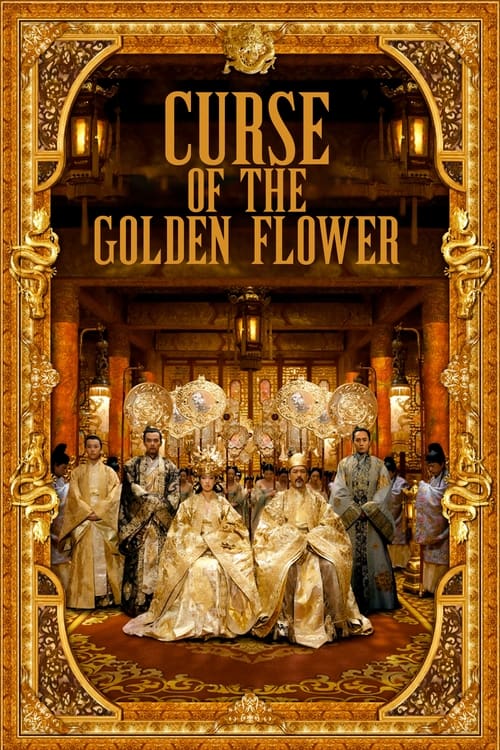
On the eve of the Double Ninth Festival, the Emperor and the second of his three sons, Prince Jai, return from their military campaign to Nanjing so they can celebrate the holiday with their family. However, the Empress has been in an affair with the first son, Crown Prince Wan, who was born of the Emperor's previous wife. At the same time, Crown Prince Wan has been in an affair with Jiang Chan, daughter of the Imperial Doctor, and is keen on rejecting the throne so that he may run away with her.
Prince Jai notices the declining health of his mother, and is confused by her sudden interest in chrysanthemums, the golden flowers. The Empress explains that the tea she drinks has been poisoned for some time by the Emperor, but that she is planning a rebellion to overthrow him. After some initial hesitation, Prince Jai agrees to be the leader of the rebellion. The Empress hires a mysterious woman to discover the type of poison which she is suffering from, but the woman is captured by Crown Prince Wan and taken to the Emperor. As it happens, the woman is Jiang Shi, the Imperial Doctor's wife, whom the Emperor imprisoned a while ago and who was believed dead, but somehow escaped. The Emperor decides to pardon her and to promote the Imperial Doctor to governor of Suzhou. When Crown Prince Wan meets with Jiang Chan to say goodbye, she informs him that the Empress has woven 10,000 scarves with golden flower sigils. Crown Prince Wan confronts the Empress, and when she admits to planning a rebellion, he is anguished, and tries to kill himself, but survives.
On the way to Suzhou, the Imperial Doctor's household is betrayed and attacked by the Emperor's assassins, resulting in his death. Jiang Shi and Jiang Chan run back to Nanjing and confront the Emperor, who refuses to answer, whereupon the Empress explains to Jiang Chan that Jiang Shi was the Emperor's first wife and Crown Prince Wan's mother, meaning that Jiang Chan and Crown Prince Wan are half-brother and sister. Jiang Chan is horrified by this news and runs from the palace. Jiang Shi chases after her, whereupon both are murdered by more assassins. At this point, the third son, Prince Yu, suddenly murders Crown Prince Wan and reveals he has been aware of the corruption of both the Emperor and the Empress. Summoning a group of his own soldiers, Prince Yu demands the Emperor abdicate and offer him the throne. However, more of the Emperor's assassins descend from the ceiling and easily defeat Prince Yu's soldiers. The Emperor proceeds to whip Prince Yu to death using his belt.
Meanwhile, the outer square of the palace is assaulted by 10,000 soldiers wearing gold flower sigils, with Prince Jai in the lead. They overpower the assassins and proceed to the inner square of the palace, trampling upon the bed of golden flowers arranged for the ceremony. However, thousands of soldiers, the reserve army of the Emperor, appear and slaughter the golden soldiers; only Prince Jai survives, and he is taken captive. Behind him, the courtyard is cleaned with mechanical efficiency by a legion of servants, with bodies being removed, floors being scrubbed and laid with carpets, and pots of yellow flowers being replaced, making it seem as if the entire rebellion never even happened. At midnight, the Double Ninth Festival begins as scheduled. At the table, the Emperor expresses disappointment with Prince Jai, saying that he was already planning to give him the throne. Prince Jai says that he did not rebel to obtain the throne, but for his mother's sake. The Emperor responds by offering to pardon Prince Jai if he cooperates in the Empress's poisoning. Prince Jai refuses and kills himself, and as he does so, his blood spills into another cup of poisoned tea that has been brought to the Empress, turning the tea red. Horrified, the Empress slaps the tea away, and the liquid is shown to corrode the table's wood, along with the golden flower image engraved into the wood.