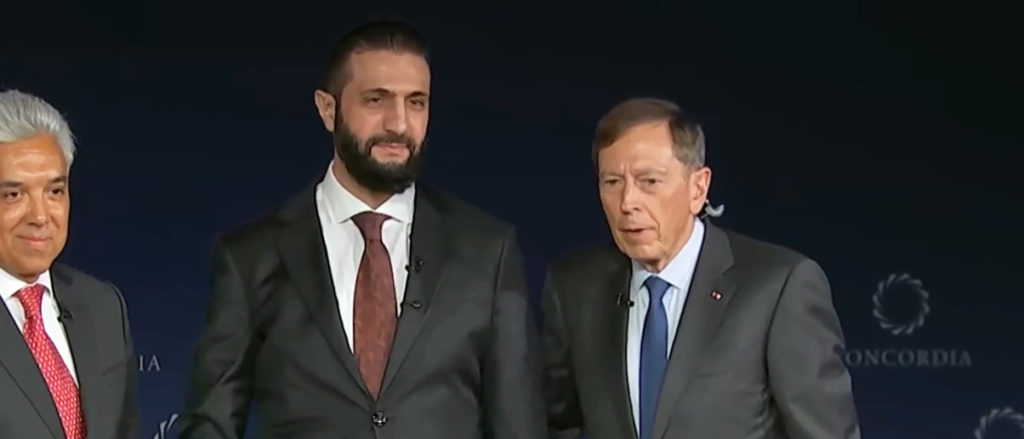
David Howell Petraeus (; born 7 November 1952) is a retired United States Army general who served as the fourth director of the Central Intelligence Agency (CIA) from September 2011 until his resignation in November 2012. Prior to his assuming the directorship of the CIA, Petraeus served 37 years in the United States Army. His last assignments in the Army were as commander of the International Security Assistance Force (ISAF) and commander, U.S. Forces – Afghanistan (USFOR-A) from July 2010 to July 2011. His other four-star assignments include serving as the 10th commander, U.S. Central Command (USCENTCOM) from October 2008 to June 2010, and as commanding general, Multi-National Force – Iraq (MNF-I) from February 2007 to September 2008. As commander of MNF-I, Petraeus oversaw all coalition forces in Iraq.
Petraeus was the General George C. Marshall Award winner as the top graduate of the U.S. Army Command and General Staff College class of 1983. He later served as assistant professor of international relations at the United States Military Academy and also completed a fellowship at Georgetown University. Since 2022, he has taught courses in international relations at Yale University as a Kissinger Senior Fellow of the university's Jackson Institute for Global Affairs.
Petraeus has repeatedly stated that he has no plans to run for elected political office. On 23 June 2010, president Barack Obama nominated Petraeus to succeed General Stanley McChrystal as commanding general of the International Security Assistance Force in Afghanistan, technically a step down from his position as Commander of United States Central Command, which oversees the military efforts in Afghanistan, Pakistan, Central Asia, the Arabian Peninsula, and Egypt.
On 30 June 2011, Petraeus was unanimously confirmed as the director of the CIA by the U.S. Senate 94–0. Petraeus relinquished command of U.S. and NATO forces in Afghanistan on 18 July 2011, and retired from the U.S. Army on 31 August 2011. On 9 November 2012, he resigned from his position as director of the CIA, citing his extramarital affair with his biographer Paula Broadwell, which was discovered in the course of an Federal Bureau of Investigation (FBI) investigation. In January 2015, officials reported that the FBI and the Department of Justice (DOJ) prosecutors had recommended bringing felony charges against Petraeus for providing classified information to Broadwell while serving as director of the CIA. Eventually, Petraeus pleaded guilty to one misdemeanor charge of mishandling classified information. He was later sentenced to two years of probation and fined US$100,000 for the unauthorized removal and retention of classified material he gave to Broadwell.
Contents
Early life and education
Petraeus was born in Cornwall-on-Hudson, New York, the son of Miriam Sweet (née Howell), a librarian, and Sixtus Petraeus, a sea captain. His father was a Dutch merchant mariner who immigrated to the United States at the start of World War II, from Franeker, the Netherlands, and his mother was American, a resident of Brooklyn, New York. They met at the Seamen's Church Institute of New York and New Jersey and married. Sixtus Petraeus commanded a Liberty ship for the U.S. for the duration of World War II. The family moved after the war, settling in Cornwall-on-Hudson, where Petraeus grew up and graduated from Cornwall Central High School in 1970.
Petraeus went on to the United States Military Academy at West Point. Petraeus was on the intercollegiate soccer and ski teams, was a cadet captain on the brigade staff, and was a "distinguished cadet" academically, graduating in the top 5% of the Class of 1974 (ranked 40th overall). In the class yearbook, Petraeus was remembered as "always going for it in sports, academics, leadership, and even his social life".
While a cadet, Petraeus started dating the daughter of Army General William A. Knowlton (the West Point superintendent at the time), Holly. Two months after Petraeus graduated, they married. Holly, who is multi-lingual, was a National Merit Scholar in high school, and graduated summa cum laude from Dickinson College. They have a daughter and son, Anne and Stephen. Petraeus administered the oath of office at his son's 2009 commissioning into the Army after his son's graduation from the Massachusetts Institute of Technology. His son went on to serve as an officer in Afghanistan as a member of 3rd Platoon, Alpha Company, 1st Battalion, 503rd Infantry Regiment, 173rd Airborne Brigade Combat Team.
Petraeus's residence is a small property in the Springfield, New Hampshire, which his wife inherited from her family. Petraeus once told a friend that he was a Rockefeller Republican.
Petraeus graduated from West Point in 1974, receiving a B.S. degree in Military Science. He earned the General George C. Marshall Award as the top graduate of the U.S. Army Command and General Staff College Class of 1983 at Fort Leavenworth, Kansas. He subsequently earned an M.P.A. degree in 1985 and a Ph.D. in international relations and economics in 1987 from Princeton University's Woodrow Wilson School of Public and International Affairs, where he was mentored by Richard H. Ullman, an international relations scholar and progressive commentator.
U.S. Army Officer (1974 – 2011)
1970s
Upon his graduation from West Point in 1974, Petraeus was commissioned an infantry officer. After completing Ranger School (Distinguished Honor Graduate and other honors), Petraeus was assigned to the 509th Airborne Battalion Combat Team, a light infantry unit stationed in Vicenza, Italy. Ever since, light infantry has been at the core of his career, punctuated by assignments to mechanized units, unit commands, staff assignments, and educational institutions. After leaving the 509th as a first lieutenant, Petraeus began a brief association with mechanized units when he became assistant operations officer on the staff of the 2nd Brigade, 24th Infantry Division (Mechanized), at Fort Stewart, Georgia. In 1979, he assumed command of a company in the same division: A Company, 2nd Battalion, 19th Infantry Regiment (Mechanized), and then served as that battalion's operations officer, a major's position that he held as a junior captain.
1980s
In 1981, Petraeus became aide-de-camp to General John Galvin, then commanding general of the 24th Infantry Division (Mechanized). He spent the next few years furthering his military and civilian education, including spending 1982–83 at Fort Leavenworth, Kansas, attending the Command and General Staff College. At graduation in 1983, he was the General George C. Marshall Award winner as the top graduate of the U.S. Army Command and General Staff College. From 1983 to 1985, he was at Princeton; and 1985–87 at West Point.
After earning his Ph.D. and teaching at West Point, Petraeus continued up the command ladder, serving as military assistant to Gen. John Galvin, the Supreme Allied Commander in Europe. From there, he moved to the 3rd Infantry Division (Mechanized). During 1988–1989, he served as operations officer to the 3rd Infantry Division (Mechanized)'s 30th Infantry Regiment. He was then posted as an aide and assistant executive officer to the U.S. Army Chief of Staff, General Carl Vuono, in Washington, D.C.
1990s
Upon promotion to lieutenant colonel, Petraeus moved from the office of the chief of staff to Fort Campbell, Kentucky, where he commanded the 101st Airborne Division (Air Assault)'s 3rd Battalion 187th Infantry Regiment, known as the "Iron Rakkasans", from 1991 to 1993. In 1991 he was accidentally shot in the chest with an M-16 rifle during a live-fire exercise when a soldier tripped and his rifle discharged. He was taken to Vanderbilt University Medical Center, Nashville, Tennessee, where he was operated on by future U.S. Senator Bill Frist. The hospital released him early after he did fifty push-ups without resting, just a few days after the accident.
During 1993–94, Petraeus continued his long association with the 101st Airborne Division (Air Assault) as the division's assistant chief of staff, G-3 (plans, operations, and training) and installation director of plans, training, and mobilization (DPTM). In 1995, he was assigned to the United Nations Mission in Haiti Military Staff as its chief operations officer during Operation Uphold Democracy. His next command, from 1995 to 1997, was the 1st Brigade, 82nd Airborne Division, centered on the 504th Parachute Infantry Regiment. At that post, his brigade's training cycle at Fort Polk's Joint Readiness Training Center for low-intensity warfare was chronicled by novelist and military enthusiast Tom Clancy in his book Airborne.
From 1997 to 1999, Petraeus served in the Pentagon as executive assistant to the director of the Joint Staff and then to the Chairman of the Joint Chiefs, Gen. Henry Shelton, who described Petraeus as "a high-energy individual who likes to lead from the front, in any field, he is going into". In 1999, as a brigadier general, Petraeus returned to the 82nd, serving as the assistant division commander for operations and then, briefly, as acting commanding general. During his time with the 82nd, he deployed to Kuwait as part of Operation Desert Spring, the continuous rotation of combat forces through Kuwait during the decade after the Gulf War.
2000s
From the 82nd, he moved on to serve as chief of staff of XVIII Airborne Corps at Fort Bragg during 2000–2001. In 2000, Petraeus suffered his second major injury, when, during a civilian skydiving jump, his parachute collapsed at low altitude due to a hook turn, resulting in a hard landing that broke his pelvis. He was selected for promotion to major general in 2001. During 2001–2002, as a brigadier general, Petraeus served a ten-month tour in Bosnia and Herzegovina as part of Operation Joint Forge. In Bosnia, he was the NATO Stabilization Force assistant chief of staff for operations as well as the deputy commander of the U.S. Joint Interagency Counter-Terrorism Task Force, a command created after the 9/11 attacks to add counterterrorism capability to the U.S. forces attached to the NATO command in Bosnia. In 2004, he was promoted to lieutenant general.
In 2007, he was promoted to General. On 23 April 2008, Secretary of Defense Gates announced that President Bush was nominating General Petraeus to command U.S. Central Command (USCENTCOM), headquartered in Tampa, Florida. In 2010, Petraeus was nominated to command the International Security Assistance Force in Afghanistan, which required Senate confirmation. He was confirmed on 30 June 2010, and took over command from temporary commander Lieutenant-General Sir Nick Parker on 4 July 2010.
Involvement in the Iraq War
In 2003, Petraeus, then a major general, saw combat for the first time when he commanded the 101st Airborne Division during V Corps's drive to Baghdad. In a campaign chronicled in detail by Pulitzer Prize-winning author Rick Atkinson of The Washington Post in the book In the Company of Soldiers, Petraeus led his division through fierce fighting south of Baghdad, in Karbala, Hilla and Najaf. Following the fall of Baghdad, the division conducted the longest heliborne assault on record in order to reach Nineveh Governorate, where it would spend much of 2003. The 1st Brigade was responsible for the area south of Mosul, the 2nd Brigade for the city itself, and the 3rd Brigade for the region stretching toward the Syrian border. An often-repeated story of Petraeus's time with the 101st is his asking of embedded The Washington Post reporter Rick Atkinson to "Tell me how this ends", an anecdote he and other journalists have used to portray Petraeus as an early recognizer of the difficulties that would follow the fall of Baghdad.
In Mosul, a city of nearly two million people, Petraeus and the 101st employed classic counterinsurgency methods to build security and stability, including conducting targeted kinetic operations and using force judiciously, jump-starting the economy, building local security forces, staging elections for the city council within weeks of their arrival, overseeing a program of public works, reinvigorating the political process, and launching 4,500 reconstruction projects in Iraq.
This approach can be attributed to Petraeus, who had been steeped in nation-building during his previous tours in nations such as Bosnia and Haiti and thus approached nation-building as a central military mission and who was "prepared to act while the civilian authority in Baghdad was still getting organized", according to Michael Gordon of The New York Times. Some Iraqis gave Petraeus the nickname 'King David', which was later adopted by some of his colleagues. In 2004, Newsweek stated that "It's widely accepted that no force worked harder to win Iraqi hearts and minds than the 101st Airborne Division led by Petraeus."
One of the General's major public works was the restoration and re-opening of the University of Mosul. Petraeus strongly supported the use of commanders' discretionary funds for public works, telling Coalition Provisional Authority director L. Paul Bremer "Money is ammunition" during the director's first visit to Mosul. Petraeus's often repeated catchphrase was later incorporated into official military briefings and was also eventually incorporated into the U.S. Army Counterinsurgency Field Manual drafted with Petraeus's oversight.
U.S. Central Command (fall 2008 to summer 2010)
On 31 October 2008, Petraeus assumed command of the United States Central Command (USCENTCOM) headquartered in Tampa, Florida. Petraeus was responsible for U.S. operations in 20 countries spreading from Egypt to Pakistan—including Operations Iraqi Freedom and Enduring Freedom. During his time at CENTCOM, Petraeus advocated that countering the terrorist threats in the CENTCOM region required more than just counter-terrorism forces, demanding instead whole-of-government, comprehensive approaches akin to those of counterinsurgency. One of his closest colleagues said that Petraeus knew that defeating an insurgency required living among the people, convincing them that we were better than the insurgents. "[Y]ou can't kill 'em all ... [Y]ou can't kill your way out of an insurgency. ... You have to find other kinds of ammunition, and it's not always a bullet."
Petraeus reiterated this view in a 2009 interview published in Parade magazine. In an interview for Newsweek magazine's "Interview Issue: The View From People Who Make a Difference," Petraeus expressed his support for President Obama's announced Afghanistan strategy and discussed his view that reconciliation efforts in Afghanistan should for the time being occur "at the lower and midlevels".
In mid-August 2009, Petraeus established the Afghanistan-Pakistan Center of Excellence within the USCENTCOM Directorate of Intelligence to provide leadership to coordinate, integrate and focus analysis efforts in support of operations in Afghanistan and Pakistan.
During a February 2010 World Affairs Council event in Philadelphia, General Petraeus discussed the ways in which diplomacy, history, and culture impact overall military strategy, then explained how these issues informed the U.S. approach to counterinsurgencies in Iraq and Afghanistan.
On 16 March 2010, in testimony to the Senate Armed Services Committee, Petraeus described the continuing Israeli–Palestinian conflict as a challenge to U.S. interests in the region. According to the testimony, the conflict was "fomenting anti-American sentiment" due to "a perception of U.S. favoritism for Israel". This was widely commented on in the media. When questioned by journalist Philip Klein, Petraeus said the original reporter "picked apart" and "spun" his speech. He said he believed there were many important factors standing in the way of peace, including "a whole bunch of extremist organizations, some of which by the way deny Israel's right to exist. There's a country that has a nuclear program who denies that the Holocaust took place. So again we have all these factors in there. This [Israel] is just one."
Commander of U.S. and ISAF forces in Afghanistan (2010–2011)
On 23 June 2010, Obama announced that he would nominate Petraeus to succeed General Stanley A. McChrystal as the commander of U.S. Forces in Afghanistan. The change of command was prompted by McChrystal's comments about the Obama administration and its policies in Afghanistan during an interview with Rolling Stone magazine. The nomination was technically a positional step down from his position as commander of Central Command; however, the President said that he believed that he was the best man for the job. After being confirmed by the Senate on 30 June, Petraeus formally assumed command on 4 July.
During the assumption-of-command remarks, Petraeus provided his vision and goals to NATO, the members of his command, and his Afghan partners. As he was known to do while the commander in Iraq, Petraeus delivered his first Letter to the Troops on the same day he assumed command.
In December 2009, then President Obama announced that there would be a 30,000 troop surge in Afghanistan, but that in 18 months there would be a troop drawdown to take these forces out of the country again. Petraeus later shared his surprise at this decision, noting that he didn't agree with the choice to announce a drawdown given that it limited bargaining power with the enemy.
On 1 August 2010, shortly after the disclosure of the Afghan war logs on WikiLeaks, which included reports of high civilian deaths and increased Taliban attacks, Petraeus issued his updated Tactical Directive for the prevention of civilian casualties, providing guidance and intent for the use of force by the U.S. military units operating in Afghanistan (replacing the 1 July 2009, version). This directive reinforced the concept of "disciplined use of force in partnership with Afghan Security Forces" in the fight against insurgent forces.
We must never forget that the center of gravity in this struggle is the Afghan people; it is they who will ultimately determine the future of Afghanistan ... Prior to the use of fires, the commander approving the strike must determine that no civilians are present. If unable to assess the risk of civilian presence, fires are prohibited, except under of the following two conditions (specific conditions deleted due to operational security; however, they have to do with the risk to ISAF and Afghan forces).
Retirement from the U.S. Army (2011)
Petraeus retired from the U.S. Army on 31 August 2011. His retirement ceremony was held at Joint Base Myer–Henderson Hall. During this ceremony, he was awarded the Army Distinguished Service Medal by Deputy Secretary of Defense William J. Lynn. During the ceremony, Lynn noted that Petraeus had played an important role as both a combat leader and strategist in the post-9/11 world. Lynn also cited General Petraeus's efforts in current counter insurgency strategy.
Admiral Michael Mullen, Chairman of the Joint Chiefs of Staff in his remarks compared General Petraeus to Ulysses S. Grant, John J. Pershing, George Marshall and Dwight D. Eisenhower as one of the great battle captains of American history. With his four-star rank, Petraeus receives an annual pension of about $220,000.
CIA director (2011–2012)
On 28 April 2011, President Barack Obama announced that he had nominated Petraeus to become the new Director of the Central Intelligence Agency. The nomination was confirmed by the United States Senate 94–0 on 30 June 2011. Petraeus was sworn in at the White House on 6 September and then ceremonially sworn in by Vice President Joe Biden at CIA Headquarters in Langley, Virginia on 11 October 2011.
Petraeus's tenure at the CIA was more low profile than that of his predecessor, Leon Panetta, declining to give media interviews while director and speaking to Congress in closed sessions. He also differed from Panetta in management style, as an article in The New York Times published just days before his resignation said; Panetta "wooed the work force and often did not question operational details, [while] Petraeus is a demanding boss who does not hesitate to order substandard work redone or details of plans adjusted". Petraeus's philosophy on leadership at the time was summarized in a twelve-point article published by Newsweek on 5 November 2012.
Although Petraeus was given good marks by most observers for his work heading the CIA, during October 2012 some critics took issue with the availability of accurate information from the CIA concerning an attack in Benghazi, Libya, the month prior. By the 11th of September, four Americans had been killed, including the ambassador, and more than thirty evacuated. Only seven of those evacuated did not work for the CIA. According to a Wall Street Journal story, other government agencies complained about being left "largely in the dark about the CIA's role," with Secretary of State Hillary Clinton telephoning Petraeus directly the night of the attacks seeking assistance. Although the "State Department believed it had a formal agreement with the CIA to provide backup security," "the CIA didn't have the same understanding about its security responsibilities," reported The Wall Street Journal.
Petraeus scandal
Petraeus reportedly began an affair with Paula Broadwell, principal author of his biography, All In: The Education of General David Petraeus, after Petraeus left his ISAF command on 18 July 2011, to become CIA director. Petraeus reportedly ended the affair in the summer of 2012, around the time that he learned that Broadwell had been sending harassing emails to a longstanding family friend of the Petraeuses, Jill Kelley.
Kelley, a Florida socialite who frequently entertained senior military personnel at her and her husband's Tampa mansion, had approached an acquaintance who worked for the FBI Tampa Field Office in the late spring with regard to anonymous emails she considered threatening. The Bureau traced the emails to Broadwell, and noted that Broadwell appeared to be exchanging intimate messages with an email account belonging to Petraeus, which instigated an investigation into whether that account had been hacked into or was someone posing as Petraeus. According to an Associated Press report, rather than transmit emails to each other's inbox, which would have left a more obvious email trail, Petraeus and Broadwell left messages in a draft folder and the draft messages were then read by the other person when they logged into the same account.
Although U.S. Attorney General Eric Holder was aware that the FBI had discovered the affair, it was not until 6 November 2012, that Petraeus's nominal superior, Director of National Intelligence James R. Clapper, was advised. That same evening Clapper called Petraeus and urged him to resign. Clapper notified the White House the next day, 7 November. After being briefed the following day, Obama summoned Petraeus to the White House where Petraeus offered his resignation. Obama accepted his resignation on 9 November, and Petraeus cited his affair when announcing that same day that he would resign as CIA Director. Eventually, Petraeus pleaded guilty to a misdemeanor charge of mishandling the classified information that he provided to his mistress and biographer.
On 13 November 2012, Reagan administration Assistant Secretary of Defense Lawrence Korb, CIA analyst and Veteran Intelligence Professionals for Sanity co-founder Ray McGovern, and investigative journalist Gareth Porter appeared on Al Jazeera English. Together they assessed the general's extensive military-media strategy, linking his writings on counterguerrilla operations and subsequent military media efforts to his downfall with his female biographer. Critics said that the Petraeus media strategy would prove damaging for American policy in the future because of omissions and distorted interpretations that Washington policymakers, other experts, and the American public accepted from Petraeus's media contacts.
Later life
Petraeus was named a visiting professor at Macaulay Honors College at the City University of New York in July 2013. According to a statement from Petraeus, "I look forward to leading a seminar at Macaulay that examines the developments that could position the United States—and our North American partners—to lead the world out of the current global economic slowdown." After his anticipated $200,000 salary for the academic year drew fire from critics, Petraeus agreed to take on the teaching position for just $1 in order to keep the focus on the students and away from any monetary controversy. In September 2013 Petraeus was harassed by students at CUNY while walking on campus.
On 1 May 2013, the University of Southern California named Petraeus as a Judge Widney Professor, "a title reserved for eminent individuals from the arts, sciences, professions, business and community and national leadership". The president of the Currahee board of trustees announced 6 May, that Petraeus agreed to serve on the board of trustees that preserves Camp Toccoa. During WWII, four of the main parachute infantry regiments of the Army trained at Camp Toccoa prior to their deployment.
Kohlberg Kravis Roberts & Co. L.P., a New York investment firm, hired Petraeus as chairman of the firm's newly created KKR Global Institute in May 2013. Part of his work would support KKR's investment teams and portfolio companies when studying new investments, especially in new locations.
In October 2013, Petraeus joined Harvard's John F. Kennedy School of Government as a non-resident senior fellow at the Belfer Center for Science and International Affairs. According to the school, Petraeus joined to lead a new project focusing on the technological, scientific and economic dynamics that are spurring renewed North American competitiveness. "The Coming North America Decades" project would analyze how potential policy choices could effect this ongoing transformation. In 2016, the center announced a new project involving Petraeus and focusing on strategic leadership.
General Petraeus was one of the "11 legendary generals" profiled in the 2014 National Geographic Channel feature "American War Generals". In 2015, Petraeus suggested the U.S. should arm members of the terror group Al-Nusra Front (the Syrian branch of Al-Qaeda) in Syria to fight ISIS.
Secretary of State consideration
On 18 November 2016, The Guardian cited "diplomatic sources" as having said that Petraeus had entered the race for U.S. Secretary of State in the Trump administration. Petraeus confirmed his interest in the position during a BBC Radio 4 interview, stating that he would serve if asked.
Petraeus met with then President-elect Donald Trump at Trump Tower on 28 November to discuss the position and world affairs. Both Petraeus and Trump expressed favorable views of the meeting, with Trump taking to Twitter to announce, "Just met with General Petraeus—was very impressed!" Petraeus joined a short list of potential candidates for the position, including Mitt Romney and Rudy Giuliani.
There was public speculation that his nomination could hurt Trump's administration, but Republican senators John McCain and Lindsey Graham advocated for Petraeus, calling him "an extraordinary pick". Petraeus also received support from Democratic senator Dianne Feinstein, suggesting that Democrats would keep an open mind concerning his confirmation.
On 13 December 2016, Trump officially selected Rex Tillerson for the role of Secretary of State. Petraeus expressed his gratitude for Trump's consideration and deferred to former Secretary of Defense Robert Gates' endorsement when asked his opinion of Tillerson.
Business activities
Petraeus has worked for KKR since 2013, where he is a partner and chairman of the KKR Global Institute. On 14 April 2025, Petraeus was appointed the chair of US private equity firm KKR's Middle East division. KKR has had a presence in the Persian Gulf since 2009, with offices in both the financial hub of Dubai and Saudi Arabia's capital Riyadh. Petraeus commented, following the announcement, that "the Middle East is emerging as a leading investment powerhouse," and that the firm saw opportunities to invest in or lend to "domestic businesses" in the region.
Political positions
Reaction to the decision to withdraw U.S. forces from Afghanistan
On 14 April 2021, President Joe Biden announced that all U.S. troops in Afghanistan would be withdrawn from the country by 11 September 2021, against the advice of many of his top generals and many diplomats.
Petraeus has been an outspoken opponent of the U.S.'s strategy for withdrawal from Afghanistan, and the agreements made with the Taliban in preparation thereof. In a Fox News interview on 17 August 2021, Petraeus called former president Donald Trump's decision to release 5,000 detainees of the Taliban held by the Afghanistan government in 2020 flawed and disastrous, with a tragic outcome. In another interview with the Wall Street Journal on 20 August 2021, he noted that the U.S. negotiated with the Taliban expecting to get something in return for withdrawing, which, he said, "didn't work out".
During an interview with Fox News on 12 May 2021, Petraeus discussed his opposition to the withdrawal of U.S. forces in Afghanistan, stating, "I fear that we will come to regret this decision." He warned of the possible psychological effects on Afghan forces following removal of U.S. support, the erosion of Afghan Air Force maintenance, and the risk of a "brutal civil war".
Following a military blitz by the Taliban that ended in the group capturing the country's capital, Kabul, Petraeus again questioned the poor planning of troop withdrawal from the region and reiterated the dangers the world would face from the potential establishment of Al Qaeda or the Islamic State in the Hindu Kush. In an email interview with Die Weltwoche, Petraeus stated "I do not believe that either terrorist group will pose a near-term threat to the U.S. homeland or our NATO allies. The longer-term threat will depend on our ability to identify, disrupt, and degrade any such sanctuaries."
Petraeus suggested that the removal of 18,000 contractors who maintained aircraft contributed to the surrender of Afghan government forces who ended up lacking air support against the Taliban. In an interview with Brian Kilmeade Petraeus drew parallels between the U.S. withdrawal from Afghanistan, the Dunkirk evacuation, and the Fall of Saigon. He advised that American forces, drones, and close air support be used to secure Kabul Airport while the U.S. communicates with the Taliban to prevent them from impeding the movement of individuals that are trying to evacuate.
Views on the Russian invasion of Ukraine
Petraeus has been vocally critical of Russia's invasion of Ukraine, joining three other retired military generals to form the Strategic Advisory Council for the Defense of Ukraine in July 2022 to provide strategic expertise and operational assistance to Ukrainian forces.
Early in 2022, as tensions mounted between Russia and Ukraine, Petraeus attended a tabletop panel with Admiral Michael Mullen, Michèle Flournoy, and Thomas Donilon to discuss economic sanctions, cyber defenses, and anti-Russian insurgency in Ukraine.
In public appearances and interviews, Petraeus has criticized not only Russia's motives for the invasion, but also the tactics and standards of the country's military effort. In the weeks following the invasion of Ukraine, Petraeus spoke with Jake Tapper and Anderson Cooper, examining Russia's strategy in attempts to seize Kyiv. On 12 March 2022, Petraeus spoke on One Nation with Brian Kilmeade, criticizing the Russian military's failed attempt to achieve a combined arms effect, which, according to Petraeus, wasn't up to the normal standards anticipated by the United States or other NATO countries' militaries. In May 2022, Petraeus commented that, in an attempt to create a stronger Russia, President Putin had instead strengthened the alliance between NATO countries. In a later interview, Petraeus said that the Russian military was nowhere near as good as NATO had thought it would be. He described the Russian military's preferred tactic as that of overwhelming artillery strikes, leading to the question of whether Russia's military valued volume over accuracy. In October 2022, he called Russia's military mobilization in Ukraine "irreversible and disastrous".
In addition to criticisms of Russia's war effort, Petraeus also discussed the negative implications that Russian sanctions have for worldwide financial markets, food supplies, and other commodities, and he commended the Ukrainian military for its impressive counter-attacks, specifically a raid on Russian tanks, the killing of five Russian generals, and the destruction of the Russian warship, Saratov.
In mid- to late 2022, Petraeus spoke further on the Western response to Russia's aggression and the impacts U.S. involvement had on Ukraine's defense. In an interview with CNN's Jim Sciutto regarding Russia's plans to annex more regions in Ukraine, he said that US- and UK-supplied high-mobility artillery rocket systems had prompted Russian forces to relocate their headquarters and fuel supplies, which had significantly slowed Russia's advances in Ukraine. In another interview, he said that Western support had improved counteroffensive strategies, resulting in retaking Crimea and Donbas territories from Russia.
Views on Israel's 2023–present Invasion of Gaza
In June 2024, Petraeus co-wrote an opinion article with Meghan O'Sullivan and Richard Fontaine, comparing Israel's invasion of Gaza to American-led regime change in Iraq. Petraeus describes the Israeli campaign as an "understandable response" to the 7 Oct. Hamas-led attack on Israel, in contrast to the typical scholarly view and pro-Palestine criticism calling it a genocide; he then proceeds to advise Israel in overcoming what he sees as America's past mistakes. Petraeus was accused by other commentators of "sanitizing history" on Iraq and puffing up his own legacy by writing this article.
General Petraeus reviewed a book on the war in Gaza written from the Israeli military's perspective, which was published in July 2024. Petraeus praised what he considered "a gripping, exhaustively researched account of the brutal October 7th attack" presented in the book.
Personal life
According to Petraeus, he does not vote in elections, having stopped following his promotion to Major General in 2002 as part of a desire to be seen as apolitical. He stated that he did not vote in the 2016 election.
Awards and honors
Decorations and badges
Petraeus's decorations and badges include the following:
Honorary degrees
Eckerd College, 23 May 2010, honorary doctorate in laws
University of Pennsylvania, 14 May 2012, honorary doctorate of laws
Dickinson College, 20 May 2012, honorary doctorate of public service
American University of Afghanistan, 17 June 2019, honorary doctorate of humane letters
American University of Iraq, Sulaimani 18 June 2025, doctorate of civil law, honoris causa
Civilian awards and honors
Petraeus's civilian awards and honors include:
2007: 100 Most Influential Leaders and Revolutionaries of the Year, Time magazine
2007: Second Most Influential American Conservative, The Daily Telegraph
2007: Person of the Year 2007 runner-up, Time magazine
2007: Man of the Year, The Daily Telegraph
2008: Leader of the Year, GQ
2008: One of World's Top 100 Public Intellectuals, Foreign Policy and Prospect magazines
2008: 16th Most Powerful Person in the World, Newsweek
2009: George F. Kennan Award, National Committee on American Foreign Policy
2009: Distinguished Service Medal, The American Legion
2009: Military Leadership Award, The Atlantic Council
2009: Abraham Lincoln Award, Union League of Philadelphia
2009: Father of the Year Award, National Father's Day Committee
2009: Eisenhower Award, National Defense Industrial Association
2009: William Donovan Award, Office of Strategic Services
2009: Freedom Award, No Greater Sacrifice
Additional recognition
In 2005, Petraeus was identified as one of America's top leaders by U.S. News & World Report.
In 2007, Time named Petraeus one of the 100 most influential leaders and revolutionaries of the year as well as one of its four runners up for Time Person of the Year. He was also named the second most influential American conservative by The Daily Telegraph as well as The Daily Telegraph's 2007 Man of the Year. His Ph.D. dissertation, "The American Military and the Lessons of Vietnam: A Study of Military Influence and the Use of Force in the Post-Vietnam Era", published by Princeton University in 1987, was number two on the list of best-selling dissertations in 2007.
In 2008, a poll conducted by Foreign Policy and Prospect magazines selected Petraeus as one of the world's top 100 public intellectuals. Also in 2008, the Static Line Association named Petraeus as its 2008 Airborne Man of the Year, and Der Spiegel named him "America's most respected soldier". As 2008 came to a close, Newsweek named him the 16th most powerful person in the world in its 20 December 2008 edition, and Prospect magazine named him the "Public Intellectual of the Year". He was also named as one of the "75 Best People in the World" in the October 2009 issue of Esquire.
On 7 March 2009, Petraeus received the Distinguished Citizen Award from the Congressional Medal of Honor Society at the Ronald Reagan Presidential Library.
Gen. David H. Petraeus, the top U.S. commander in the war against terrorism in the Middle East and Central Asia, was the spring commencement convocation speaker at Texas A&M University on 13 May, a relatively new practice at Texas A & M.
On 9 December 2010, Barbara Walters picked Petraeus for the Most Fascinating Person of 2010. Walters called the top commander in Afghanistan "an American hero". Petraeus was chosen as "one of Time magazine's 50 "People Who Mattered" in December 2010. The same year he was named number 12 of 50 people who mattered in 2010 by the New Statesmen magazine, and Petraeus was listed as number 8 of 100 Foreign Policy Top 100 Global Thinkers for 2011.
The New Statesman annual survey presents the most influential people from pop stars and dissident activists to tech gurus and heads of state, the people doing most to shape our world keep changing. On 26 September 2011, Petraeus was listed as number 2 of the 50 for 2011. The Association of Special Operations Professionals named Petraeus as its 2011 Man of the Year for 2011, and was presented the award at Ft. Bragg on 2 November 2011, at its annual Special Operations Exposition.
Works
Conflict (2023)
Petraeus co-authored a book published in 2023 that is generally considered more notable than most of his other published works:
Petraeus, David; Roberts, Andrew (2023). Conflict: The Evolution of Warfare from 1945 to Ukraine. Harper. ISBN 978-0-06-329313-7.
Conflict was No. 13 on The New York Times best-seller list for the week of 5 November 2023, #12 on USA Today's best-seller list the week of 25 October 2023, and #10 on Publishers Weekly's best seller list on 3 November 2023. It was included in National Business Review's annual selection of summer reading on 24 December 2023. It was listed under "Best Reads Of 2023" by
The Cipher Brief | 17 December
Foreign Policy Research Institute | 26 December
Modern War Institute | 29 December
Petraeus appeared at the 2024 New Orleans Book Festival and spoke with the former New Orleans mayor Mitch Landrieu about Conflict and the evolution of warfare.