
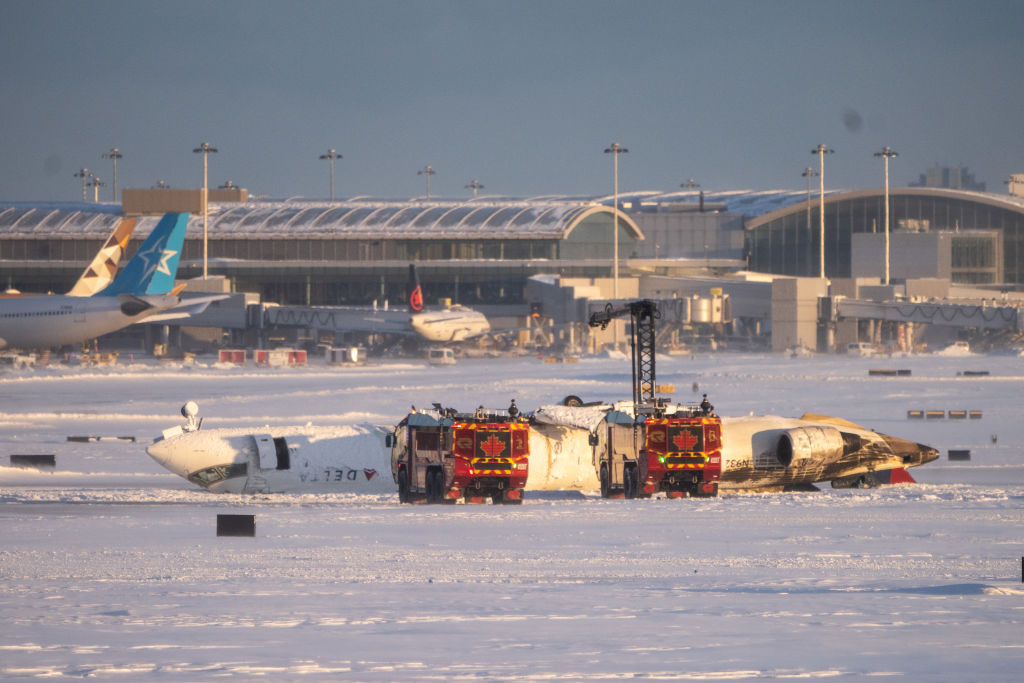
Delta Connection is a brand name under which Delta Air Lines has air service agreements with domestic regional air carriers that feed traffic to their network by serving passengers primarily in small and medium-sized cities in the domestic market, allowing a better match of capacity with demand in these markets. These include Delta's wholly owned subsidiary Endeavor Air and its third-party contractors Republic Airways and SkyWest Airlines.
These agreements are primarily capacity purchase arrangements, where Delta controls scheduling, pricing, reservations, ticketing, and seat inventories for the flights. Delta is entitled to all ticket, cargo, mail, in-flight, and ancillary revenues from these flights, while paying the regional airlines a defined amount based on their operating costs and market rates. These capacity purchase agreements are typically long-term, often lasting at least ten years with an option to extend. Some agreements grant Delta the right to terminate or remove certain aircraft for convenience at specific future dates. Additionally, SkyWest Airlines operates some flights under a revenue proration agreement, which divides the revenue for connecting flight itineraries based on a fixed dollar or percentage division.
A scope clause agreement between Delta Air Lines and its mainline pilots union, the Air Line Pilots Association, limits the number and size of aircraft that may be flown by Delta Connection. The current agreement allows up to 125 airplanes with 50 seats or fewer, 102 airplanes with between 51 and 70 seats, and 223 airplanes with up to 76 seats.
Contents
Airlines and fleet
As of February 2025, the combined Delta Connection-branded fleet consists of the following regional jet aircraft:
History
Delta Connection was founded in 1984 as a means of expanding the Delta network to smaller markets via partnerships with regional airlines.
Atlantic Southeast Airlines (ASA) began Delta Connection service on March 1, 1984, from their hub at Hartsfield–Jackson Atlanta International Airport, and soon had a substantial presence at Delta's hub at Dallas Fort Worth International Airport. ASA was a wholly owned subsidiary of Delta Air Lines under the Delta Connection, Inc., holding company from May 11, 1999, to September 7, 2005, when it was purchased by SkyWest, Inc., the parent company of SkyWest Airlines.
Ransome Airlines operated Delta Connection flights in the northeast from March 1, 1984, to June 1, 1986, when it was purchased by Pan Am.
Comair began Delta Connection service on September 1, 1984. Comair primarily operated from Delta's hub at Cincinnati/Northern Kentucky International Airport which was established the same year. Comair also began operating Delta Connection service from Delta's hub at Orlando International Airport in 1987. In January 2000, Comair became a wholly owned subsidiary of Delta Air Lines.
Rio Airways operated Delta Connection flights from their hub in Dallas/Fort Worth from June 1, 1984, to December 14, 1986, when the airline declared bankruptcy. ASA subsequently became the main Delta Connection carrier at the Dallas/Fort Worth hub.
Business Express Airlines operated Delta Connection flights in the northeastern US and Canada from June 1, 1986, to March 15, 2000. The company was purchased by AMR Corporation in 1999 and integrated into the American Eagle Airlines system in 2000.
Following the acquisition of Western Airlines by Delta Air Lines, SkyWest Airlines, which had been operating codeshare service flying as Western Express for Western, became a Delta Connection carrier on April 1, 1987, primarily operating from their hub at Salt Lake City International Airport, which Delta inherited from Western.
Merging Delta Connection and Northwest Airlink
The merger of Delta Air Lines and Northwest Airlines meant that Northwest's regional brand, Northwest Airlink, would be merged into Delta Connection. The new Delta Connection would include the regional airlines from both the original Delta and Northwest. On November 8, 2008, Delta and Mesaba Airlines, a fully owned regional subsidiary of Northwest Airlines that operated flights as Northwest Airlink with turboprop aircraft and also with regional jet aircraft, announced that the seven CRJ900 aircraft previously operated by Freedom as well as eight new-order aircraft would be operated for Delta Connection beginning February 12, 2009.
Citing cost reductions, Delta Air Lines sold former Northwest Airlines regional subsidiary Mesaba Airlines on July 1, 2010, to Pinnacle Airlines Corp. for $62 million. Its headquarters were moved to Pinnacle's in Memphis on December 26, 2011. Mesaba merged its operations into Pinnacle on January 4, 2012. The same day, Trans States Holdings purchased Compass Airlines from Delta for $20.5 million. It has maintained both regional operations with the airlines as of January 1, 2012.
Delta announced that it would add in-flight WiFi to 223 Delta Connection aircraft beginning in 2011.
Regional carrier GoJet Airlines, also owned by Trans States Holdings, began operations from Detroit Wayne County Metropolitan Airport to cities in the Midwest using 15 CRJ700 aircraft on January 11, 2012.
Following a merger between Atlantic Southeast Airlines (ASA) and ExpressJet, Delta Connection flights operated under the latter's name and ceased operations as ASA. All routes remained the same, but the flights began operating as ExpressJet beginning in 2012.
On July 25, 2012, Delta announced that its wholly owned subsidiary Comair would cease all operations at midnight on September 28, 2012.On May 1, 2013, as a condition of exiting bankruptcy, Pinnacle Airlines became a subsidiary of Delta and was subsequently renamed Endeavor Air.
On December 31, 2014, Chautauqua Airlines operated its last flight for Delta Connection. All aircraft and crew and maintenance bases would be absorbed by the Shuttle America certificate. The conclusion of this service also removed the last operating three seat wide aircraft from the Delta Connection fleet.
Historical regional jet fleet
The Delta Connection brand, through its various regional and commuter airline partners, operated a variety of jet aircraft over the years including the following types:
Historical turboprop fleet
The Delta Connection brand, through its various regional and commuter airline partners, operated a variety of twin turboprop aircraft over the years including the following types:
Destinations
Delta Connection flights usually fly from, or to mainline Delta's hubs. (See sidebar above for hubs)
Academy
Delta Connection Academy was an airline flight school established in October 1989. The academy was located in Sanford, Florida, on the grounds of the Orlando Sanford International Airport. It contained a fleet that had 73 aircraft and over 550 flight students who attended the academy. On January 13, 2010, it was acquired by Flight Training Acquisitions for $50 million. Today, it operates as L3Harris Flight Academy.
Incidents and accidents
On 19 September 1986, an Atlantic Southeast Airlines EMB 120RT (N219AS) struck a mountain near Mantiqueira, Brazil while being delivered to Atlantic Southeast, killing all five on board.
On January 15, 1987, SkyWest Airlines Flight 1834, a Fairchild Metroliner collided with a Mooney M20 transporting an instructor and a student while on a flight between Pocatello to Salt Lake City in the vicinity of Kearns, Utah. All eight people on Flight 1834 and the two occupants of the Mooney were killed. The cause was found to be a navigation error by the Mooney's student pilot.
On April 9, 1990, Atlantic Southeast Airlines Flight 2254, an Embraer EMB 120 collided with a Civil Air Patrol Cessna 172 shortly after takeoff from Northeast Alabama Regional Airport, after losing the right stabilizer, the Embraer landed safely back at GAD with no fatalities or injuries but the Cessna crashed, killing both occupants.
On April 5, 1991, Atlantic Southeast Airlines Flight 2311, an Embraer EMB 120, crashed on approach to the Glynco Jetport serving Brunswick, GA. Twenty passengers and three crew members were killed. The cause was a combination of an engine malfunction and crew fatigue.
On August 21, 1995, Atlantic Southeast Airlines Flight 529, an Embraer EMB 120, crashed in Burwell, Georgia. Officials determined that a propeller-blade loss and inability to feather the remaining blades caused the accident, which killed eight of the 28 passengers and crew.
On January 9, 1997, Comair Flight 3272, an Embraer EMB 120, crashed near Monroe, Michigan. The flight, which originated from Cincinnati, Ohio, was on approach to Detroit. All 29 passengers and crew were killed when the plane crashed 18 miles from the airport. The cause was determined as the "FAA's failure to establish adequate aircraft certification standards for flight in icing conditions, the FAA's failure to ensure that an FAA/CTA-approved procedure for the accident airplane's deice system operation was implemented by U.S.-based air carriers, and the FAA's failure to require the establishment of adequate minimum airspeeds for icing conditions."