Development
After founding his own namesake studio, special effects artist Phil Tippett directed Prehistoric Beast (1984), an experimental animated short film in which a Centrosaurus is stalked by a Tyrannosaurus. Tippett's skill at creating go motion animated creatures led to the 1985 CBS animated documentary Dinosaur!. A year later, Tippett was hired to work on the special effects team for RoboCop (1987). During filming, in December 1986, Tippett recalled, "When Jon Davison and I were shooting the live-action plates where ED-209 falls down the stairs, there was some kind of delay. Peter Weller's shoes didn't fit. so we had to wait for someone to get the right stunt shoes." Frustrated by the delay, Tippett suggested to Paul Verhoeven that they should produce a "dinosaur picture". That way, according to Tippett, "[w]e wouldn't have to be held up by actors in robot outfits."
Verhoeven was excited at the idea and suggested an approach inspired by Shane (1953) in which "you follow a lead character through a number of situations and moving from a devastated landscape into a promised land." Verhoeven, Tippett, and Davison pitched their idea to Walt Disney Pictures, where it was placed into active development under their live-action division. Verhoeven and Tippett then hired screenwriter Walon Green, best known for The Wild Bunch (1969) and Sorcerer (1977), to write a story treatment. Green explained, "I wrote a pretty extensive treatment, which we were going to use instead of a script. Since there was no dialogue, we were going to storyboard from the treatment."
Their version was intended to be darker and violent in tone, in a style akin to a nature documentary. The film's original main protagonist was a Styracosaurus named Woot and the main antagonist was a Tyrannosaurus rex named Grozni, with a small mammal named Suri as a supporting character. After Woot defeats Grozni in a final fight, the film would end with the Cretaceous-Paleogene extinction event, which would ultimately result in the death of the dinosaurs.
Once Green had finished his treatment, Disney's finance department calculated the film's production budget would total $75 million, opposite to the studio's insistence to cost approximately $20 million. Verhoeven told Cinefantastique he had calculated the project's preliminary budget to be $45 million, but then Disney chairman Jeffrey Katzenberg felt there wasn't "enough of an audience to justify that cost." In December 1990, Thomas Schumacher of Walt Disney Feature Animation flew out to Eastern Europe after the release of The Rescuers Down Under to hire new animators. Schumacher remembered, "While I traveled around Eastern Europe looking for my traditional animators, I was meeting with people who had also been talked with about the stop motion animation to make this dinosaur film." Verhoeven and Tippett had planned to use stop motion animation techniques such as puppets, scale models and miniatures. Despite a successful stop motion test, and being impressed with early computer animation tests, Tippett felt stop motion was not the right approach for the film.
Meanwhile, Green was prompted to write a "voice-over" treatment where the lemurs would narrate the story, though he remained unsure if "this'll work or not." Further meetings with Katzenberg reached an impasse to the point Green, Davison, and Verhoeven told Tippett that they were going to skip another scheduled meeting. By this point, producer Kathleen Kennedy approached Tippett with a galley for Michael Crichton's then-upcoming novel Jurassic Park. Verhoeven then called Tippett stating, "I know Spielberg has contacted you about Jurassic Park, you should do that instead."
Before Verhoeven and Tippett had left the project, producer/director Thomas G. Smith became involved in the film, but became the director after they had left. Reflecting on his tenure, Smith said, "Jeanne Rosenberg was still writing the script, but it was in trouble. Disney wanted a cute story of dinosaurs talking, and I didn't like the idea. I thought it should be more like Jean Annaud's The Bear. I wanted to have actual lemurs in it. They actually existed at the time of dinosaurs [...] We actually located a guy who trains them." However, Katzenberg called Smith to help on Honey, I Blew Up the Kid (1992) in which he was replaced by David W. Allen, who had just finished directing Puppet Master II (1990). Multiple months were spent filming actual lemurs to portray Suri and creating visual development, but Allen's version also fell into development hell. Smith stated, "The thing that ultimately killed it is that Disney knew that Jurassic Park was coming along pretty well, and they knew it was being done digitally. They figured, 'Well, maybe, we should wait until we can do it digitally.'"
By 1993, Walt Disney Imagineering (WDI) was developing the DinoLand U.S.A. section for Walt Disney World's Animal Kingdom, to be accompanied with a dinosaur attraction ride. Michael Eisner wanted to revive the dinosaur film, thus it would create a "reciprocal process between the studio and Imagineering." Schumacher recalled, "So Michael wanted to make this movie, but we didn't have a story. All we knew is that it had to have dinosaurs, and at the time it was called Countdown to Extinction, like the attraction at Animal Kingdom." As CGI animation was still in its infancy, Disney considered hiring Industrial Light & Magic (ILM) to animate the film, but this proved to be too expensive.
George Scribner was selected as the director, and he was later teamed with Ralph Zondag. Zondag had previously animated for Sullivan Bluth Studios in Ireland, and was hired as a storyboard artist on Pocahontas (1995). Storyboard artist Floyd Norman described Scribner's version as being "more than just a struggle for survival. He wanted this dinosaur movie to have elements of fun and humor ... Our director wanted to explore the fun elements of dinosaurs, such as their size, shape, and texture. George also knew that since dinosaurs come in all sizes—what wacky relationships might I come up with? What funny situations might plague a critter of such massive size?" Scribner left the project to work at Walt Disney Imagineering, and Eric Leighton was hired as co-director. Leighton had previous experience as a stop motion animator for Colossal Pictures, ILM, Tippett Studio, and Henry Selick Productions. Leighton had been familiar with the project beforehand, stating he had read Green's 1988 treatment. Both Zondag and Leighton cited King Kong (1933) as an inspiration.
In late 1994, Walt Disney Feature Animation developed various animation tests, placing CGI characters in miniature model backdrops. The idea to use CGI backgrounds was considered, but based on a proof-of-concept animation test in March 1996, it was rejected. Ultimately, the filmmakers decided to take the unprecedented route of combining live-action scenery with computer-generated character animation.
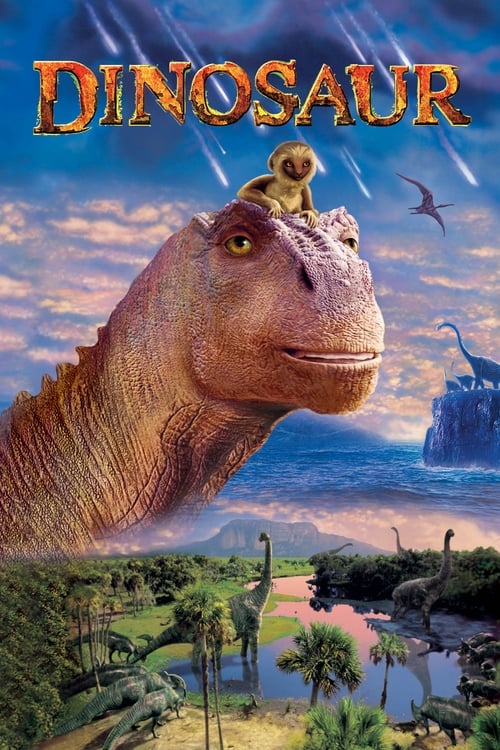
Initially, the characters were intended to be nonverbal characters, with the characters communicating in voice-over similar to Homeward Bound: The Incredible Journey (1993). Michael Eisner was screened a voice-over animation test (now known as the "Noah version") and felt it was strange the characters were communicating without lip or mouth movement. Pam Marsden, the film's producer, agreed, "We felt we needed to have them talk. Part of it is, we don't have any people in the movie, so somebody has to act." To accommodate this change, Aladar was given lips in contrast to actual Iguanodons which had beaks.
The new script had an Iguanodon named Noah as the protagonist wandering with his grandparents and a lemur companion named Adam, and a group of Carnotaurus as well as a rival Iguanodon named Cain playing the antagonists. The story dealt with Noah, who had the ability to see visions of the future, foreseeing the coming of an asteroid and struggling to guide a herd of other dinosaurs to safety. Further into production, Noah, Cain and Adam were renamed Aladar, Kron and Zini, and certain aspects of the story were altered further into what was later seen in the final product.