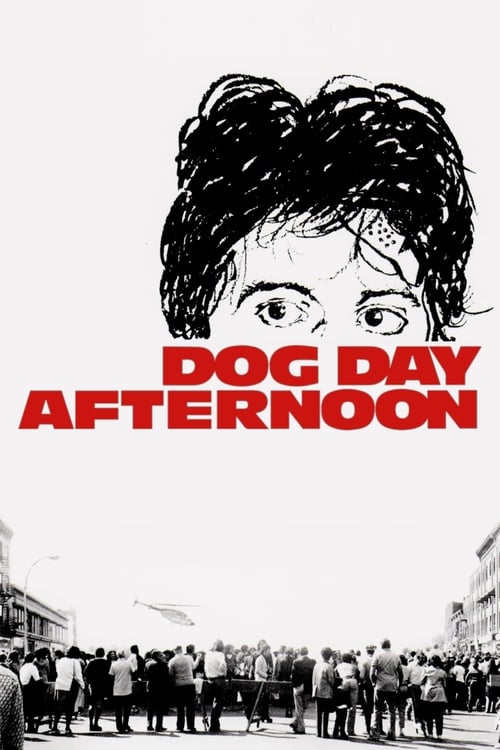
Dog Day Afternoon is a 1975 American biographical crime drama film directed by Sidney Lumet and produced by Martin Bregman and Martin Elfand. The film stars Al Pacino, John Cazale, James Broderick and Charles Durning. The screenplay is written by Frank Pierson and is based on the Life magazine article "The Boys in the Bank" by P. F. Kluge and Thomas Moore. The feature chronicles the 1972 robbery and hostage situation led by John Wojtowicz and Salvatore Naturile at a Chase Manhattan branch in Brooklyn.
Elfand brought the article to Bregman's attention, who proceeded to negotiate a deal with Warner Bros. Pictures and clear the rights to use the story. Pierson conducted his research and wrote a script that centered on the story of the robbery around Wojtowicz. The cast was selected by Lumet and Pacino, with the latter selecting past co-stars from his off-Broadway plays. Filming took place between September and November 1974, and the production was finished three weeks ahead of schedule.
When theatrically released on September 21, 1975, Dog Day Afternoon was a critical and box-office success. The film was nominated for seven Golden Globe Awards, six BAFTAs (winning Best Actor for Pacino and Best Editing), and six Academy Awards (winning Best Original Screenplay). In 2009, Dog Day Afternoon was deemed "culturally, historically, or aesthetically significant" by the Library of Congress, and was selected for preservation in the National Film Registry.
Contents
Plot
On August 22, 1972, first-time crook Sonny Wortzik and his friends Salvatore "Sal" Naturile and Stevie attempt to rob the First Brooklyn Savings Bank. The plan immediately goes awry when Stevie loses his nerve and flees. Sonny discovers they arrived after the daily cash pickup which left only $1,100 in cash at the bank. Sonny takes the bank's traveler's checks and burns the register in a trash can. When smoke raises suspicion outside, the building is surrounded by police. The two panicked robbers take the bank employees hostage.
Police Detective Sergeant Eugene Moretti calls the bank, and Sonny threatens to kill the hostages. Sal assures Sonny he is ready to kill if necessary. Sonny releases an asthmatic security guard as a display of good faith. Moretti convinces Sonny to negotiate outside, and their dialogue culminates in Sonny's shouting "Attica!" to cheers from the crowd.
Sonny lists his demands: a vehicle to the airport so they can board a jet, pizzas for the hostages, and to see his wife at the bank. Sonny's lover Leon Shermer reveals the robbery was intended to pay for Leon's gender reassignment surgery and that Sonny has children with estranged wife Angie.
The bank's lights shut off when FBI agent Sheldon takes command of the scene. He refuses to discuss additional requests. Sheldon convinces Leon to talk to Sonny on the phone. Leon had been hospitalized at Bellevue Hospital after a suicide attempt. Leon turns down Sonny's offer to join in their escape. Sonny tells the police Leon wasn't involved with the robbery.
Sonny agrees to let the bank's director Mulvaney leave due to his diabetic shock, but he refuses to leave his employees. Sonny comes outside to talk to his mother, who fails to persuade him to surrender, then dictates his will to one of the hostages. He arranges for his life insurance to go to Angie and Leon.
Agent Murphy drives Sonny, Sal and the remaining hostages to Kennedy Airport in a limousine. As they wait in the car for their plane to taxi, Sal releases another hostage. Sheldon seizes Sonny's weapon, Murphy shoots Sal in the head with a hidden revolver, Sonny is immediately arrested, and the hostages are freed, while Sal's body is wheeled away.
Production
Background
On August 22, 1972, John Wojtowicz, Salvatore Naturile and Robert Westenberg attempted to rob a branch of the Chase Manhattan Bank at 450 Avenue P in Gravesend, Brooklyn. The robbers aimed to take the US$150,000–$200,000 (equivalent to $1.5 million in 2025) that they expected to be delivered at 3:30 p.m. that afternoon by an armored truck. According to Wojtowicz, a Chase Manhattan executive that he met at a gay bar in Greenwich Village tipped him off. They entered the bank at 3:00 p.m. to discover that the armored truck had instead taken the money away at 11:00 a.m. The robbers took the $29,000 (equivalent to $223,200 in 2025) that was available at the branch and tried to escape. Westenberg was successful, but Wojtowicz and Naturile were left behind as the police arrived on the scene. The robbery then turned into a hostage situation.
Two hours into the negotiations, Wojtowicz and Naturile extended a list of demands to the police: release Elizabeth Eden (Ernest Aron) from Kings County Hospital Center in exchange for a hostage, bring hamburgers and Coca-Cola, and provide transportation to John F. Kennedy International Airport for them and the hostages. In the words of Wojtowicz: "I want them to deliver my wife here from King's County hospital. His name is Ernest Aron. It's a guy. I'm gay." They also requested a plane to fly to a safe location, where the unharmed hostages were to be released. After more than fourteen hours of holding the hostages, Naturile was killed, and Wojtowicz was arrested at Kennedy Airport.
Wojtowicz told Judge Anthony J. Travia that the motive for the robbery was to pay for a sexual reassignment surgery for Eden. Shortly after a suicide attempt in 1971, Eden expressed to Father Gennaro Aurichio the desire to marry Wojtowicz. Aurichio recalled Eden told him, "I'm all mixed up. I want to be a girl. I have to marry the boy I introduced you to. If I don't, I'll be more successful next time." Aurichio, who counseled Eden, agreed to perform a ceremony. He told Eden that he would "perform a blessing" but that he was unable and unwilling to "perform a homosexual marriage". Aurichio was subsequently defrocked. Arthur Bell, an investigative journalist, expressed his belief that the surgery was a peripheral motive for the robbery. Bell met Wojtowicz before the hold up through the Gay Activists Alliance, under the alias of "Littlejohn Basso". In his article published by The Village Voice, he laid out Wojtowicz's connection to pornographer Mike Umbers and proposed that the heist was organized by the Gambino crime family instead.
Development
Life published in its September 22, 1972, issue a chronicle of the robbery. The feature, written by P. F. Kluge and Thomas Moore, was titled "The Boys in the Bank". It detailed the holdup and the hostages' eventual fraternization with their captors. The authors compared Wojtowicz's appearance to that of Dustin Hoffman or Al Pacino. The feature caught the attention of producer Martin Elfand. Elfand took it to Martin Bregman, who piqued the interest of Warner Bros. Pictures executive Richard Shepherd. Elfand hired Kluge and Moore to interview the people involved in the story. Before the script was written, Elfand wanted to ensure that he had signed releases by all the interviewees for the story rights. After the negotiation, each hostage received $600 (equivalent to $4,400 in 2025); one hostage asked for more money and was not included in the script.
Initially, Westenberg was offered $2,000, but he turned it down following the advice of his lawyer, because he was still serving a two-year sentence. After his release, he settled for $750. Wojtowicz received $7,500 (equivalent to $54,400 in 2025) for the rights to the story. From the money, he earmarked $2,500 to Eden's reassignment surgery.
News outlets reported that Wojtowicz was granted one percent of the film's net profit; Bregman later denied that his company, Artists Entertainment Complex, granted Wojtowicz a percentage of the gross. Bregman added he would give him $25,000 if the film performed as well as Serpico (1973) at the box office. Wojtowicz's lawyer Mark Landsman retained $3,500 of the payment he received. Meanwhile, Warner Bros. paid for Naturile's funeral. The working title of the film was The Boys in the Bank. The budget was set at an estimate of $3.8 million (equivalent to $27.56 million in 2025).
Frank Pierson was hired to write the screenplay. Aside from Kluge and Moore's research, Pierson conducted his own. He contacted journalist Randy Wicker, who covered the story of the heist for gay publications, and provided technical assistance regarding Manhattan's gay nightclub scene. Pierson decided that he wanted to center the story around Wojtowicz, who refused to receive Pierson in prison while he was in a financial dispute with Warner Bros.
Pierson analyzed the tapes of the interviews and news articles about the robbery, and approached those involved for additional information. Pierson could not define Wojtowicz's character because a different impression was left on each of the interviewees. The project overwhelmed him, but he could not quit because he had spent his cash in advance. Pierson reviewed his material and found that the unfulfilled promises Wojtowicz made was the common trait. Pierson viewed them as "the story of the bank", and the failure of the robbery.
Tie-In Novel
Pierson had not completed the script when author Leslie Waller was engaged to write the tie-in novel; thus Waller was given only a screen treatment and partial draft of the script from which to work. In order to give fullest dimension possible to characters and story, Waller did his own research and crafted his own approach as Pierson simultaneously and independently finished the script, which is why the novel and the film are often substantially different from one another. Originally published in hardcover by Delacorte Press and packaged to look like an original novel rather than one extrapolated in part from a screenplay, the book was released almost a year before the film, under the pseudonym "Patrick Mann." It was subsequently released in paperback by Dell Publishing just prior to the film's release.
Casting
With the finished script, Martin Bregman met with director Sidney Lumet and star Al Pacino in London. Pacino, who, at the time, was represented by Bregman, agreed to play the role.
Pacino backed out, and Dustin Hoffman expressed interest. Bregman did not meet with Hoffman; he felt that Pacino could bring the "sensitivity" and "vulnerability" needed for the role. After more discussion, Pacino accepted the part but rejected it again. Bregman attributed it to Pacino's use of method acting and said that it "might have been a world [Pacino] did not want to explore". Bregman added that "no major star had ever played a gay".
But he wanted to make the film with Pacino. The actor backed out of the project a third time, and told Bregman that he wanted to return to the theater. He said that he would "never make the adjustment necessary for the movies". Pacino again returned to the project, and attributed his behavior to stress and drinking, and that he needed "a life outside work". Lumet mentioned the characterization of Sonny Wortzik's (Wojtowicz) "insane framework of life" as the stress factor for Pacino. In a meeting before the rehearsals, Pacino asked Pierson and Lumet to tone down Sonny Wortzik's behavior; his request was rejected. Eden described Wojtowicz as "a very domineering person", and added: "he is good-natured ... but sometimes went overboard ... and he terrified me". Wicker later said that the screenplay of Dog Day Afternoon portrayed Wojtowicz to be "more rational than he really was".
Much of the cast consisted of actors Pacino performed with in off-Broadway plays. Pacino asked Lumet to cast John Cazale as Sal Naturile, the only name that did not change for the film. Pacino had worked with Cazale on Israel Horovitz's play The Indian Wants the Bronx, and then in the 1972 film The Godfather. Lumet was not initially convinced he should cast Cazale. He was thirty-nine years old, while Naturile was eighteen years old at the time of his death, but the director agreed after meeting him. Penelope Allen starred as Sylvia "Mouth" (based on Shirley "Mouth" Ball), and had worked with Pacino before on Scarecrow. For the role of Wortzik's mother, Pacino asked Lumet to cast Judith Malina, co-founder of The Living Theatre. Lumet wanted to portray the difference between a street police officer and one with an office job. Charles Durning and James Broderick were cast as Moretti and Sheldon respectively, though Lumet initially decided on Durning being the bank manager and Broderick playing Moretti until Pacino intervened. Because Durning was also working on Robert Wise's Two People, Lumet and Wise had to coordinate his schedule, as he flew between California and New York. Lumet did not worry about Broderick's recasting because of his reputation for method acting. Sully Boyar was cast as bank manager Mulvaney (based on Robert Barrett). Chris Sarandon convinced Lumet and Pacino during his reading and was cast as Leon Shermer. Lumet asked him to shift the focus of his characterization to "a little less Blanche DuBois, a little more Queens housewife".
Filming
Filming took place between September and November 1974. The opening montage shows New York's traffic, bridges, beaches, and neighborhoods before moving to a view of the Manhattan skyline from a cemetery. Lumet wanted to convey "a hot boring day, a dog day afternoon". The director shot the footage from a station wagon, and ended in front of the bank, showing the robbers. The footage was silent, as Lumet decided that he did not want a score for the film. The director felt that "he could not reconcile trying to convince an audience that this really happened ... with putting a music score into it". Editor Dede Allen played Elton John's composition "Amoreena" in the editing room. Lumet added the song to the film, which comes out of the getaway car's radio.
Most of the film took place inside of the bank. Lumet discarded the idea of building a studio set; instead, the director found a street with a warehouse on the lower floor of a building that used to be an automotive workshop. The crew built a bank set with movable walls, which allowed Lumet to place the cameras as he desired, and to use long lenses to shoot from a distance. The warehouse's location also allowed Lumet to transition freely between the bank and the street, and he avoided changing film locations, and allowed the street to be visible from the inside of the bank. The scenes were shot on Prospect Park West, between 17th and 18th streets. The bus line that ran through the street was re-routed for filming, and the second story of the building housed the production offices and catering.
To capture Pacino's movements in a natural fashion, and to allow the actor greater mobility, Lumet integrated the use of roller skates and wheelchairs for the cameramen in the panoramic shots. Lumet would order the camera operators to be pulled as Pacino acted to make the scene look "naturalistic", and "like it was shot by television cameramen, fighting their way through the crowd". He wanted the production to have the appearance of a newsreel. The film featured close-ups centered on Sonny and the situation in the bank.
Two different cameras were used to cover the negotiations from Durning and Pacino's side. Lumet and cinematographer Victor J. Kemper relied on long shots to depict the point of view of the police, and the robbers' "entrapment". Lumet wanted to use the light available on the set to avoid additional luminescence. He fitted the bank with extra fluorescent lamps to achieve desired exposure, and he used other fluorescent lamps of lower power as fill light in close-ups. The film required seven nights of filming. Lumet needed the neighbors' cooperation for the use of their fire escapes to hold additional lights. The production was challenged by the weather, as temperatures dropped. On the day of the heist in August 1972, the temperature reached 87 °F (31 °C) when the robbers entered the bank. The film was shot during the fall; to avoid having their breath be visible, the cast placed ice in their mouths to even out the temperature. Lighting was provided for the scenes by emergency vehicles, that were specially fitted with four 7,500 watt lamps. The white brick façade of the building provided light reflection. An existing lamp post was used, and its lighting reinforced to keep the crowd visible. Emergency lights were used on set in scenes where the power was shut off by the police.
Release and reception
Dog Day Afternoon opened on September 20, 1975, at the San Sebastián International Film Festival. The film premiered in New York City on September 21, 1975, and released nationwide in October. It grossed between $50 million (equivalent to $299.17 million in 2025) and $56 million (equivalent to $335.06 million in 2025).
The New York Times delivered a favorable review. It called the film a "gaudy street-carnival", and Lumet's "most accurate, most flamboyant" depiction of New York. The reviewer remarked the "brilliant characterizations" of the cast: Pacino's display of a "bravura style", Sarandon's performance of "fear, dignity and silliness" and the acting "that one remembers" from the supporting cast. New York Daily News gave Dog Day Afternoon four stars: it described the film as a "gut-level human comedy" and called Pacino "stunning", "brilliantly erratic and terribly touching". The publication felt that Pacino portrayed "a rich, volatile character". It favored Durning and Sarandon, and called the female cast "marvelous". The Record welcomed the performances as "very natural". It determined that "all the slickness" was on Pierson's script, and it attributed it to its closeness to the real events portrayed on the film. For The Village Voice, critic Andrew Sarris opined that Pacino acted "assiduously with the whites of his eyes". Sarris also noted that "pain [came] pouring out of Pacino's eyes" as he deemed Sonny a "Freudian tragic hero", and that the combination with Cazale's character's "deadpan death wish" produced "much emotional debris". The piece declared the "high point" of the film to be the phone conversation between Pacino and Sarandon. Sarris pointed that the dialogue featured "two wounded creatures capable of an extraordinary emotional audacity", and concluded that the film was to be "seen, but not swallowed whole" and "making heroes out of felons" was "a short step to utter chaos". Film critic Roger Ebert rated it with three-and-a-half stars out of four, welcoming its "irreverent, quirky sense of humor". Gary Arnold of The Washington Post called it "a triumphant new classic of American movie naturalism". Penelope Gilliatt of The New Yorker wrote, "Though the farcical tone of the movie is blusterous, falling into the common show-biz habit of supplying energy in place of intent, the movie succeeds, on the whole, because it has the crucial farcical value of not faltering."
Gene Siskel gave Dog Day Afternoon four stars on his review for the Chicago Tribune, and rated the film as "superb", noting the "scenes mixing the fear of violence with insane laughter". He felt that Pacino, Cazale, and Durning kept the film from "degenerating into silliness". Siskel talked about Pacino's display of "so much energy" that made him "believe the unbelievable" and Cazale's "haunting, sallow-cheeked silence". Lumet and Allen were praised for the "terrific, roller-coaster" pace of the film. United Press International defined it as an "exceptionally fine film—outrageously funny and deeply moving", and welcomed Pacino's acting as a "dazzing display". The supporting roles by Cazale, Durning, Allen and Broderick were deemed "excellent", while Peretz and Sarandon's performances were singled out. For Joe Baltake, Pacino's appearance was a "raw, high voltage, uproariously funny performance". His review on the Philadelphia Daily News continued by calling the film "super-charged", and "multi-leveled" by "a slapstick comedy, tense drama, caper tale, biographical material and character study". Baltake compared Cazale's appearance on the film to that of a Coonskin character by Ralph Bakshi. In regards to the rest of the cast, he determined "everyone [was] good". He praised Kemper's cinematography as "you-are-there" and Allen's "razor-sharp editing".
Lawsuits
Wojtowicz's wife, Carmen, received $50 (equivalent to $400 in 2025) from Artists Entertainment Complex for her contribution to the story. She signed the documents to Wicker, who recorded in exchange a tape with her account on behalf of the company. The depiction of her character, Angie, in the film affected her, as she felt she was deemed "repulsive". The novelization of Dog Day Afternoon described her as "a fat cunt", "no-good pusbag" and a "guinea broad", among other pejorative terms. In the film, Angie laments her weight gain as the reason for Sonny's distance. Wojtowicz was also angered by her depiction in the film, and defined his then-wife as "a sweet kid". Pierson declared that the character was presented "farthest from the truth", and that he could not "stand how [Lumet] cast the role," or how Peretz portrayed her. He further stressed his disappointment at the publicity campaign that presented the film as a "true story", and remarked its differences with the Life article. Pierson presented a complaint to the Writers Guild of America. Kluge, a coauthor of the Life feature, believed the film-makers "stayed with the surface of a lively journalistic story" and that the film had a "strong, fast-paced story" without "reflection" or "a contemplative view of life".
Carmen took legal action against Warner Bros. On behalf of her, and her daughters Carmen and Dawn, Wojtowicz filed a lawsuit alleging invasion of privacy and requesting $12,000,000 in damages. The appellate division of the New York Supreme Court ruled in favor of Warner Bros, as the court determined that the true names or pictures of the family and robbers were not used in the film or the book. Wojtowicz then sued the studio for 1% of the earnings he claimed were included in the deal for the use of his story; he received $40,000 (equivalent to $212,500 in 2025) after lawyer's fees were deducted. The New York Supreme Court ordered that $100 (equivalent to $400 in 2025) were to be given weekly to Carmen Wojtowicz, plus $50 weekly for both children. The rest of the money was placed in escrow of the New York State Crime Victims Compensation Board to pay for the claims of the victims of the 1972 robbery.
Accolades
Dog Day Afternoon was nominated for six Academy Awards. Pierson received the Academy Award for Best Original Screenplay. The film was nominated for seven Golden Globes but won none. It received six British Academy Film Awards nominations: Pacino was nominated for Best Actor in a Leading Role and Allen won the Best Editing. Pierson also received the Writers Guild of America Award for Best Written Drama, and Durning the National Board of Review Award for Best Supporting Actor. At the San Sebastián International Film Festival Pacino won Best Actor, while the movie was nominated for Best Film.
The film ranked at number seventy on AFI's 100 Years... 100 Thrills list. Meanwhile, the line "Attica! Attica!" placed at number eighty-six on 100 Years...100 Movie Quotes. It was nominated for 100 Years...100 Movies in 1998 and 2007. In 2006, Premiere issued its "100 Greatest Performances of All Time". The magazine placed Pacino's performance as Sonny as the fourth-greatest ever. In the same year, Writers Guild of America West ranked its screenplay 69th in WGA's list of 101 Greatest Screenplays. In 2012, the Motion Picture Editors Guild listed Dog Day Afternoon as the twentieth best edited film of all time based on a survey of its membership.
Legacy
Analysis in the 21st century of Dog Day Afternoon has interpreted it as an "anti-authoritarian film" that "defied the establishment," particularly with the emphasis on the Attica Prison riot and the character's resentment toward the police. Commentators also mentioned its contemporaneity with the aftermath of the Vietnam War and the Watergate scandal. It became one of the first motion pictures to portray a bisexual male character as the protagonist. In 2009, Dog Day Afternoon was deemed "culturally, historically, or aesthetically significant" by the Library of Congress, and it was selected for preservation in the National Film Registry.
On November 11, 1979, a censored and shortened version was broadcast on NBC's Sunday Night Big Event, which marked the film's television premiere. It was released on VHS in 1985. In 2006, Warner Home Video released Dog Day Afternoon on a double-disc DVD. For the film's fortieth anniversary, a two-disc blu-ray was released in 2015. Metacritic, which uses a weighted average, assigned the film a score of 86 out of 100, based on 15 critics, indicating "universal acclaim". Meanwhile, On the review aggregator website Rotten Tomatoes, 94% of 125 critics' reviews are positive, with an average rating of 8.6/10. The website's consensus reads: "Dog Day Afternoon offers a finely detailed snapshot of people in crisis with tension-soaked drama shaded in black humor."
AllMovie gave the movie five stars out of five. The review defined it as "a quintessential 1970s story", and focused on the film's "contemporary tensions over law, media, and sexuality". Christopher Null wrote in 2006 that the film "captures perfectly the zeitgeist of the early 1970s, a time when optimism was scraping rock bottom and John Wojtowicz was as good a hero as we could come up with". During the 2011 San Francisco International Film Festival, the film was included as a tribute to Pierson for his recent death. The San Francisco Chronicle reflected on the time of its release, and the reviewer felt that "it seemed as if the great movies would never stop, when the extraordinary creative burst we'd been seeing in the 1970s looked as though it might go on forever". The A.V. Club called it a "frank social melodrama that's also a celebration of quotidian bravery", while it praised the cinematography by Kemper that "captures the joy as well as the decay of a crowded city". IGN delivered a good review, and considered Pacino's performance to be "spectacular, and achieves a kind of nuance and complexity that few actors from his or any other generation have before or since achieved". Meanwhile, the reviewer considered that the movie displayed the reason Cazale was "one of the great character actors of all time".
In popular culture
The 1977 Italian film Operazione Kappa: sparate a vista was loosely based on Dog Day Afternoon. The 1987 Hong Kong film People's Hero was a remake of the film. For his audition on The Simpsons, actor Hank Azaria used an imitation voice based on Pacino's Dog Day Afternoon character. It was the basis for the final voice of Moe Szyslak. A bank robbery featuring Sonny and Sal was featured on The Simpsons' episode "I Don't Wanna Know Why the Caged Bird Sings". In 2006, Marcia Jean Kurtz and Lionel Pina reprised their Dog Day Afternoon roles as Miriam Douglas and a pizza delivery man in the heist thriller film Inside Man.
The names of several television series episodes referenced the film, including All in the Family, Welcome Back, Kotter, Alice, St. Elsewhere, Sledge Hammer!, Hill Street Blues, Perfect Strangers, The New Adventures of Winnie the Pooh, The New Lassie, Kenan & Kel, King of the Hill, Bob's Burgers, Supernatural, and 2 Broke Girls. The shout "Attica! Attica!" was also reproduced in multiple films and television series.
Stage adaptation
A stage adaptation of the movie is set to premiere on Broadway in the spring of 2026 written by Stephen Adly Guirgis. Rupert Goold is set to direct with Jon Bernthal and Ebon Moss-Bachrach starring as Sonny and Sal, respectively. In October 2025, it was announced the show would premiere on March 10, 2026 at the August Wilson Theatre and run through June 28.