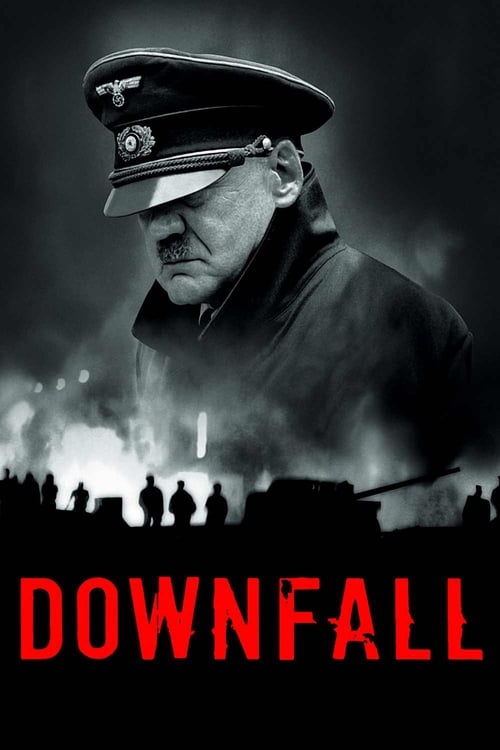
Plot
In November 1942, Adolf Hitler interviews young women for the position of personal secretary in the Wolf's Lair and chooses Traudl Junge.
On 20 April 1945, Hitler's 56th birthday, Berlin comes under fire from Red Army artillery, beginning the Battle of Berlin. Reichsführer-SS Heinrich Himmler, unable to persuade Hitler to flee Berlin, leaves to secretly negotiate with the Allies. SS-Gruppenführer Hermann Fegelein, Himmler's liaison officer and brother-in-law to Hitler's companion Eva Braun, is also unable to persuade Hitler to leave. SS doctor Obersturmbannführer Ernst-Günther Schenck remains in Berlin in defiance of Operation Clausewitz, granted permission to safeguard the health of the civilian population. The father of Hitler Youth member Peter Kranz, who has been conscripted to fight, tries to persuade him to desert but Peter denounces his father.
At a meeting in the Führerbunker, Hitler forbids the overwhelmed 9th Army to retreat, ordering Obergruppenführer Felix Steiner's units and Lieutenant General Walther Wenck's 12th Army to counter-attack. Hitler makes a rare foray out of the bunker to award Peter, who has destroyed two enemy tanks, the Iron Cross, hailing him as braver than his generals. Hitler then talks to armaments minister Albert Speer about his scorched-earth policy. Speer disagrees with the destruction of Germany's infrastructure, but Hitler believes the German people are weak and deserve death. Eva Braun holds a party in the Reich Chancellery, which is broken up by artillery fire, and refuses Fegelein's pleas to leave Berlin with him.
When General Helmuth Weidling learns he has been sentenced to death for allegedly moving his command post, he reports to the Führerbunker to clear himself. His action actually impresses Hitler, who promotes him commander of Berlin's defence. Weidling mutters that he would have rather the Führer carry out his death sentence instead.
When Hitler learns Steiner's weakened forces did not counter-attack as ordered, he launches into a furious tirade, denouncing his generals and for the first time openly acknowledges the war is lost. He promises to commit suicide rather than surrender or leave Berlin.
SS-Brigadeführer Wilhelm Mohnke asks Propaganda Minister Joseph Goebbels to stop sending inexperienced soldiers into the fighting, but Goebbels replies he has no sympathy and that the German people, who proved weaker than their enemies, deserve their fate. Hitler receives a message from Reichsmarschall Hermann Göring, requesting state leadership for himself in the absence of Hitler's freedom of action. Hitler orders Göring's arrest for treason. Speer makes a final visit to the Führerbunker and admits he has defied the scorched earth order. Hitler, emotionally overcome by the betrayal, dismisses Speer without punishment and lets him leave Berlin.
Hitler learns of Himmler's secret negotiations with the Allies and orders his execution. SS physician Obergruppenführer Ernst-Robert Grawitz is refused permission by Hitler to leave Berlin. Fearing Soviet reprisal, he kills himself and his family with hand grenades. Hitler discovers Fegelein's plans to desert and has him executed despite Braun's pleas.
As conditions worsen in Berlin, Hitler hopes Wenck's 12th Army will turn the tide. Hitler dictates his last will and testament to Junge before marrying Braun in an early morning ceremony. When Hitler learns that the 12th Army is unable to save Berlin, he plans his suicide, testing the poison on his dog Blondi. After bidding farewell to his staff, and refusing a final plea by Magda Goebbels to escape, he commits suicide with Braun. The couple are cremated in the Chancellery garden.
General Hans Krebs fails to negotiate a ceasefire with Red Army Colonel General Vasily Chuikov, who insists on Germany's unconditional surrender and the full Soviet takeover of Berlin. Goebbels poisons their six children with cyanide capsules before committing suicide. Krebs and Wilhelm Burgdorf also commit suicide before Weidling announces the unconditional surrender of German forces in Berlin. Peter, sole survivor of his unit, discovers that his parents were executed. The remaining occupants of the bunker attempt to break out from the city. German diplomat SS-Brigadeführer Walther Hewel commits suicide as well, despite Schenck's attempts to persuade him to live. Only Junge successfully escapes, joined by Peter. The two find an abandoned bicycle and escape Berlin.
On May 8, the German government, with Karl Dönitz as Chancellor and the capital moved to Flensburg, unconditionally surrendered to the Allied forces, marking the end of the war for Germany. The film concludes with documentary footage of an elderly Junge confessing that her youthful ignorance should have been no excuse for her involvement in the Nazi regime.