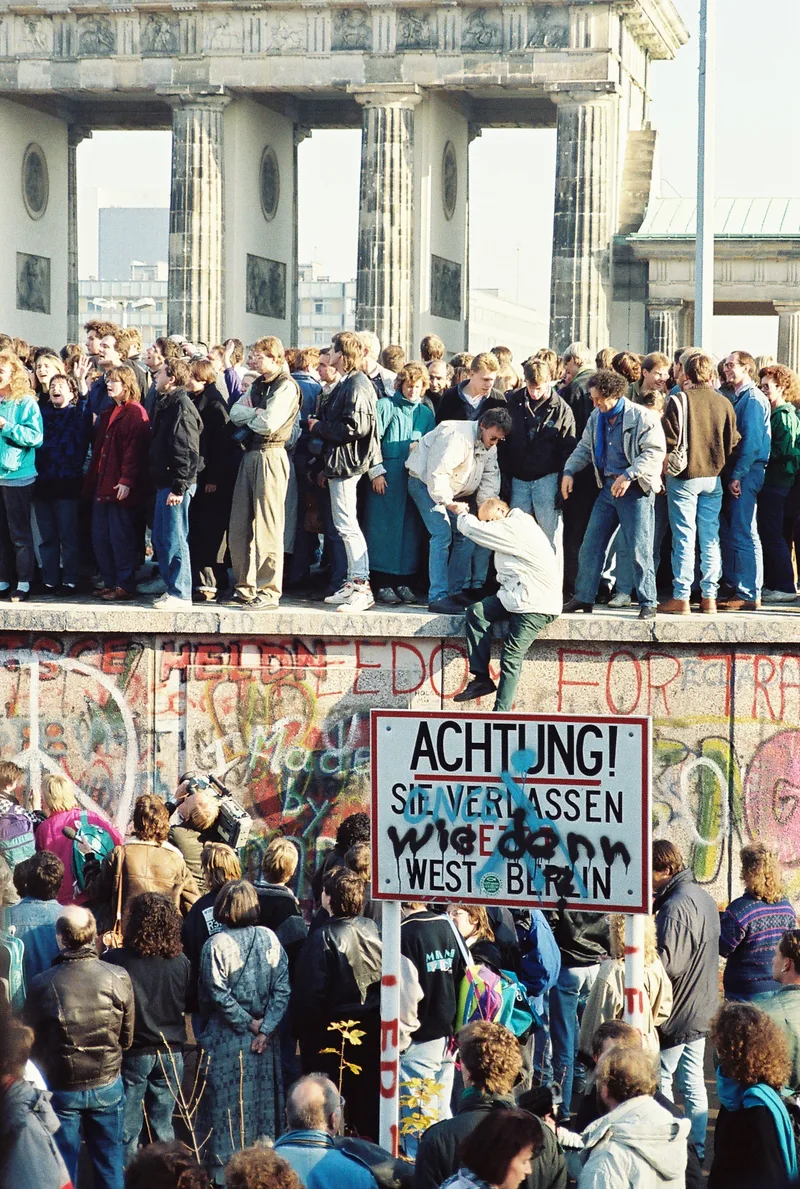
Overview
The fall of the Berlin Wall on 9 November 1989, during the Peaceful Revolution, was a pivotal event in world history which marked the destruction of the Berlin Wall and the figurative Iron Curtain. It was one of the series of events that started the fall of communism in Central and Eastern Europe, preceded by the Solidarity Movement in Poland. The fall of the inner German border took place shortly afterwards. An end to the Cold War was declared at the Malta Summit three weeks later and the German reunification took place in October the following year.
Background
Opening of the Iron Curtain
The opening of the Iron Curtain between Austria and Hungary at the Pan-European Picnic on 19 August 1989 set in motion a peaceful chain reaction, at the end of which there was no longer an East Germany and the Eastern Bloc had disintegrated. Extensive advertising for the planned picnic was made by posters and flyers among the GDR holidaymakers in Hungary. It was the largest escape movement from East Germany since the Berlin Wall was built in 1961. After the picnic, which was based on an idea by Otto von Habsburg to test the reaction of the USSR and Mikhail Gorbachev to an opening of the border, tens of thousands of media-informed East Germans set off for Hungary. Erich Honecker dictated to the Daily Mirror for the Paneuropa Picnic: "Habsburg distributed leaflets far into Poland, on which the East German holidaymakers were invited to a picnic. When they came to the picnic, they were given gifts, food and Deutsche Mark, and then they were persuaded to come to the West." The leadership of the GDR in East Berlin did not dare to completely block the borders of their own country and the USSR did not respond at all. Thus the bracket of the Eastern Bloc was broken.
From Wikipedia (CC BY-SA 4.0).