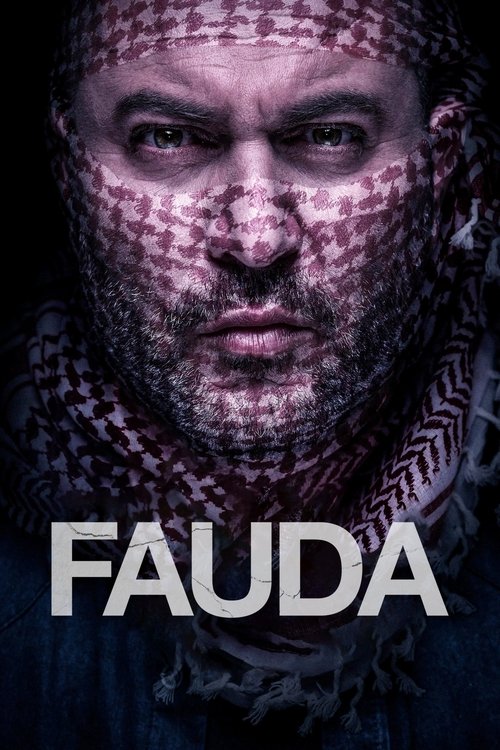
Fauda (Hebrew: פאודה, from Arabic: فوضى fawḍā, meaning "chaos" or "mess") is an Israeli television series developed by Lior Raz and Avi Issacharoff drawing on their experiences in the Israel Defense Forces (IDF). It tells the story of Doron, a commander in the Mista'arvim unit and his team; in the first season, they pursue a Hamas arch-terrorist known as "The Panther". Internationally, the series is streamed by Netflix.
The first season was filmed in Kafr Qasim during the 2014 Gaza War, and premiered on 15 February 2015. The second season premiered on 31 December 2017. The third season takes place in the Gaza Strip and aired in 2019 and 2020. A fourth season aired in early 2023 and it expands the Fauda world to Brussels, Syria, and Lebanon. Season 5 was filmed in 2025 and was released on 18 May 2026. A film follow-up has been reported to be in creation, though the show's frontrunners have not confirmed this.
Contents
Synopsis
The first season focuses on Doron, a former Mista'arev (special Israeli soldiers trained to operate undercover as Arabs for intelligence-gathering operations), who learns that Taufiq Hammed ("Abu Ahmad") former Hamas terrorist whom he and his unit were credited for killing, is still alive and plotting a terror attack. Doron rejoins his former unit to hunt down and eliminate Hammed, setting the stage for a chaotic chain of events. The last episode of the first season ends with Taufiq's sidekick Walid killing his mentor.
In the second season, Doron leaves his unit, separates from his wife and moves back with his father. Following the events of the first season, Walid has become "the head of the military wing of Hamas in the West Bank". The main antagonist in the second season is Nidal Awadallah (also known as "Abu Seif al-Maqdisi"), the son of the Sheikh who was killed in the first season, and an operative in the Islamic State organization who has returned from Syria and wants to take revenge on Doron for killing his father. Adopting the Mista'arvim's tactics, Nidal's ISIS operatives pose as Israeli personnel. In this season, the fight is more personal, between Doron and Nidal, and focuses a lot on their attempts to hurt each other's family.
The third season is set six months after the events of the second season. Doron has resumed his undercover work as Abu Fadi, a boxing instructor who is training Bashar, a young aspiring Palestinian boxer in Hebron. Bashar is the son of Jihad Hamdan, who had been imprisoned for the past 20 years for his involvement with a Palestinian terrorist cell. Following Jihad's release in prison, Doron and Bashar are caught up in a plot involving Bashar's cousin Fauzi smuggling weapons to Hamas in the Gaza Strip. In the process, Doron's cover is blown. Bashar is forced to prove his loyalty to his militant cousin and father. After the Hamdans kidnap two Israeli hikers, Doron and his comrades are forced to embark on a rescue mission behind enemy territory.
In the fourth season, Doron is retired and estranged from his Mista'arvim team. Doron reluctantly accompanies Shin Bet agent Gabi Ayub on a mission to Brussels to meet a source named Omar. However, this is a trap since Omar is a double agent working for Hezbollah and kidnaps Gabi. Taking the kidnapping of Gabi personally, Doron rejoins his squad as they pursue Hezbollah operatives. The rescue mission coincides with a Hezbollah plot to launch a missile attack against Israel.
Cast and characters
Main
Doron Kabilio portrayed by Lior Raz. Doron is married to Gali, and has a son, Ido, and a daughter, Noga. Doron, after leaving the army, lives on a farm and grows grapes in order to make his own wine. Having been previously credited with killing Abu Ahmad, he rejoins his old Israel Defense Force (IDF) unit 18 months later, after intelligence discovered that Abu Ahmad was still alive.
Taufiq Hammed portrayed by Hisham Sulliman. Taufiq is commonly referred to as Abu Ahmad, and is nicknamed "The Panther". He is married to Nassrin and had a son (Ahmad) and a daughter (Abir). Taufiq had been trained by Ali Karmi, since he was a kid, and considers him a father; however, he ordered Ali to be killed when Ali turned his back on him and gave information over to Israel in exchange for surgery for his daughter.
Walid Al Abed portrayed by Shadi Mar'i. As of season 1, Walid is 20 years old. He is a trusted member of Taufiq's team, and one of the few who knows the truth about him being alive after his funeral. Taufiq views Walid like a son to him, and eventually Taufiq wants Walid to replace him. However, Walid eventually winds up killing Taufiq, shooting him in the head from behind. After shooting him, Walid cries and kisses Taufiq.
Dr. Shirin Al Abed portrayed by Laëtitia Eïdo. Shirin is 32 years old as of season 1, and a cousin of Walid. Her mother is from Nablus, her father is from Paris. She volunteered with Doctors Without Borders in 2006. She studied medicine at An-Najah National University, and works in the emergency room of Rafidia Surgery Hospital. She is a widow who was originally married at age 23 to a chemist, named Naji, who died four years later from multiple sclerosis. She spent more of her life in Paris than in Israel, and left Paris after Naji died to be closer to her mother.
Captain Gabi Ayub portrayed by Itzik Cohen. He has been divorced twice, and lives by himself. He has five kids, with the youngest son being named Nadav, and has another son named Yiftah. Gabi's favorite time of the year is when his family goes to the desert on vacation and he has no mode of communication with those who are not with him. He develops a respectful and affectionate relationship with Abu Maher, the head of Palestinian Preventive Security.
Mickey Moreno portrayed by Yuval Segal, commander of Doron's former unit, who pulled him back in. He is romantically involved with Nurit. Following the issues which followed Boaz's capture, Moreno met with Gideon Avital in order to tell him his future plans for the unit, only to be told he was being let go, with the unit being disbanded. Moreno ultimately blackmails Avital into giving him his unit back, lest he will reveal to the press that the two of them had shot five prisoners in the head in Gaza years ago.
Recurring
Ido Kabilio portrayed by Mel Malka, son of Doron and Gali. Ido, eventually finds out about the affair his mother is having with Naor, while listening in on a phone conversation, and later sees them kissing on the couch from upstairs. Ido eventually pulls Naor's gun on him stating that his father is not there because of him. After Doron stops him, Ido states that he should have killed him.
Jihan Hamed portrayed by Khawlah Hag-Debsy
Sheikh Awadalla portrayed by Salim Dau, is a spiritual leader and a close and trusted friend of Taufiq. When Taufiq wants to exchange Boaz for Hamas members imprisoned by Israel, Sheikh is the man he wants to run negotiations with Egypt. After Taufiq gives the order to detonate the bomb inside Boaz, Doron orders the bomb vest strapped to Sheikh to be detonated as well, killing him.
Gideon Avital portrayed by Uri Gavriel, is the Minister of Defense. While in Gaza with Moreno, years prior to entering politics, they shot five prisoners in the head.
Production
Development and writing
Fauda was created by the journalist Avi Issacharoff and Lior Raz, an IDF veteran who also played the show's Israeli lead character Doron Kavillio. The series was produced by Liat Benasuly Productions and yes TV.
The first season was written by Moshe Zonder and directed by Assaf Bernstein. For the series' storyline and main character Doron, Raz drew upon his personal experiences as an undercover commando in the Israel Defense Forces. While pitching story ideas with Issacharoff, Raz proposed writing a story about Israeli special forces, undercover units and Palestinian characters.
In mid-July 2016, showrunner Issacharoff announced that Fauda had been renewed for a second season, which would focus on contemporary news headlines. He also confirmed that conflicts between the writers, production company and YES satellite TV had been resolved. In May 2017, fellow showrunner Raz stated that the second season would be more "personal" and would "talk about revenge" and "have a lot — a lot — of action." Amir Mann served as the head writer for the second season. Rotem Shamir served as the second season's director.
In December 2017, Fauda was renewed for a third season. The third season was written by Noah Stollman, directed by Rotem Shamir and produced by Liat Benasuly.
In mid-September 2020, Issacharoff and Raz confirmed that the series had been renewed for a fourth season, making it the longest-running Israeli action television series. The fourth season was directed by Omni Givon and written by Noah Stallman, with the plot focusing on the team dealing with new threats in the form of Hezbollah activists from Lebanon and Palestinian militants from the West Bank.
In 2023, the showrunners had rejected a proposed storyline for the fifth season by the writers about a group of Hamas terrorists breaching the Gaza border and taking over a kibbutz, deeming it "unbelievable" at the time. Following the October 7 attacks and the outbreak of the Gaza war in 2023, the showrunners abandoned the fifth season's original storyline and rewrote the script to incorporate the events of that conflict. The fifth season was directed by Omri Givon and written by Omri Senhar. In May 2026, Issacharoff posted on X (formerly Twitter) that he hoped that the fifth season would "bring to every point in the world the story of our personal and national trauma" stemming from the October 7 attacks.
Casting
Cast members for the first season included Lior Raz as Doron, Hisham Suliman as Abu Ahmad, Doron Ben-David as Steve, Rona-Lee Shimon as Nurit, Idan Amedi as Sagi, Laëtitia Eïdo as Shirin Al Abed, Tzachi Halevy as Naor, Doron Ben-David as Herzel, Yaakov Zada-Daniel as Eli, Boaz Konforty as Avihai, Itzik Cohen as Gaby, Yuval Segal as Mickey and Netta Garti as Gali. The antagonistic Abu Ahmad was based on Ibrahim Hamed, a Hamas commander who was convicted of murdering 54 Israelis.
During the second season, the cast was joined by Shadi Mar’i as Hamas leader Walid, Firas Nassar as ISIS leader Nidal ("Al Makdesi"), Amir Khoury as Samir, and Meirav Shirom as Dana. Returning cast members from the first season included Ben-David, Shimon, Amedi, Eïdo, Halevi, Ben-David, Zada-Daniel, Konforty, Cohen, Segal and Garti. Ëido also worked with an Arabic language instructor due to her lack of proficiency in the language.
During the third season, Konforty drew upon his Israel Defense Forces (IDF) military service experience while portraying his character Avihai, a sniper in Doron's squad. According to Shimon, cast members also performed their own stunts and received training in firearms, Krav Maga and kickboxing. New cast members included Marina Maximilian, who played a Shin Bet investigator.
During the fourth season, several regular cast members including Raz, Cohen, Shimon, Amedi, Ben-David, Zada-Daniel and Shirom reprised their roles. New cast members for the fourth season included Inbar Lavi, Mark Ivanir, Amir Boutrous, Lucy Ayoub and Loai Noufi.
In December 2024, Fauda's production instructed casting agents not to propose Jewish actors for roles portraying Arab characters in the fifth season as part of the show's commitment towards authenticity. In mid-April 2025, French actress Mélanie Laurent joined the cast of the fifth season in an undisclosed role.
Filming
The first season of Fauda was co-produced by Raz and Issacharoff, in partnership with Tender Productions. Most of the first season was filmed in the Israeli Arab village of Kfar Qasim for a month and half in 2014. Due to the ongoing 2014 Gaza War, shooting was cancelled for the first day but production resumed. The first season production hired a mixed cast and crew of Israeli Jews and Arabs.
During the filming of the second season, the producers granted access to a BBC film crew, resulting in the production of the 2018 documentary The Real Fauda. Filming also took place in an Israeli Arab town where female Jewish Israeli extras were cast as Palestinian women due to a local customary ban on female participation.
Filming for the third season commenced in March 2019. The third season was filmed in several Israeli Arab villages, Jaffa and IDF training zones over a period of three months. The IDF assisted the production with the scenes taking place in the Gaza Strip and also provided helicopters. To simulate Gaza, the production and art team built a set at Tze'elim, the IDF's Urban Warfare Army Camp. The Israeli Arab town of Jisr az-Zarqa also served as a stand-in for scenes in Gaza and West Bank.
The fourth season was filmed in several locations in Israel and the Ukraine from November 2021. Filming took place in the central Israeli Arab town of Kafr Qasim in December 2021, prompting complaints from several residents about the sound of explosions and gunfire. The production compensated residents living near the production site and coordinated with the Kafr Qasim municipal authorities and local police.
Filming for the fifth season had been planned for 2023 but was delayed due to the Gaza war. Filming for the fifth season took place in both Israel and Budapest in 2025. While parts of the fifth season were originally intended to be filmed in Marseille, they were moved to Budapest for security reasons by September 2025.
Release
The first season of Fauda premiered on the satellite network yes in 2015. The series is distributed by the online streaming service Netflix, billed as a Netflix original program, and premiered on 2 December 2016.
In the summer of 2016, yes officially picked up season 2 of the show, stating it will focus more on real world events. During the fall of 2017 the initial trailer was released, and the official premier date was later announced to be 31 December. Season 2 was added to Netflix in May 2018.
A few weeks prior to the airing of season 2, Fauda was renewed for a third season, to air in 2019. The third season premiered on Yes Action's TV channel, VOD and YouTube channel on 30 December 2019. It premiered on Netflix on 16 April 2020.
The fourth season aired on yes TV and Netflix in early 2023.
The first two episodes of the fifth season aired on Yes Action and Yes VOD on May 18, 2026, with the remaining nine episodes being released on a weekly basis. The fifth season will also be released on Netflix later in 2026. On June 21, Yes TV warned that the seventh and eighth episodes, scheduled to be released on June 22, were based on the events of the October 7 attacks, and would contain "difficult" content, images and sounds. Viewers would be given the option to skip these two episodes and resume the ninth episode the following week, which would continue the season's main storyline.
Reception
Viewership
According to BBC and CNN, Fauda has garnered significant popularity not only in Israel but in the Palestinian Territories and Arab countries as well between 2018 and 2019.
Critical response
The review aggregator Rotten Tomatoes indicated that 100% of reviews were favourable for all four seasons.
In a piece for The Guardian, film producer Trudie Styler found the series to be "an electric and fantastically acted drama", adding that "[the] moral context is complex and provides more fodder for dinner-table discussions."
Don Trachtman of The Times of Israel praised the series, writing that it "tries to level and equate the sides, without clear message of who is acting worse or who is right and who is wrong." He also compared Fauda favourably to similar American spy television series, observing the focus on drama over spectacle and special effects. Trachtman praised Fauda for humanising Israeli spies and commandos by depicting them as "humane, with personal lives, families, love, greif, [sic] consicence, [sic] doubts." He also opined that the second season improved on the first season by raising the stakes, level of suspense, and exploring the show's minor characters.
Paul Nyhart of TheWrap gave the series a positive review, describing it as next Homeland. He praised the second season for using Arabic and Hebrew dialogue to tell both sides of the story and for its positive representation of female characters. Nyhart also praised Fauda for its high stakes and action scenes.
Mihir Fadnavis of Firstpost gave the second series a positive review, writing that it "had huge expectations to live up to, and it's a matter of celebration that the follow-up is not just bigger, but also better. It is truly an unforgettable piece of entertainment that should be on the must-see list for those who dig films and TV that revel in the gray area rather than black or white." Fadnavis praised the series for focusing on the humanity and complexity of both its Israeli and Palestinian characters. While he credited the series for helping viewers understand the Arab-Israeli conflict, Fadnavis suggested that the series could also explore the political situation rather than relying on thrills. He also praised the second season's character development for exploring its individual character arcs and raising the stakes, comparing it favourably to the "stereotypical machine-gun trotting sexist joke spewing" trope of the first season's male characters.
Political commentary
Various pro-Palestinian groups have labeled Fauda as an "Israeli propaganda". Rachel Shabi, writing in The Guardian, criticised the show for its politics and its "relentless machismo". According to Yasmeen Serhan of The Atlantic, "Viewers who are hungry for a Palestinian perspective on the conflict would do well to urge Netflix to commission a Palestinian-created series, because Fauda will probably prove a disappointment." George Zeidan of Right to Movement Palestine, was more direct; in Haaretz, he wrote "The Middle East is already bursting with disinformation, insinuations and dangerous propaganda: there's no need for yet more. Fauda can do better."
An article by Yara Hawari in Al Jazeera about the "latest surge of programmes focusing on Israel and trying to show it as a force for good" gave the opinion that "although not as crude as classic Orientalist cinema and TV, these programmes are no less racist and perhaps even more dangerous in their subtlety and slick presentation." York University philosophy professor Muhammad Ali Khalidi described the series "as an effective tool of Israeli propaganda," comparing it to the 1960 Hollywood film Exodus. Khalidi said the series whitewashed Israeli human rights violations and the military occupation, and accused it of cultural appropriation. Reviewers have described it as "shooting and crying".
Jewish critics of Israel have also critiqued Fauda. Alessio Franko of Jewish Currents complimented the series for attempting to humanize its Palestinian characters but conceded that it was still locked into an Israel-Jewish point of view; observing that Palestinian characters were not accorded the same "embattled, contemplative moments" as their Jewish counterparts. Mitchell Abidor described Fauda as "poisonous politically, presenting Palestinians as murderous, cowardly, treacherous, and untrustworthy. The Israelis, on the other hand, are either supermen or superwomen." He opined that the series' efforts to humanize its Palestinian characters was negated by its role as an "apologia" for Israel's war on the Palestinians.
Pro-Israeli critics also panned the show as depicting Israelis in a bad light. In Tablet Magazine, Alter Yisrael Shimon Feuerman states:
Doron, then, isn’t a new Zionist hero negating the old nebbishy Jewish stereotypes. He’s merely a curious new form of the Jew as schlemiel, only this time with the powerful fisticuffs and a high-powered rifle.
Accolades
In 2016, the show took six awards, including Best Drama Series, at the Israeli Academy Awards. In December 2017, The New York Times voted Fauda among the best international shows of 2017. In 2018, the show took 11 Israeli TV Academy Awards, including best TV drama, best actor for Lior Raz and also best screenplay, casting, cinematography, recording, special effects and in other categories.
Adaptation and responses
In November 2019, content studio Applause Entertainment (promoted by Aditya Birla Group) announced an Indian adaptation of Fauda, which would depict the relationship between India and Pakistan. Tanaav, the Indian adaptation, premiered on SonyLIV on 11 November 2022.
In early 2022, the Hamas-affiliated Al-Aqsa TV produced a television series called Qabdat al-Ahrar ("Fist of the Free") as a Palestinian response to Fauda. The series was directed by Mohammed Soraya and consisted of 30 episodes. It focused on a gang of Hamas fights outmaneuvering the IDF.
Gaza War
Series production manager Matan Meir, a reservist in the IDF, was killed by a bomb trap in a Hamas tunnel in the Gaza Strip on 11 November 2023, while deployed during the Gaza war.
Idan Amedi, who appeared in Seasons 2-4 as Sagi, was severely injured in Gaza on 8 January 2024 while serving as a reservist in the IDF. A blast that was the result of a premature explosion intended to demolish tunnels killed six soldiers and resulted in shrapnel hitting Amedi in his neck and spine. Amedi has stated that he hopes to return to Fauda for season 5.