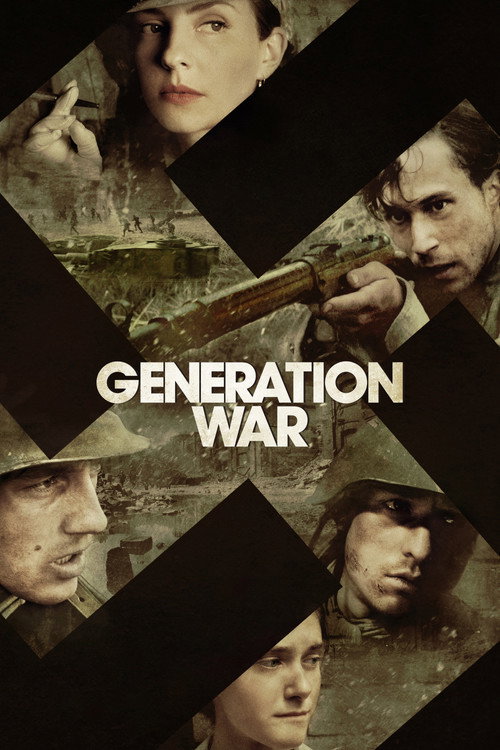
Commenting on its success in Germany, The Economist wrote that some German critics suggested that "putting five sympathetic young protagonists into a harrowing story just offers the war generation a fresh bunch of excuses." The Daily Telegraph wrote that Generation War "has been hailed by critics as a 'turning point' in German television for examining the crimes of the Third Reich at an individual level," and that it, "explores the seductive aspect of Nazism."
Jackson Janes, president of the American Institute for Contemporary German Studies at the Johns Hopkins University, commented that the series "does not filter the Nazi atrocities nor the reality of war. Instead, it tries to portray how the millions of people who followed Hitler into the catastrophe he created were attracted to the vision he offered, only to then be confronted with trying to survive it." The Hollywood Reporter noted that the sales company in Cannes billed the series as "a German equivalent to HBO's Band of Brothers."
When the three-part TV film saw a limited theatrical release in the United States as a four-and-a-half-hour two-part film on 15 January 2014, The New York Times reviewer A.O. Scott stated that by not showing the Nazi death camps, Generation War perpetuates "the notion that ordinary Germans were duped by the Nazis and ignorant of the extent of their crimes." The review ends with the comment that of the five protagonists, "the artist, the intellectual and the Jew are all punished, for wantonness, weakness and naïveté, and pushed into extreme states of moral compromise, [while] the chaste, self-sacrificing Aryans, the lieutenant and the nurse, though they are not without guilt, are the heroes of the story, just as they would have been in a German film made in 1943."
According to the NPR review by Ella Taylor, the film depicts how totalitarianism corrupts almost everything in its path, including individual responsibility.
The New Yorker reviewer David Denby wrote that "Generation War has the strengths and the weaknesses of middlebrow art: it may be clunky, but it's never dull, and, once you start watching, you can't stop," and "the old accepted notion that the barbarians were confined to the S.S. and the Gestapo has been cast aside. The series acknowledges what scholars have established in recent years: that the Wehrmacht played a major role in committing atrocities in the occupied countries." But "while destroying one myth, the filmmakers have built up another. The movie says that young men and women were seduced and then savagely betrayed—brutalized by what the Nazis and the war itself put them through. Their complicity, in this account, is forced, never chosen. Aimed at today's Germans, who would like, perhaps, to come to a final reckoning with the war period, Generation War is an appeal for forgiveness. But the movie sells dubious innocence in the hope of eliciting reconciliation."
The Tablet reviewer Laurence Zuckerman said that Generation War' presented World War II Germans as tolerant and free of anti-Semitism which was "wildly out of sync" with what scholars have learned from letters, diaries, and other primary sources. In reality, "most ordinary Germans at the time held attitudes of casual racism at the very least, and a strong sense of imperial entitlement over Jews, Slavs and other races deemed racially and culturally inferior. The series tries to draw a distinction between Nazis and everyday Germans that simply did not exist in any broad way. The tagline on the movie's poster – 'What happens when the country you love betrays everything you believe?' – is demonstrably false. Most Germans believed in the Nazi agenda."
The Spectator reviewer James Delingpole criticized the series as "semi-apologia" that "had ducked frank and fearless authenticity in favour of face-saving, intellectually dishonest, respectful melodrama that leaves its audience feeling frustrated, cheated and rudderless". He criticized the film's portrayal of its main characters as non-zealots, spirited young people forced to confront unpleasant realities and make agonizing choices as ahistorical, with Delingpole describing Friedhelm as "a 21st-century German parachuted into a period where he wouldn't have survived more than a few seconds".
According to German-British journalist Alan Posener, "While the shows dealing with communist East Germany are realistic, the Third Reich gets off too lightly. None of the new productions directly addresses the Holocaust or other Nazi crimes. The dramas don’t even focus on the resistance to Hitler. Instead, most Germans appear as victims...The 2013 miniseries Unsere Mütter, unsere Väter (released as Generation War in English) continued the trend".