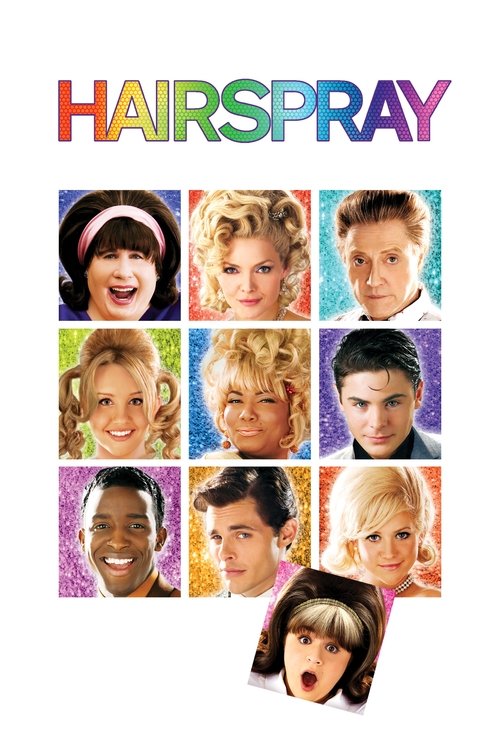
Hairspray is a 2007 musical romantic comedy film directed and choreographed by Adam Shankman, and written by Leslie Dixon. It is based on the 2002 stage musical by Mark O'Donnell and Thomas Meehan, which itself was based on John Waters's 1988 film. Produced by Ingenious Media and Zadan/Meron Productions, the film features an ensemble cast including John Travolta, Michelle Pfeiffer, Christopher Walken, Amanda Bynes, James Marsden, Queen Latifah, Brittany Snow, Zac Efron, Elijah Kelley, Allison Janney, and Nikki Blonsky in her feature film debut.
Set in 1962 Baltimore, Maryland, the film follows "pleasantly plump" teenager Tracy Turnblad (Blonsky) as she pursues stardom as a dancer on a local television dance show and rallies against racial segregation.
Development began in 2004, with Dixon reworking Meehan and O'Donnell's first screenplay draft to tone down the musical's campiness; by the following year, Shankman agreed to direct. The musical's composer and lyricist team, Marc Shaiman and Scott Wittman, reworked their songs for the film's soundtrack, and also wrote four new original songs. Principal photography lasted from September to December 2006 with a budget of $75 million; filming took place on locations in Toronto and Hamilton, Ontario, and on sound-stages at Toronto's Showline Studios. Recording sessions took place in San Diego, California.
Hairspray premiered at the Mann Village Theater on July 10, 2007, and was released in the United Kingdom and the United States by New Line Cinema on July 20. It achieved critical and commercial success, breaking the record for the largest opening weekend for a musical film, and ranking as the seventh-highest-grossing musical film adaptation with a worldwide gross of $203.6 million. Among its accolades, Hairspray was nominated for three Golden Globe Awards (including Best Motion Picture – Musical or Comedy), five Critics' Choice Awards (winning two), and the Screen Actors Guild Award for Outstanding Performance by a Cast in a Motion Picture.
Contents
Plot
In 1962, overweight 16-year-old Tracy Turnblad lives in Baltimore. She and her shy best friend Penny Pingleton frequently watch The Corny Collins Show, a local teen dance television show broadcast live on the WYZT station. Several of the dancers on the show, including lead dancers Amber von Tussle and her boyfriend Link Larkin, attend Tracy and Penny's high school. Amber's mother Velma, the station's manager, ensures that her daughter is prominently featured and only allows African-American dancers to appear on the show's monthly "Negro Day", hosted by local R&B disc jockey "Motormouth" Maybelle Stubbs.
Corny reveals that one of the dancers on the show will be taking a nine-month leave of absence, so Link announces auditions for a replacement to be held at the WYZT studio the next day. Ecstatic, Tracy skips class to attend the audition, but Velma rejects Tracy for both her size and support of integration. While in detention for cutting class, Tracy discovers the "Negro Day" youths practicing in the detention room and befriends Maybelle's son, Seaweed.
While leaving detention, Tracy inadvertently meets Link and dreams of a life with him. At a record hop, Tracy's dance moves, taught to her by Seaweed, garner Corny's attention, so he chooses her to join the cast.
Tracy quickly becomes one of Corny's most popular performers, threatening Amber's chances of winning the show's annual "Miss Teenage Hairspray" pageant the following month and her relationship with Link, who grows fonder of Tracy. When Tracy is enlisted as the spokesgirl for a plus-size fashion boutique, she persuades her agoraphobic mother Edna to accompany her there as her agent, where both receive makeovers, sharply boosting Edna's confidence.
Tracy introduces Seaweed to Penny, and they become smitten. Later, Seaweed and his younger sister Little Inez bring Tracy, Penny, and Link to a party at Maybelle's store. Amber anonymously calls Edna and divulges Tracy's whereabouts. Edna rushes to the store and attempts to take Tracy home immediately, but Maybelle convinces her to stay and take pride in herself. After Maybelle sadly informs everyone that Velma has canceled Negro Day, Tracy suggests they march for integration. Link, unwilling to endanger his career, apologizes to Tracy and explains that he is scheduled to sing in front of talent scouts at the pageant.
Cast
John Travolta as Edna Turnblad, Tracy's mother who owns a laundry business, is agoraphobic and ashamed of her obesity. Travolta's casting as Edna continued the tradition of having a man in drag portray the character, going back to the 1988 film, which featured drag queen Divine as Edna, as well as to the Broadway adaptation, which featured Harvey Fierstein as Edna. Executives at New Line Cinema originally expected the part to be filled by an actor accustomed to playing comic roles, tossing around names such as Robin Williams, Steve Martin, and Tom Hanks. However, Travolta was aggressively sought after by producers Craig Zadan and Neil Meron for this role because he had starred as Danny Zuko in Grease, the second most successful movie musical to date, beaten only by Mamma Mia!.
Michelle Pfeiffer as Velma Von Tussle, the racist and sizeist manager of station WYZT. Velma is invested in keeping her daughter Amber in the spotlight and The Corny Collins Show segregated. Hairspray was the first film featuring Pfeiffer to be released in five years. Stardust, also featuring Pfeiffer, was shot before Hairspray, but released three weeks afterwards. The peculiarity of Pfeiffer and Travolta appearing onscreen together (Travolta starred in Grease, Pfeiffer in Grease 2) was not lost on the production staff; Travolta requested that Pfeiffer play the part of the villainess.
Queen Latifah as "Motormouth" Maybelle Stubbs, a Baltimore rhythm and blues radio DJ who hosts "Negro Day" on The Corny Collins Show. Maybelle also runs a record shop on North Avenue. Queen Latifah appeared in the successful Zadan/Meron film musical Chicago, and worked under Adam Shankman's direction in Bringing Down the House. Aretha Franklin had been previously considered for the role.
Nikki Blonsky as Tracy Turnblad, an optimistic, overweight teenage girl who loves dancing. Tracy's racial acceptance leads her to become an active supporter for the integration of The Corny Collins Show. Hairspray was Blonsky's debut as a professional actress.
Amanda Bynes as Penny Lou Pingleton, Tracy's best friend, a sheltered girl who falls in love with Seaweed despite the disapproval of her stern, devoutly religious and racist mother Prudy. A young actress famous for appearances on Nickelodeon TV shows and in feature films, Bynes was one of the few movie stars cast among the teen roles.
Musical numbers
"Good Morning Baltimore" – Tracy (Nikki Blonsky)
"The Nicest Kids in Town" – Corny and Council Members (James Marsden)
"It Takes Two" – Link (Zac Efron)
"(The Legend of) Miss Baltimore Crabs" – Velma and Council Members (Michelle Pfeiffer)
"I Can Hear the Bells" – Tracy (Nikki Blonsky)
"Ladies' Choice" – Link (Zac Efron)
"The Nicest Kids in Town (Reprise)" – Corny, Council Members, Penny, Edna, Wilbur (James Marsden)
"The New Girl in Town" – Amber, Tammy, Shelley, and The Dynamites (Brittany Snow)
"Welcome to the 60's" – Tracy, Edna, The Dynamites, and Hefty Hideaway Employees (Nikki Blonsky and John Travolta)
"Run and Tell That" – Seaweed, Little Inez, and Detention Kids (Elijah Kelley ft. Taylor Parks)
"Big, Blonde and Beautiful" – Motormouth (Queen Latifah)
"Big, Blonde and Beautiful (Reprise)" – Velma and Edna (Michelle Pfeiffer and John Travolta)
"(You're) Timeless to Me" – Wilbur and Edna (Christopher Walken and John Travolta)
"I Know Where I've Been" – Motormouth (Queen Latifah)
"Without Love" – Link, Tracy, Seaweed, Penny, and Detention Kids (Zac Efron, Nikki Blonsky, Elijah Kelley, Amanda Bynes)
Production
Early development
Following the success of the Broadway musical of the same name, which won eight Tony Awards in 2003, New Line Cinema, who owned the rights to the 1988 John Waters film upon which the stage musical is based, became interested in adapting the stage show as a musical film. Development work began in late 2004, while a similarly film-to-Broadway-to-film project, Mel Brooks' The Producers, was in production.
Craig Zadan and Neil Meron, the executive producers of the Academy Award-winning film adaptation of the Broadway musical Chicago, were hired as the producers for Hairspray, and began discussing possibly casting John Travolta and Billy Crystal (or Jim Broadbent) as Edna and Wilbur Turnblad, respectively. Thomas Meehan and Mark O'Donnell, authors of the book for the stage musical, wrote the first draft of the film's screenplay, but were replaced by Leslie Dixon, screenwriter for family comedies such as Mrs. Doubtfire and Freaky Friday. After a year's deliberation on who should direct the film, Zadan and Meron finally decided to hire Adam Shankman to both direct and choreograph Hairspray. Upon learning he had been hired, Shankman arranged a meeting with John Waters, who advised him "don't do what I did, don't do what the play did. You've gotta do your own thing." Despite this, Shankman still noted "all roads of Hairspray lead back to John Waters."
Adaptation changes
Dixon was primarily hired to tone down much of the campiness inherent in the stage musical. The 2007 film's script is based primarily on the stage musical rather than the 1988 film, so several changes already made to the plot for the stage version remain in this version. These include dropping several characters from the 1988 version (such as Arvin Hodgepile (the role Mr. Spritzer fills), Velma's husband Franklin, Corny's assistant Tammy, the beatniks, et al.), removing the Tilted Acres amusement park from the story, and placing Velma in charge of the station where The Corny Collins Show is filmed.
One notable difference between the stage musical, the original film, and the 2007 film version of Hairspray is that Tracy does not go to jail in the 2007 version (thus eliminating the musical's song "The Big Dollhouse"). In both previous incarnations of Hairspray, Tracy is arrested and taken to jail along with the other protesters. Edna is presented in this version as an insecure introvert, in contrast to the relatively bolder incarnations present in the 1988 film and the stage musical. Among many other elements changed or added to this version are the removal of Motormouth Maybelle's habit of speaking in rhyming jive talk and doubling the number of teens in Corny Collins' Council (from ten on Broadway to twenty in the 2007 film).
Dixon restructured portions of Hairspray's book to allow several of the songs to blend more naturally into the plot, in particular "(You're) Timeless to Me" and "I Know Where I've Been". "(You're) Timeless to Me" becomes the anchor of a newly invented subplot involving Velma's attempt to break up Edna and Wilbur's marriage and keep Tracy off The Corny Collins Show as a result. The song now serves as Wilbur's apology to Edna, in addition to its original purpose in the stage musical as a tongue-in-cheek declaration of Wilbur and Edna's love for each other. Meanwhile, "I Know Where I've Been", instead of being sung by Maybelle to the kids after being let out of jail, now underscores Maybelle's march on WYZT (which takes place in the stage musical at the end of "Big, Blonde, and Beautiful").
Pre-production and casting
Hairspray was produced on a budget of $75 million. Casting director, David Rubin, introduced an open casting call to cast unknowns in Atlanta, New York City, and Chicago. After auditioning over eleven hundred candidates, Nikki Blonsky, a high school student from Great Neck, New York was chosen for the lead role of Tracy. Blonsky auditioned for the role of Tracy Turnblad in New York City in 2006 at seventeen years old. She had no previous professional experience in acting or in singing. Blonsky had auditioned for the role because it became her dream to play the role of Tracy after seeing the musical on Broadway. Blonsky, working at Cold Stone Creamery at the time, received the news from film director, Adam Shankman, that she had received the part. Relative unknowns Elijah Kelley and Taylor Parks were chosen through similar audition contests to portray siblings Seaweed and Little Inez Stubbs, respectively. John Travolta was finally cast as Edna, with Christopher Walken ultimately assuming the role of Wilbur. Several other stars, including Queen Latifah, James Marsden, Michelle Pfeiffer, and Allison Janney were chosen for the other supporting adult roles of Motormouth Maybelle, Corny Collins, Velma Von Tussle, and Prudy Pingleton, respectively. Teen stars Amanda Bynes, and Zac Efron were cast as Tracy's friends Penny and Link, and Brittany Snow was cast as her rival, Amber Von Tussle. Jerry Stiller, who played Wilbur Turnblad in the original film, appears as plus-sized women's clothes retailer Mr. Pinky in this version.
Since Hairspray's plot focuses heavily on dance, choreography became a heavy focus for Shankman, who hired four assistant choreographers, Jamal Sims, Anne Fletcher, and Zach Woodlee, and put both his acting cast and over a hundred and fifty dancers through two months of rehearsals. The cast recorded the vocal tracks for their songs as coached by Elaine Overholt in the weeks just before principal photography began in September.
Principal photography
Principal photography took place in Toronto, and Hamilton, Ontario, Canada from September 5 to December 8, 2006.
Hairspray is explicitly set in Baltimore, Maryland and the original 1988 film had been shot on location there, but the 2007 film was shot primarily in Toronto because the city was better equipped with the sound stages necessary to film a musical. The opening shots of the descent from the clouds and the newspaper being dropped onto the stoop are the only times that the actual city of Baltimore is shown in the film.
Most of the film was shot at Toronto's Showline Studios. Most of the street scenes were shot at the intersection of Dundas Street West and Roncesvalles Avenue. A PCC streetcar with Toronto Transit Commission livery is seen in the opening sequence. Some of the signs for the 1960s-era stores remain up along the street. Toronto's Lord Lansdowne Public School was used for all of the high school exteriors and some of the interiors, while the old Queen Victoria School in Hamilton was also used for interiors. Scenes at Queen Victoria were shot from November 22 to December 2, and the school was scheduled to be demolished after film production was completed. As of the 2017–2018 school year, there are no plans to close this school.
Thinner than most of the other men who have portrayed Edna, Travolta appeared onscreen in a large fat suit, and required four hours of makeup in order to appear before the cameras. His character's nimble dancing style belies her girth; Shankman based Edna's dancing style on the hippo ballerinas in the Dance of the Hours sequence in Walt Disney's 1940 animated feature, Fantasia. Although early versions of the suit created "a dumpy, Alfred Hitchcock version of Edna," Travolta fought for the ability to give his character curves and a thick Baltimore accent. Designed by Tony Gardner, the fat suit was created using lightweight synthetic materials, consisting of layered pads and silicone, which was used from the chest upwards. The suit provided the additional benefit of covering Travolta's beard, eliminating the problem of his facial hair growing through his makeup midday.
Shankman's inspirations
Shankman included a number of references to films that influenced his work on Hairspray:
The film's opening shot — a bird's-eye view of Baltimore that eventually descends from the clouds to ground level — is a combination of the opening shots of West Side Story and The Sound of Music.
Before we see a full shot of Tracy, we see individual shots of her upraised right and left arms. This is reminiscent of our first views of Sadie Thompson (Joan Crawford) in the 1932 film Rain.
Several scenes involving Tracy, such as her ride atop the garbage truck during the "Good Morning Baltimore" number and her new hairstyle during "Welcome to the '60s", are directly inspired by the Barbra Streisand musical film version of Funny Girl.
During "Without Love", Link sings to a photograph of Tracy, which comes to life and sings harmony with him. This is directly inspired from the MGM musical The Broadway Melody of 1938, in which a young Judy Garland swoons over a photo of actor Clark Gable as she sings "You Made Me Love You".
The dress that Penny wears during "You Can't Stop the Beat" is made from her bedroom curtains, which can be seen during "Without Love". This is homage to The Sound of Music, where Maria uses old curtains to make play clothes for the von Trapp children.
Release
Home media
Hairspray was released on DVD and Blu-ray on November 20, 2007, by New Line Home Entertainment. An HD DVD version of the film was originally slated for release in 2008, but was canceled due to New Line Cinema's announcement that it would go Blu-ray exclusive.
Television
USA Network purchased the cable broadcast rights to Hairspray and was scheduled to debut the film in February 2010, but in the end, it did not broadcast that month. The film eventually premiered on July 24, 2010, with USA's sister channel Bravo also showing it multiple times. In February 2011, Hairspray made its network television debut on ABC.
Reception
Box office
Hairspray debuted in 3,121 theaters in North America on July 20, 2007, the widest debut of any modern movie musical. The film earned $27.5 million in its opening weekend at #3, behind I Now Pronounce You Chuck and Larry and Harry Potter and the Order of the Phoenix. This made Hairspray the record-holder for the biggest opening weekend for a movie based on a Broadway musical. This record was later broken by the release of Mamma Mia!, which grossed $27.8 million on its opening weekend. Hairspray is currently the twelfth highest grossing musical in U.S. cinema history, surpassing The Rocky Horror Picture Show ($145 million) and Dreamgirls ($103 million), released seven months prior. Ending its domestic run on October 25, 2007, Hairspray has a total domestic gross of $118.9 million and $202.5 million worldwide. Its biggest overseas markets include the United Kingdom ($25.8 million), Australia ($14.4 million), Japan ($8 million), Italy ($4.6 million), France ($3.9 million) and Spain ($3.8 million). At the time, this made Hairspray the third musical film in history to cross $200 million internationally, behind 1978's hit Grease ($395 million) and 2002's Chicago ($307 million). It is the seventh highest-grossing PG-rated film of 2007, and has grossed more than other higher-budgeted summer releases like Ocean's Thirteen ($117 million) and Evan Almighty ($100 million).
Two weeks after its original release, new "sing-along" prints of Hairspray were shipped to theaters. These prints featured the lyrics to each song printed onscreen as subtitles, encouraging audiences to interact with the film. On January 4, 2008, Hairspray was re-released in New York City and Los Angeles for one week because John Travolta was present for Q&A and autographs.
Critical reception
The film received positive reviews upon release. Hairspray has garnered acclaim from film critics such as Roger Ebert, The New York Times, and The Boston Globe, as well as a smaller number of reviews comparing it unfavorably to the Waters original. The film is one of the top picks on Metacritic, with an average of 81 from 37 critics. On review aggregator Rotten Tomatoes, the film has an approval rating of 92% based on 216 reviews, with an average rating of 7.8/10, making it one of 2007's best-reviewed films. The site's consensus reads: "Hairspray is an energetic, wholly entertaining musical romp; a fun Summer movie with plenty of heart. Its contagious songs will make you want to get up and start dancing". Audiences polled by CinemaScore gave the film an average grade of "A" on an A+ to F scale. Peter Rainer of The Christian Science Monitor named it the fourth best film of 2007.
Ebert gave the film 3.5 stars out of 4, saying that there was "a lot of craft and slyness lurking beneath the circa-1960s goofiness", also stating that "The point, however, is not the plot but the energy. Without somebody like Nikki Blonsky at the heart of the movie, it might fall flat, but everybody works at her level of happiness ..." Ebert also noted that this film is "a little more innocent than Waters would have made it ..." Krishna Shenoi, of the Shenoi Chronicle, called the movie "Shankman's masterpiece," saying that it moved away from his previous works into a different direction, making a light comedy that deals with serious issues maturely. Shenoi also said that the film was everything he wanted Grease to be. New York Daily News critic Jack Matthews called the film "A great big sloppy kiss of entertainment for audiences weary of explosions, CGI effects and sequels, sequels, sequels." The Baltimore Sun review offered Michael Sragow's opinion that "in its entirety, Hairspray has the funny tilt that only a director-choreographer like Shankman can give to a movie", pointing out that Shankman skillfully "puts a new-millennial zing behind exact re-creations of delirious period dances like the Mashed Potato." Dana Stevens from Slate called Hairspray "intermittently tasty, if a little too frantically eager to please." Stevens noted that "Despite its wholesomeness, this version stays remarkably true to the spirit of the original, with one size-60 exception: John Travolta as Edna Turnblad", saying "How you feel about Hairspray will depend entirely on your reaction to this performance ..."
The New Yorker's David Denby felt the new version of Hairspray was "perfectly pleasant", but compared unfavorably to the Broadway musical, since "[director Adam Shankman and screenwriter Leslie Dixon] have removed the traces of camp humor and Broadway blue that gave the stage show its happily knowing flavor." Denby criticized the dance numbers, calling them "unimaginatively shot," and he considered "the idea of substituting John Travolta for Harvey Fierstein as Tracy's hefty mother ... a blandly earnest betrayal." Stephanie Zacharek of Salon.com found Hairspray "reasonably entertaining. But do we really need to be entertained reasonably? Waters' original was a crazy sprawl that made perfect sense; this Hairspray toils needlessly to make sense of that craziness, and something gets lost in the translation." Zacharek was also displeased with the way Latifah's performance of "I Know Where I've Been" was incorporated into the movie, saying "The filmmakers may believe they're adding an extra layer of seriousness to the material ... [but] the inclusion of this big production number only suggests that the filmmakers fear the audience won't get the movie's message unless it's spelled out for them."
Cancelled sequel
Due to Hairspray's financial success, New Line Cinema had asked John Waters to write a sequel to the film. Waters reunited with director/choreographer Adam Shankman for the project, and songwriters Marc Shaiman and Scott Wittman were set to compose the film's musical numbers.
The story would have looked at Tracy's entering the late 1960s era of music and the British Invasion, and used the Hippie movement and Vietnam War as backdrops. While no official casting was announced, New Line said that they hoped to "snag much of the original Hairspray cast." John Travolta, however, publicly announced that he would not return because he is "not a big sequel guy".
The sequel was set for a mid-July 2010 release by Warner Bros., which owns New Line Cinema. However, in June 2010, Shankman told British press that Hairspray 2: White Lipstick was no longer in development. Shankman has also said that there will be no sequel. In February 2019, John Waters announced he had written a sequel for HBO, but did not produce it.