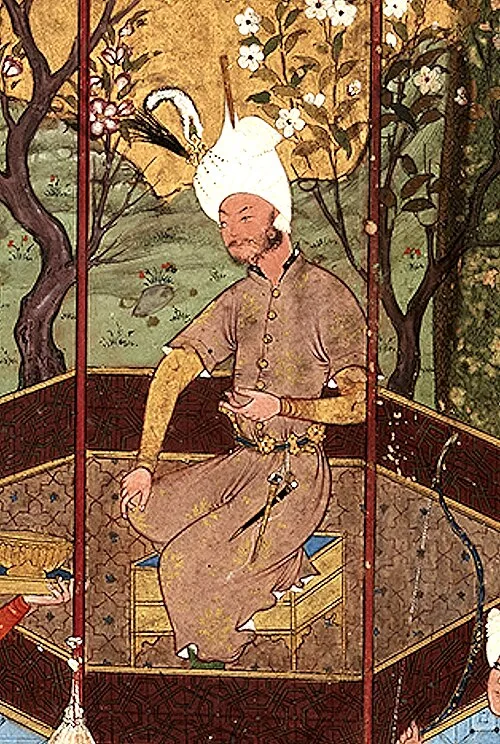
Overview
Prince Ibrahim Mirza, Solṭān Ebrāhīm Mīrzā, in full Abu'l Fat'h Sultan Ibrahim Mirza (; April 1540 – 23 February 1577) was a Persian prince of the Safavid dynasty, who was a favourite of his uncle and father-in-law Shah Tahmasp I, but who was executed by Tahmasp's successor, the Shah Ismail II. Ibrahim is now mainly remembered as a patron of the arts, especially the Persian miniature. Although most of his library and art collection was apparently destroyed by his wife after his murder, surviving works commissioned by him include the manuscript of the Haft Awrang of the poet Jami which is now in the Freer Gallery of Art in Washington D.C.
Biography
Ibrahim Mirza was a grandson of the founder of the Safavid dynasty, Ismail I (1487–1524) by Ismail's fourth son, prince Bahram Mirza Safavi (1518–1550), who was governor of Khorasan (1529–32), Gilan (1536–37) and Hamadan (1546–49), and also a commissioner of manuscripts. Two of his uncles and two of his brothers were to rebel against Tahmasp. Ibrahim Mirza, however, who grew up at court, was a long-time favourite of Tahmasp, and remained loyal, and was appointed governor of Mashhad at the age of 16, arriving there in March 1556. The appointment had a nominal element — Tahmasp himself had received his first governorship at the age of four — but was also political, connected to Ibrahim Mirza's mother, who came from the Shirvanshah dynasty.
In 1560 he married Tahmasp's eldest daughter by a concubine, Gawhar Sultan Begum (died 1577); they had one daughter, Gawhar Shad Begum (died 1587). Around the end of 1562 he was travelling to Ardabil to take up the governorship there, when he was reported to the shah for his reaction to a joke that angered the shah, and the appointment was switched to the much less important governorship of Qa'en, in Khorasan. In 1564 and 1565 he had to suppress a major tribal revolt of the Takkalu, who used a slave army numbering 10,000.
After a few years, Shah Tahmasp's anger had subsided, and Ibrahim Mirza was re-appointed Governor of Mashhad by 1566. He was removed again "within a year or two, apparently for his failure to assist in rescuing the shah’s besieged son, Solṭān Moḥammad Mīrzā". He was sent to govern Sabzavār until 1574 when, by now 34, he was recalled to the capital at Qazvin to serve as grand master of ceremonies (eshīk-āqāsī-bāshī).
From Wikipedia (CC BY-SA 4.0).