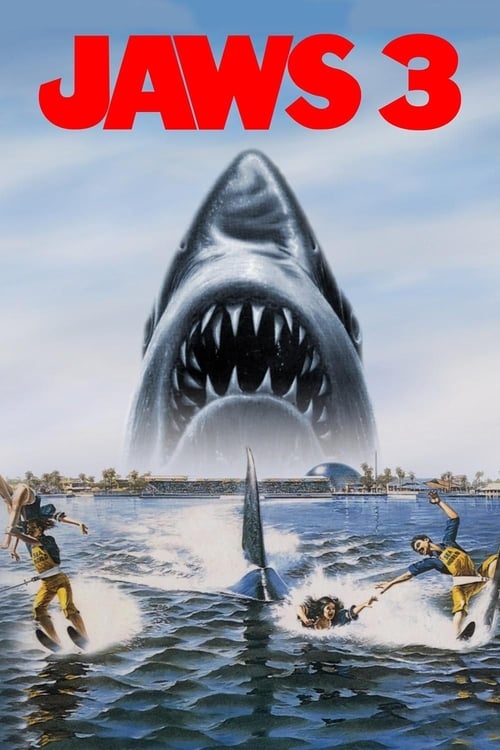
Jaws 3-D, also known as Jaws III and Jaws 3, is a 1983 American horror film directed by Joe Alves and starring Dennis Quaid, Bess Armstrong, Simon MacCorkindale and Louis Gossett Jr. As the second sequel to Steven Spielberg's Jaws, it was the third installment in the Jaws franchise. The film follows the Brody children from the previous films to SeaWorld, a Florida marine park with underwater tunnels and lagoons. As the park prepares for its opening, a young great white shark infiltrates the park from the sea, seemingly attacking and killing the park's employees. Once the shark is captured, it becomes apparent that a second, much larger shark also enters the park and happens to be the real culprit.
The film made use of 3D during the revived interest in the technology in the 1980s, amongst other horror films such as Friday the 13th Part III and Amityville 3-D. Cinema audiences could wear disposable cardboard polarized 3D glasses to create the illusion that elements penetrate the screen. Several shots and sequences were designed to use the effect, such as the shark's destruction. Since 3D was ineffective in home viewing until the advent of 3D televisions in the late 2000s, the alternative title Jaws III is used for television broadcasts and home media.
To a lesser degree than its predecessors, Jaws 3-D was still commercially successful despite overwhelmingly negative reviews. It was followed by Jaws: The Revenge in 1987, which retroactively ignores this film.
Contents
Plot
Michael "Mike" Brody, son of police chief Martin Brody of Amity Island, is working as a chief engineer at SeaWorld Orlando alongside his girlfriend, Kathryn "Kay" Morgan, the park's senior biologist. Among the attractions are new underwater tunnels that allow for a view of the undersea life.
While the park's lagoon gates are stuck open, a great white shark follows an unsuspecting team of water skiers into the park. Kay and her assistants notice that the resident dolphins, especially two individuals Cindy and Sandy, are afraid of leaving their pen and going out into the lagoon. Later, Calvin Bouchard, the park manager, welcomes his friend, adventurer and hunter Philip FitzRoyce, and Mike's younger brother Sean arrives for a visit having taken the summer off from college. That night, Shelby Overman, a mechanic, dives into the water to repair and secure the gates. He is attacked by the shark and killed, severing his right arm. Mike, Kay, and Sean go out for drinks, and Sean meets and begins dating Kelly Ann Bukowski, one of the park's water skiers. Meanwhile, two criminals sneak into the park and go underwater to steal coral they intend to sell, but both are killed by the shark in the process.
The next day, Kay and Mike are informed of Overman's disappearance. They go down in a submarine to look for his body and, during the search, they encounter a juvenile great white, that's only 10 ft (3.0 m) long. The dolphins rescue Kay and Mike, but the shark escapes back into the park. They inform Bouchard, and FitzRoyce suggests killing the shark on network television. Kay protests, instead recommending capturing the shark and keeping it alive in captivity, which would generate more publicity for the park. The shark is successfully captured, as Kay and her staff begin to nurse it back to health. Calvin, who's desperate to have the money start rolling in immediately, orders it to be moved to an exhibit, but the shark dies. Kelly persuades Sean to go out onto the water in a bumper boat, despite his trepidation due to his traumatic experiences at Amity Island.
Overman's corpse is discovered and, reviewing the body, Kay realizes that based upon the bite radius that the shark that killed him is the first shark's 35 ft (11 m) long mother and that it must also be inside the park. She attempts to convince Calvin about this newest development when the shark herself shows up at the window of the underwater café. Upon being flushed out from her refuge inside a filtration pipe, the shark begins to wreak havoc upon the park. The giant shark attacks Sean and Kelly, biting the latter in the leg before attacking a floating platform that causes injuries to multiple onlookers. As FitzRoyce and Sean bring the badly injured Kelly to shore the shark heads towards the Undersea Kingdom. She attacks the transparent viewing tunnels, causing a leak that nearly drowns everyone in the complex. Calvin orders all watertight doors shut to prevent the complex's destruction, trapping many tourists in a partially flooded hub.
Cast
Dennis Quaid as Michael Brody
Bess Armstrong as Kathryn "Kay" Morgan
Simon MacCorkindale as Philip FitzRoyce
Louis Gossett Jr. as Calvin Bouchard
John Putch as Sean Brody
Lea Thompson as Kelly Ann Bukowski
P. H. Moriarty as Jack Tate
Dan Blasko as Danny
Liz Morris as Liz
Lisa Maurer as Ethel
Harry Grant as Shelby Overman
Kaye Stevens as Mrs. Kallender
Production
Development and writing
David Brown and Richard Zanuck, the producers for the first two films, originally pitched the second Jaws sequel as a spoof named Jaws 3, People 0. In 1979, Variety reported that the film would be produced by Matty Simmons, fresh off the success of National Lampoon's Animal House, with Zanuck and Brown serving as executive producers. Simmons outlined a story and commissioned National Lampoon writers John Hughes and Todd Carroll for a script. Joe Dante was briefly pursued as a director. The project was also to star Bo Derek and Richard Dreyfuss. The project was shut down as Steven Spielberg, who directed the first film, managed to convince Universal to not make the film by threatening to never work with the studio again. However, industry magazines also reported that the project failed because Zanuck and Brown wanted to produce a PG rated film, while Universal wished to include material which would have 'destined' the film to be rated R. According to Simmons, Zanuck and Brown preferred the original script, while Simmons also had other creative differences with Universal. David Brown later said that the studio attitude was that a spoof would have been a mistake and that it would be like "fouling in your own nest," although he himself felt that the project would have been successful.
Alan Landsburg bought the rights to produce the film. He attempted to involve experimental filmmaker Murray Lerner in Jaws 3, telling him that people at the Marineland theme park in Florida had seen his 1978 3D film Sea Dream. Lerner said that his "heart sank" when he was sent the first script of Jaws 3-D, saying, "I can't really get involved in this". As the production already had an art director, Lerner, who didn't like the script, declined to be involved in the film.
The film was directed by Joe Alves, who was the production designer for the first two films and was the second unit director for Jaws 2. It had been suggested that Alves co-direct the first sequel with Verna Fields when first director John D. Hancock left the project. It was filmed at SeaWorld Orlando, a marine zoological park; and Navarre, Florida, a community in the Florida Panhandle near Pensacola.
As with the first two films in the series, many people were involved in writing the film. Richard Matheson, who had written the script for Steven Spielberg's 1971 television film Duel, says that he wrote a "very interesting" outline, although the story is credited to "some other writer". Universal forced Matheson to include Martin Brody's two sons Michael (Dennis Quaid) and Sean (John Putch), which the writer "thought was dumb". They also wanted it to be the same shark that was electrocuted in Jaws 2. Matheson was also requested to write a role specifically for Mickey Rooney, saying that "when Mickey Rooney turned out not to be available, the whole part was pointless". The writer was unhappy with the finished film.
Casting
The film did not use any actors from the first two Jaws films. Roy Scheider, who played Police Chief Martin Brody in the first two films, laughed at the thought of Jaws 3, saying that "Mephistopheles ... couldn't talk me into doing [it] ... They knew better than to even ask". He agreed to do the film Blue Thunder to ensure his unavailability for Jaws 3-D.
Dennis Quaid stated in a 2015 interview that, of all his films, he made the most aggressive use of cocaine during the filming of Jaws 3D, and he was very embarrassed to find himself high on the drug in "every frame" in which he appears.
3D
There was a revival in popularity of 3D at this time, with many films using the technique. Jaws's second sequel integrated the technology into its title, as did Amityville 3D. Friday the 13th Part III could also make dual use of the number three. The gimmick was also advertised in the tagline "the third dimension is terror." As it was Joe Alves' first film as director, he thought that 3D would "give him an edge".
Cinema audiences could wear disposable polarized glasses to view the film, creating the illusion that elements from the film were penetrating the screen to come towards the viewers. The opening sequence makes obvious use of the technique, with the titles flying to the forefront of the screen, leaving a trail. There are more subtle instances in the film where props are meant to leave the screen. The more obvious examples are in the climactic sequence of the shark attacking the control room and its subsequent destruction. The glass as the shark smashes into the room uses 3D, as does the shot where the shark explodes, with fragmented parts of it apparently bursting through the screen, ending with its jaws. There were many difficulties in making the blue screen compositing work in 3D, and a lot of material had to be reshot.
Jaws 3-D had two 3D consultants: the production started with Chris Condon, president of StereoVision, and Stan Loth was later added to the team for the ArriVision 3D. Production began using the StereoVision, but this was dropped after a week for the ArriVision system, "which Alves believed was a superior system because it has a wider variety of lenses". According to Alves, inferior systems lead to ghosting and blurring, leaving audiences with headaches. He says that "the left and right images [in Jaws 3-D] are very well-matched, and the photography is very clean; it's restful to the eye, and though we do have the occasional effects where things do emerge toward the audience from the plane of projection, you come out of the film without a headache." Historian R. M. Hayes says that the film was shot using both the Arrivision and StereoVision single strip-over-and-under units. The cameras were used in conjunction, a means of shooting 3D movies in normal color with a single camera and single strip of film. The Arrivision 3D technique uses a special twin-lens adapter fitted to the film camera, and divides the 35 mm film frame in half along the middle, capturing the left-eye image in the upper half of the frame and the right-eye image in the lower half, a technique known as "over/under". This allows filming to proceed as for any standard 2D film, without the considerable additional expense of having to double up on cameras and film stock for every shot. When the resultant film is projected through a normal projector (albeit one requiring a special lens that combines the upper and lower images), a true polarized 3D image is produced. This system allows 3D films to be shown in almost any cinema since it does not require two projectors running simultaneously through the presentation — something most cinemas are not equipped to handle. What is required of the theatre is both the special projection lens and a reflective "silver" screen to enable the polarized images to reflect back to the viewer with the appropriate filter on each eye blocking out the wrong image, thus leaving the viewer to see the film from two angles as the eyes naturally see the world. According to the company that built the underwater camera housings for Jaws 3-D, the underwater sequences were shot using an Arriflex 35–3 camera with Arrivision 18 mm over/under 3D lens.
Music
The score was composed and conducted by Alan Parker, who had previously provided music for British television shows including Van der Valk and Minder, and as a session musician for Jerry Goldsmith for First Blood, as well as for John Barry and Henry Mancini. It was Parker's first feature score, but he would later work on What's Eating Gilbert Grape and American Gothic.
Parker and music editor Graham Walker travelled from England to Los Angeles to spot the film at Universal. They were only afforded a "brief meeting" with director Joe Alves, who was immersed in the film's post-production difficulties. The score was recorded at Angel Recording Studios in London in five dates in April-June 1983. Changes during the film's editing mean that Parker had to rewrite and record around 36 minutes of music across only six days. Parker composed and conducted several versions of some cues with varying tone and intensity. He also wrote party and dance source music, although such cues would be heavily cut in the completed film. Most of the cues with Parker recorded were significantly shortened or relocated to a different part of the film. He recorded four separate tracks for the opening sequence, which the music editors could use to fit in with how long the shark attack would appear on screen. John Williams' original shark theme is judiciously integrated into the score, with Parker using two horns for the 'baby shark' and six horns for its mother to represent the different identities and threat. Parker lamented that he was unable to have a conversation with Williams about using his motif, although reflects that he was able to satisfy audiences' expectations by using the famous theme while putting his "own stamp on things".
The soundtrack album was released by MCA Records. Some of the recordings used on the album release were different to those used in the film. The soundtrack was released on CD by Intrada in 2007. Intrada released a two-disc special collector's edition in 2015, produced by Douglass Fake, featuring a range of film cues, alternate takes, source music, and advertisement stings.
Release
The film was heavily promoted before its wide release across the U.S. As with Jaws 2, Topps produced a series of trading cards. Television stations were encouraged to broadcast the featurette, Making of Jaws 3-D: Sharks Don't Die, in a prime-time slot between July 16 and 22, 1983 to take advantage of an advertisement in that week's issue of TV Guide. Alan Landsburg Productions found itself in trouble for using 90 seconds of footage from the National Geographic 1983 documentary film The Sharks in the featurette without authorization.
Reception
Box office
The film grossed $13,422,500 on its opening weekend, which was 1983's second highest-grossing opening weekend of the year, playing to 1,311 theaters at its widest release and accounting for 29.5% of its final gross. It has achieved total lifetime worldwide gross of $88 million. Despite being No. 1 at the box office, this illustrates the series' diminishing returns, since Jaws 3-D has earned nearly $100 million less than the total lifetime gross of its predecessor and $300 million less than the original film. The final sequel would attract an even lower income, with around two thirds of Jaws 3-D's total lifetime gross. After its opening weekend the film's box office grosses declined sharply by over 40% during later weeks, although it was still drawing huge audiences when it was pulled from theaters; film historian R.M. Hayes says this action "was pure nonsense considering some cinemas were actually turning over more money per screen than the latest Star Wars film".
Critical response
While Jaws 2 had received mixed, differentiated reviews and is regarded as the best of the Jaws sequels, reception for Jaws 3-D was generally negative. Variety calls it "tepid" and suggests that Alves "fails to linger long enough on the Great White." It has a 10% 'rotten' rating at Rotten Tomatoes based on 39 reviews, with an average rating of 3.5/10. Its critical consensus reads, "A cheese-soaked ocean thriller with no evident reason to exist, Jaws 3 bellows forth with a plaintive yet ultimately unheeded cry to put this franchise out of viewers' misery." Metacritic, using a weighted average, assigned the film a score of 27 out of 100 based on 9 reviews, indicating "generally unfavorable reviews". Audiences polled by CinemaScore gave the film an average grade of "D+" on an A+ to F scale. The 3D was criticized as being a gimmick to attract audiences to the aging series and for being ineffective. Roger Ebert heavily criticized the film on At the Movies, particularly a scene where the shark follows some waterskiing performers which he found unrealistic while his colleague Gene Siskel criticized the 3D finding the scene where the shark breaks the aquarium glass the worst effect of the film. Both named it one of the worst sequels of the year. AllMovie, however, says that "the suspense sequences were made somewhat more memorable during the film's original release with 3D photography, an attribute lost on video, thereby removing the most distinctive element of an otherwise run-of-the-mill sequel." Derek Winnert says that "with Richard Matheson's name on the script you'd expect a better yarn" although he continues to say that the film "is entirely watchable with a big pack of popcorn." Others are disappointed that Matheson and Gottlieb produced this script given their previous success. Later reviews expressed astonishment "that a sequel this downright abominable didn't kill the franchise, but that it actually would be followed by a movie that was arguably worse—Jaws: The Revenge."
Amongst the flaws, a BBC critic described the film as "still marginally entertaining." The sound design has been commended, however. The moment when an infant's cry is heard when the baby shark dies in the pool is particularly praised by one reviewer. Gossett said he was the "only cast member to survive the generally negative reviews".
In her screenwriting textbook, Linda Aronson suggests that its protagonist Mike Brody, played by Quaid, is a major problem with the film. She says that after taking too long for him to be introduced, the character is "essentially a passive onlooker." There is no hunt until the climax when the shark is terrorizing the people in the aquarium; only then does Mike Brody become center of the action. She also highlights inaccuracies in the plot. For instance, she refutes the idea of a "mother shark protecting her offspring [as] sharks do not mother their young," and points out that dolphins can attack sharks.
Home media
The film was released in a standard 2-D format on DVD by Universal on June 3, 2003, under the title Jaws 3. A trailer was included as a bonus feature.
Universal Studios Home Entertainment released the Jaws series of films in HD on Blu-ray in 2016, including, Jaws 3-D on Blu-ray 3D. The main presentation is in 2D, but the 3D cut is included as a bonus feature. In 2020, a Blu-ray bundle containing the 2016 release and the other sequels released. Universal released Jaws 3-D on 4K Ultra HD Blu-ray on July 23, 2024, alongside Jaws: The Revenge. The 4K remaster was criticized for the use of AI upscaling and digital noise reduction.